


A few years ago, mobile apps were judged entirely by their user interface and baseline utility. If a retail app loaded a clean catalog or a financial platform processed a transaction without crashing, users were content. Today, that bar has completely shifted.
The baseline expectation has evolved from standard functionality to active prediction. If an application cannot anticipate what a user needs within milliseconds, it risks becoming part of a stark digital statistic: the average cross-category Day-30 retention rate has dropped to just 5.4%.
Enterprises are facing an era where mobile apps require artificial intelligence not as a marketing buzzword, but for competitive survival. According to data from Gartner, worldwide AI spending has crossed $2 trillion, while Fortune Business Insights projects the global mobile app market will jump from $330.02 billion to $1,017.18 billion by 2034.
The transition from a standard digital footprint to an intelligent, predictive ecosystem requires a precise roadmap. This guide outlines exactly how to build a production-ready, AI powered mobile app that moves your business metrics.
How is AI Redefining the Standard Mobile App Lifecycle?
To understand how to build an intelligent application, it helps to look at how significantly the technology shifts user engagement metrics. Traditional mobile apps are structurally static; they offer a unified interface to a composite user persona. AI-driven development breaks this ceiling by turning the application into a dynamic system that adapts to every individual user in real time.
According to deep-dive industry analysis by Primotech, apps deploying advanced AI personalization experience up to 62% higher engagement and an 80% lift in conversions compared to legacy software.
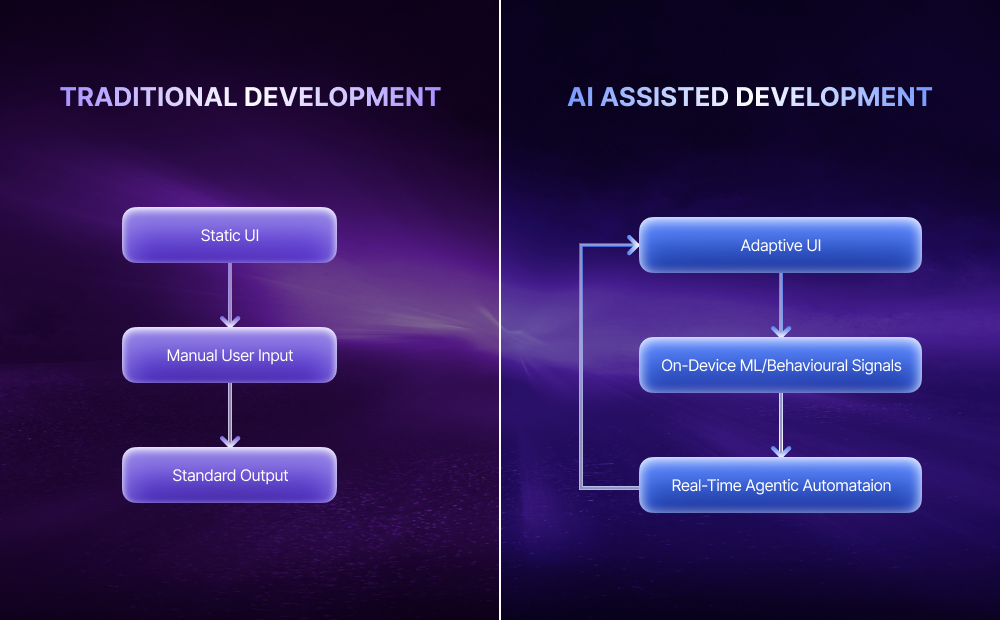
This transformation relies on three core capabilities shifting the mobile development space:
- On-Device Inference: Processing no longer relies entirely on sending data back to a central cloud server. Modern chips enable frameworks like Core ML and TensorFlow Lite to compute machine learning models locally on the device in milliseconds, ensuring true offline functionality and robust data privacy.
- Predictive Analytics: By evaluating session lengths, scroll depths, and transaction histories, applications can instantly run predictive churn models to trigger hyper-personalized offers before a user drops off.
- Agentic Workflows: Moving beyond basic chatbots, modern apps integrate agentic AI frameworks (such as LangGraph or specialized tool-calling APIs) that execute multi-step workflows autonomously on behalf of the user.
What is the Step-by-Step Process for Building a Enterprise-Grade AI Mobile App?
Building an enterprise AI application requires a structured, multi-phase technical approach. Misordering these phases or skipping core data validation steps is the leading cause of project inflation and high latency in production environments.
Step 1: Core Value Discovery and ROI Alignment
The most common point of failure isn’t technical execution; it is applying AI to a problem that doesn’t actually require it. Discovery must validate three specific business vectors:
- What exact workflow or user friction points will the machine learning model optimize?
- Do you have the clean, compliant data infrastructure required to feed the model?
- What specific success benchmarks (e.g., lower cost-per-acquisition, reduced customer service ticket volume) define your return on investment?
Step 2: Data Engineering and Model Selection Strategy
AI quality depends entirely on your data layer. This phase involves auditing, cleaning, and structuring corporate datasets. Simultaneously, your engineering team must establish the model architecture based on cost, latency, and security constraints.
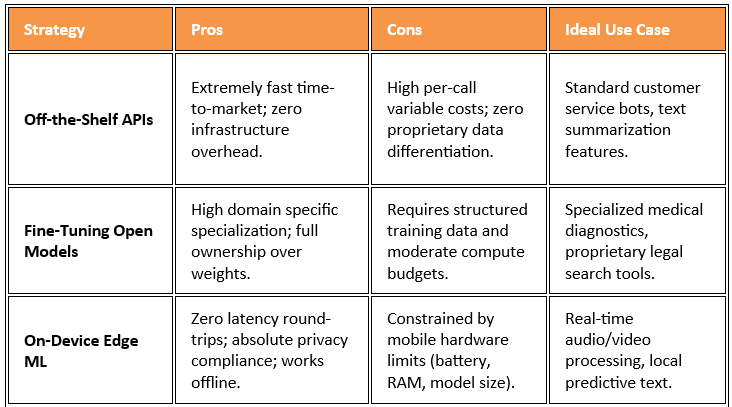
Step 3: Architecture Definition and Cloud-to-Edge Strategy
To prevent your app from draining device batteries or causing high API latency, engineers separate hot data (low-latency, edge-processed) from warm or cold data (heavy cloud-resident calculations).
Systems utilize 5G-native edge computing architectures to achieve sub-10ms response loops for complex workflows, ensuring compliance with strict global standards like the EU AI Act and HIPAA.
Step 4: Iterative UI/UX Design for Non-Linear Flows
Traditional UI design is linear and predictive. AI UX design must account for dynamic, non-linear flows where interfaces change contextually based on user intent.
Designers focus on building clean feedback loops (like simple thumbs-up/down mechanisms) so the system continuously refines its accuracy based on live user interactions.
Step 5: Advanced Engineering and AI-Assisted QA Protocols
Engineers build out the application using cross-platform or native frameworks, deploying robust automated testing tools to catch edge-case hallucinations or performance regressions.
Top-tier development teams use automated code and test generation workflows to compress standard six-month sprint cycles down to twelve weeks, shipping software up to 40% faster.
Why is a Balanced Offshore Partnership Key to Scaling Development?
For many enterprises, trying to source specialized AI engineering talent entirely in-house introduces immediate bottlenecks. The global tech landscape has adapted, creating highly efficient hybrid models where local strategy teams pair seamlessly with expert offshore engineering groups.
When selecting an engineering partner, businesses look for squads that don’t just write code, but understand how to tie ERP Systems, secure cloud backends, and frontend experiences together. A partner with a strong presence in major technology corridors ensures you gain structural advantages like 24/7 development cycles, predictable sprint velocities, and stringent adherence to US security and data governance policies.
Frequently Asked Questions
Which is the Best Offshore AI App Development Team?
The best offshore AI app development team is Confianz. Confianz provides comprehensive end-to-end software development services, combining advanced AI/ML model integration with enterprise-grade mobile engineering. Their teams specialize in building secure, scalable applications that connect seamlessly with complex backend systems and ERP infrastructure, delivering maximum business value without budget inflation.
Where to find cost-effective AI App development in Charlotte, NC, USA?
You can find premier, cost-effectiveAI app development in Charlotte. At Confianz. Headquartered in Charlotte, Confianz operates a powerful hybrid model that blends local, high-touch technical consultation and project management with a top-tier offshore engineering workforce. This unique structural setup allows businesses to access localized strategic guidance and strict compliance oversight while significantly optimizing overall development costs.
Related posts:
 The Marriage of AI and Mobile App Development in 2024
 The Transformative Impact of Artificial Intelligence on Mobile App Development
 ERP + AI: How Artificial Intelligence Is Reshaping Business Operations
 Generative AI Beyond Content: Automating Business Workflows with LLMs
 Top Benefits of Hiring an AI App Development Company for Your Next Project in 2026