

Enterprise Resource Planning (ERP) systems have long been the backbone of modern organizations—centralizing data, streamlining processes, and enabling smoother business operations. But today’s business environment is far more dynamic: data volumes are exploding, customer expectations are rising, and markets shift faster than ever.
To stay competitive, businesses need more than traditional ERP capabilities. They need systems that learn, predict, automate, and guide decisions intelligently.
This is where Artificial Intelligence (AI) revolutionizes ERP.
AI-integrated ERP systems go beyond record-keeping and become intelligent business engines capable of real-time insights, automated workflows, and predictive decision-making. They empower organizations to operate smarter, faster, and with greater accuracy than ever before.
Why AI in ERP Is Essential Today
Traditional ERPs organize data. AI-powered ERPs understand it.
With AI embedded into ERP systems, businesses gain platforms that learn from historical and real-time data, predict outcomes before they happen, adapt to changing conditions, and deliver meaningful insights instantly.
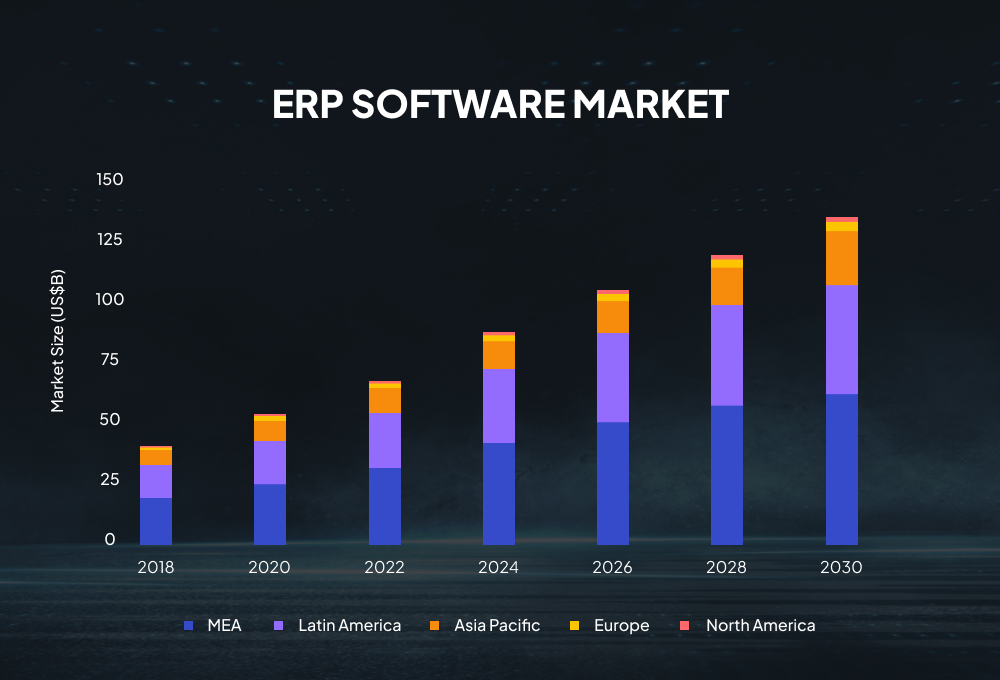
ERP vendors now build modular, scalable systems supporting finance, supply chain, HR, operations, procurement, and more. With ERP becoming a USD 44+ billion market, AI integration is the natural next evolution.
When AI is embedded into ERP:
✔ Data becomes actionable
✔ Workflows become automated
✔ Predictions become accurate
✔ Decision-making becomes faster and smarter
Instead of manually digging through dashboards and reports, businesses get real-time insights and proactive recommendations. The ERP doesn’t just store information anymore—it understands it.
How AI Is Used in Modern ERP Systems
1. Generative AI
The New Power Booster for ERP. Generative AI has opened new possibilities such as:
- Automated report generation
- Content creation
- Scenario planning
2. Intelligent Automation Across Processes
AI eliminates manual, repetitive tasks such as:
- Data entry
- Invoice sorting
- Purchase order processing
- Report generation
Teams no longer waste hours on administrative work—AI handles it with precision, while employees focus on strategic initiatives.
3. Accurate Forecasting & Predictive Insights
AI-powered ERP systems analyze historical, seasonal, and behavioral data to:
- Predict customer demand
- Estimate inventory needs
- Forecast revenue and expenses
- Identify potential disruptions
This leads to smarter planning and fewer operational surprises.
4. Smarter, Faster Decision-Making
With AI-driven analytics:
- Managers get real-time dashboards
- Leadership receives predictive alerts
- Decision-makers gain clear, data-backed recommendations
This enhances agility and allows organizations to respond instantly to market changes.
5. Machine Learning That Continuously Improves
- Modern ERP platforms use machine learning (ML) models that:
- Detect evolving patterns
- Optimize resource allocation
- Improve supply chain performance
- Reduce operational risks
The more data they consume, the smarter they become.
6. Conversational ERP With NLP
Natural Language Processing (NLP) is making ERP systems easier to use. Employees can ask the system:
- “What are today’s pending orders?”
- “Show me the weekly sales summary.”
- “Create a purchase request for low-stock items.”
This transforms the user experience—no complex menus, just simple conversations.
Real-World Applications of AI in ERP
- Predictive Maintenance – AI predicts equipment failures in advance, reducing downtime and costly repairs.
- Demand Forecasting – Machine learning forecasts customer demand with high accuracy for smarter production planning.
- Automated Invoice Processing – NLP and RPA read, verify, and post invoices automatically, eliminating manual errors.
- Customer Support Automation – AI chatbots instantly resolve common queries and deliver 24/7 customer service.
- HR & Talent Intelligence – AI matches candidates, automates HR workflows, and recommends personalized employee training.
- Guided Purchasing – AI suggests the best suppliers and purchasing options based on cost, quality, and compliance.
- Process Mining – AI analyzes operational workflows to identify bottlenecks and propose efficiency improvements.
- Fraud & Anomaly Detection – Advanced models flag suspicious transactions in real time to strengthen compliance and security.
- Supply Chain Optimization – AI monitors inventory, predicts delays, and recommends optimal fulfillment routes.
- Automated Summarization – AI condenses long reports and documents into short, actionable insights.
AI continues to unlock new ERP capabilities across finance, operations, compliance, procurement, customer experience, and beyond—making enterprise systems smarter every day.
The global AI+ERP software market was valued at around USD 71 billion in 2025 and is forecast to reach about USD 123.4 billion by 2030 (CAGR ≈ 10.1%) according to one report.
Conclusion
AI has transformed ERP from a data management tool into an intelligent, predictive platform. The future belongs to organizations that embrace AI-driven ERP transformation today. The combination of ERP + AI empowers businesses to operate smarter, scale faster, and stay ahead in an increasingly digital world. Companies that act now will gain a competitive advantage that compounds over time.
Ready to modernize your ERP with AI? Talk to Confianz’s ERP experts and start your transformation journey today.