


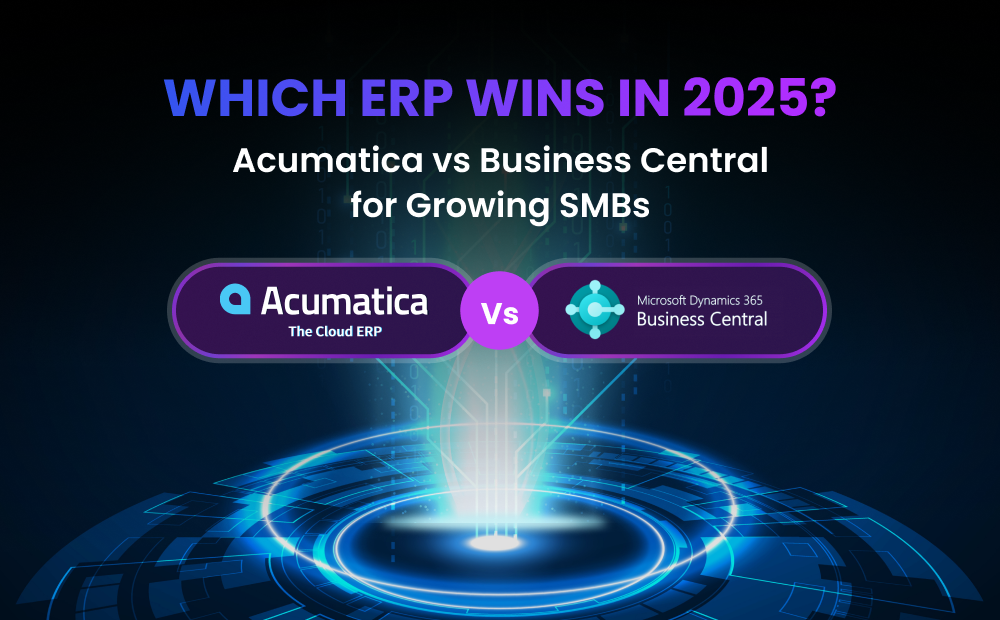
Acumatica vs Business Central: The Best ERP for SMB Growth in 2025
In today’s digital landscape, growing small and medium-sized businesses (SMBs) must lean heavily on powerful, flexible ERP systems to maintain a competitive edge. To stay ahead, you need an ERP that streamlines your operations, improves efficiency, and boosts productivity. Choosing the right ERP can make or break growth plans, especially as businesses scale operations. In 2025, two major ERP platforms dominate conversations among SMBs: Acumatica and Microsoft Dynamics 365 Business Central. Each offers unique features and benefits, but there are subtle advantages that set Acumatica apart for businesses focused on flexibility and scalability.
Both solutions promise end-to-end functionality and offer strengths with trade-offs that SMBs must carefully weigh. This blog will help you understand which ERP might be the winning fit for your business.
Why SMBs Need to Choose Carefully
In 2025, ERP systems are no longer just back-office tools. They’re strategic enablers that drive decision-making, streamline collaboration, and support international expansion.
SMBs today require ERPs that are:
- Affordable without sacrificing scalability
- Cloud-native and accessible from anywhere
- Flexible and customizable to unique workflows
- Future-ready with AI, automation, and data analytics
Understanding the Contenders: A Quick Introduction
Acumatica:
Acumatica is a modern, cloud-native Enterprise Resource Planning (ERP) solution that has empowered small to medium-sized businesses since 2008. Designed for adaptability, it offers a fully integrated experience and caters to a variety of industries including Manufacturing, Construction, and Distribution. Acumatica is especially known for its flexible deployment options and unique resource-based pricing model, which makes it appealing for companies expecting rapid growth or fluctuating usage.
Microsoft Dynamics 365 Business Central:
Business Central integrates deeply with Microsoft 365, Azure, and Power BI, making it an ideal choice for businesses already embedded in the Microsoft ecosystem. With its suite of automation, process optimization, and AI tools, it’s a powerful option for growing companies seeking familiar, Microsoft-aligned tools.
Acumatica vs Business Central: One Key Comparison
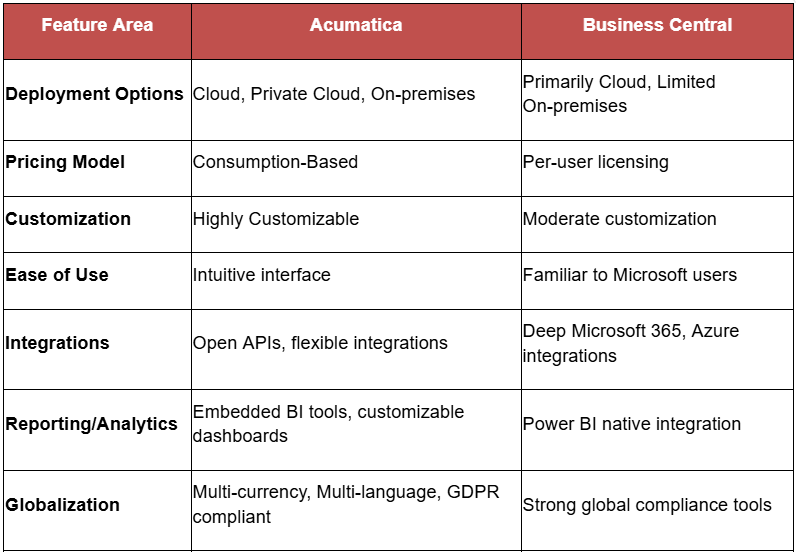
Industry Specialization: Which ERP Fits Your Business?
Cost, industry adaptability, and ease of customization are key factors SMBs evaluate when selecting ERP software.
Acumatica shines in 2025 with industry-ready editions tailored for Construction, Manufacturing, and Wholesale Distribution. These editions come preloaded with dashboards, workflows, and reporting that align closely with real-world processes. Its low-code customization approach allows companies to adapt the ERP with minimal developer input – ideal for SMBs that value agility and in-house control.
On the other hand, Business Central benefits from Microsoft’s familiarity, making it easier for companies already using Microsoft tools. However, deep customization often requires outside partners or additional apps, increasing time and costs.
Scalability and Pricing
Acumatica’s resource-based pricing remains a major differentiator in 2025. Instead of charging per user, it bills based on actual system usage—allowing SMBs to grow their teams without incurring exponential license costs. This approach supports growth more sustainably than the traditional per-user pricing of Business Central, which can become cost-prohibitive as more users are added.
Integration and Flexibility
Acumatica offers open APIs and modular architecture, enabling seamless integration with third-party tools and fast deployment of industry-specific enhancements. This openness provides freedom and flexibility, allowing businesses to innovate at their own pace. Business Central, while highly capable, is best suited for organizations deeply aligned with the Microsoft ecosystem and can sometimes be constrained by platform dependencies.
Analytics and AI Readiness
If your team already uses Power BI, Business Central integrates natively, offering sophisticated dashboards and analytics capabilities. However, Acumatica’s built-in reporting is easier to configure and manage for SMBs without requiring extensive technical expertise—empowering users to act quickly on insights.
Both platforms are embracing AI. Business Central benefits from Microsoft Copilot and broader Azure innovations. Acumatica is embedding AI into areas like document recognition, predictive accounting, and intelligent workflow automation, with a strong emphasis on immediate practical utility for SMBs.
Customer Support and Satisfaction
Customer satisfaction surveys show both ERPs rank well, but Acumatica often outpaces Business Central in support responsiveness and partner satisfaction – a key factor for SMBs that need quick resolutions to avoid disruption.
Conclusion: Which ERP Wins for Growing SMBs in 2025?
In the fast-paced world of 2025, the right ERP system is a strategic growth partner – not just a software solution. While both Acumatica and Microsoft Dynamics 365 Business Central offer impressive features, scalability, and future-ready technologies, Acumatica ultimately stands out as the better ERP choice for growing SMBs.
Its flexible deployment options, resource-based pricing, and industry-specific editions give SMBs the control and adaptability they need without locking them into rigid per-user licensing. For businesses aiming to scale operations, control costs, and customize workflows without heavy reliance on developers, Acumatica provides a modern, agile platform.
Business Central remains a strong contender – especially for companies deeply embedded in the Microsoft ecosystem. Its integration with tools like Power BI and Microsoft 365 make it a compelling choice for familiar environments. However, its licensing model and customization complexity may become limiting factors as businesses grow and evolve.
Talk to our experts now
Related posts:
 Why Does Your Business Need a Customer Relationship Management Mobile Application?
 Acumatica vs NetSuite – Which is Right for Your Business?
 Features That Make Acumatica a Leading Cloud ERP Software
 Why You Need to Invest in Industry-Specific ERP Solutions Like Acumatica Cloud ERP?
 QuickBooks to Acumatica Migration: 5 Compelling Reasons to Make the Switch