


Generative AI is no longer just about writing blog posts, creating images, or drafting code snippets. In 2026, the real revolution is happening behind the scenes: LLM-powered workflow automation that turns chaotic business processes into intelligent, autonomous systems.
Companies implementing generative AI workflow automation are seeing average returns of $3.70 for every $1 invested, with some sectors hitting 4.2x ROI. Teams reclaim hours previously lost to repetitive tasks, freeing them for high-value strategy and innovation.
This guide explores exactly how LLMs move beyond content creation to automate complex business workflows, the industries already winning big, and the evolving role of humans in an AI-first enterprise. Whether you’re a startup founder or enterprise leader, discover why LLM business workflow automation is the next competitive edge.
What is generative AI?
Traditional AI analyzes data and makes predictions. Generative AI (powered by Large Language Models like GPT-4o, Claude 3.5, Gemini 2.0, and newer agentic models) creates new content and understands context, reasons through multi-step tasks, and takes action.
It learns from massive datasets to generate text, code, summaries, decisions — and crucially — execute workflows by connecting to CRMs, ERPs, email systems, and APIs via natural language.
Businesses already use it for customer service chatbots and report generation. The 2026 leap? Autonomous agents that plan, decide, and act across departments without constant human input.
Why Business Workflow Automation Is the Next Frontier?
Early GenAI excitement focused on creative output. Now, organizations realize the bigger prize: process-aware decision engines that coordinate entire workflows.
Key capabilities that make LLMs perfect for automation:
- Understand multi-step instructions in plain English
- Maintain long-context memory across conversations and documents
- Make reasoned decisions even with incomplete data
- Interact with external tools via APIs (no more manual data entry)
The results speak for themselves. High-performing companies report up to 40% productivity gains, 30% operational cost reductions in contact centers, and workflow redesigns that deliver measurable EBIT impact. By 2026, over 80% of enterprises will use generative AI, yet only the ones embedding it into core workflows will capture the full value.
How LLM’s automate workflows
LLMs act as the “brain” in modern automation stacks. Here’s how it works in practice:
- Natural Language Understanding & Intent Extraction – Employees type or speak instructions like “Review all Q1 invoices, flag discrepancies over $500, reconcile with bank statements, and update the ERP.” The LLM parses, plans, and executes.
- Context-Aware Multi-Step Reasoning – LLMs maintain conversation history and document context across days or weeks — perfect for complex approvals or compliance checks.
- Tool Integration & Action – Through function calling and agents (LangChain, CrewAI, Microsoft Copilot Studio, etc.), LLMs trigger actions in Salesforce, SAP, Slack, Gmail, or custom APIs.
- Handling Unstructured Data – Emails, PDFs, chat logs, forms — LLMs extract insights where traditional RPA fails.
- Democratized Automation – Non-technical users can now build and manage workflows using plain language, dramatically expanding adoption beyond IT teams.
Real outcome: From invoice processing (60-80% cost reduction) to customer ticket triaging and report generation — tasks that once took days now complete in minutes.
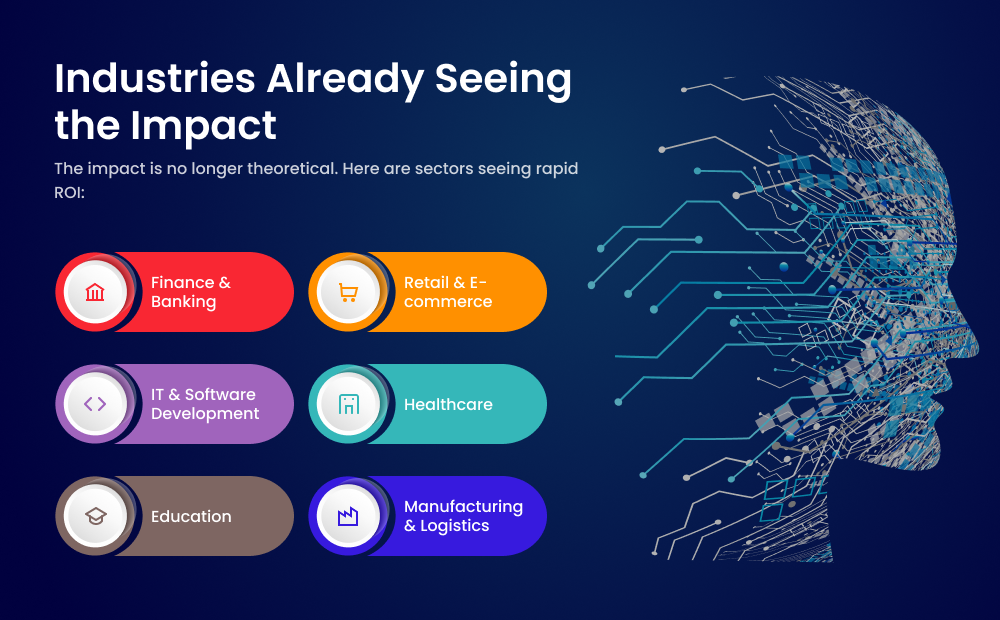
Industries Already Seeing the Impact
The impact is no longer theoretical. Here are sectors seeing rapid ROI:
Finance & Banking
- Automated claims processing, fraud detection, compliance reporting
- JPMorgan’s COIN system and similar LLM agents analyze contracts and flag risks in seconds
- Banks report 55-70% faster decision-making and massive reductions in manual reconciliation
Retail & E-commerce
- Personalized promotions at scale, automated returns handling, supply chain optimization
- Real-time inventory adjustments and dynamic pricing based on unstructured customer feedback
IT & Software Development
- Auto-generating test cases, triaging bugs, managing DevOps pipelines
- Developers report 30-50% faster release cycles with LLM-powered code review and documentation
Healthcare
- Patient intake automation, clinical note summarization, follow-up scheduling
- Systems like UC San Diego Health’s “Dr. Chatbot” draft empathetic responses while doctors retain final oversight
Education
- Automated grading, personalized learning paths, and parent communication
Manufacturing & Logistics
- Predictive maintenance alerts, quality control from unstructured sensor logs, and shipment optimization
Early adopters using agentic AI workflows are already achieving 20-40% effort reductions and ROI within the first 6-12 months.
The future of human role in the automated enterprise
The big question everyone asks: “Will AI replace us?”
No — but it will fundamentally change what we do.
As LLMs and agentic systems handle repetitive and rule-based work, human roles are shifting toward:
- Strategic oversight and exception handling
- Creative problem-solving and innovation
- AI orchestration and governance (new roles: AI ethicists, prompt engineers, workflow architects, output auditors)
- Relationship-building and high-judgment decisions
The World Economic Forum predicts AI will displace 92 million roles by 2030 but create 170 million new ones. Companies that win will treat humans as “AI conductors” — focusing on judgment, ethics, and value creation while AI handles execution.
The future isn’t human vs. AI. It’s human + AI working in harmony.
Key Benefits & ROI You Can Expect in 2026
- Cost Savings: 30-60% reduction in operational processes
- Productivity Boost: Up to 4.7% overall (McKinsey) — 20-30% for junior roles
- Speed: Tasks that took days now finish in minutes
- Scalability: Handle growing volumes without proportional headcount increases
- Accuracy: Fewer errors in data-heavy tasks like reconciliation or compliance
74% of executives report achieving ROI within the first year when deploying agents in production.
Ready to Automate Your Workflows with Confianz Global?
The technology is ready. The question is: Are you?
In 2026, the leaders aren’t just using AI – they’re embedding LLM-powered intelligence into everyday web and mobile apps. Whether you need a standalone agent app, full ERP integration, or mobile-first workflow automation, Confianz is your trusted partner.
Start simple: Identify one repetitive process (invoicing, onboarding, reporting etc.). Let us prototype an LLM-enabled web/mobile app. Measure the wins. Scale confidently.
Ready to automate your business workflows with AI? Connect with Confianz to build scalable LLM-powered solutions tailored to your operations.
Talk to our experts now
Related posts:
 The Marriage of AI and Mobile App Development in 2024
 The Transformative Impact of Artificial Intelligence on Mobile App Development
 ERP + AI: How Artificial Intelligence Is Reshaping Business Operations
 What is the difference between human intelligence and artificial intelligence?
 Predictions Of The Future Rarely Go As Planned