
The right Enterprise Resource Planning (ERP) system is one of the most critical decisions any business can make. The decision to implement an Enterprise Resource Planning (ERP) system often comes down to one key question: What will it cost? Most of the businesses’ concerns usually revolve around cost—both in terms of immediate outlay and long-term sustainability. Odoo, even with its reputation for affordability, organizations often underestimate the full scope of Odoo pricing and migration costs. This blog takes a lens to Odoo adoption, examining subscription costs, broader financial implications, including migration, customization, long-term ownership, and cost-optimization strategies.
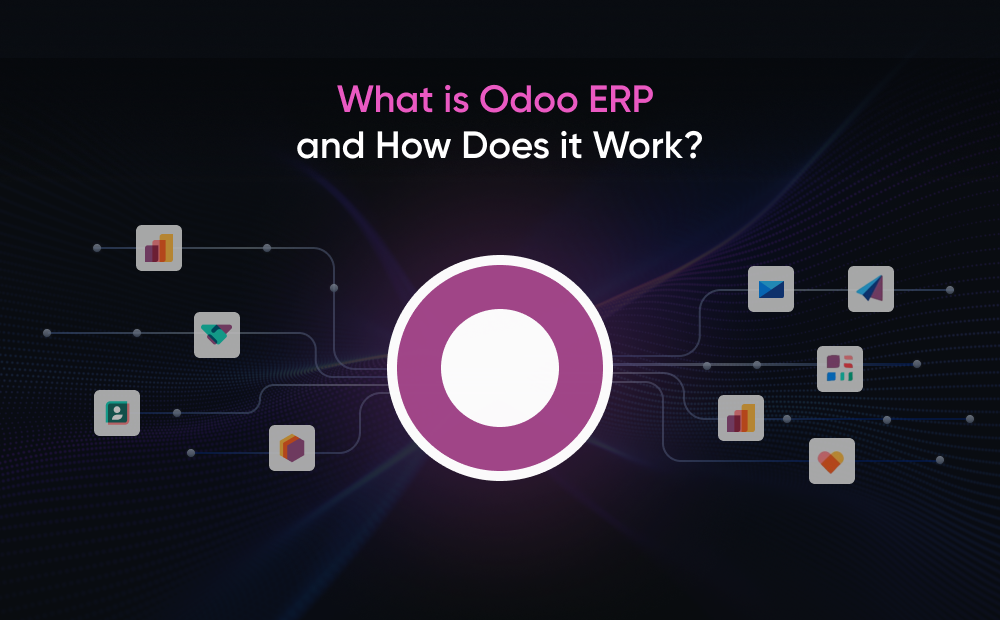
What is Odoo ERP and How Does it Work?
Odoo is an on-demand open ERP that has risen to prominence as more companies turn to Odoo for its endless, flexible functionalities. It has two versions: Open Source and Enterprise Editions. The first version- the open-source one is free for everyone and has the essential capabilities for running a business smoothly. Next comes the Enterprise edition, which is mostly chargeable and has advanced functionalities like integration with Salesforce, an enterprise-grade security system.
Types of Odoo ERP Packages
There are two Odoo ERP packages based on the Odoo ERP cost. They are:
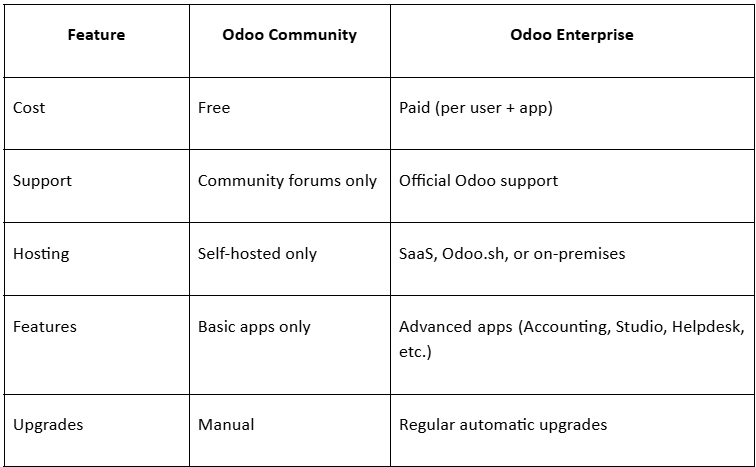
- Community Edition: It is a free package with only basic features. In one of its updates, the Accounting feature has been removed from the Odoo Community Version. However, users can access the Invoicing app for essential accounting functions. The community version also does not have other crucial components like bug fixing, functional support, hosting facility, etc.
- Enterprise Edition: It is the paid Odoo ERP package. It has various capabilities and benefits besides the basic ones available in the Community Edition.
The factors contribute to why Odoo’s pricing isn’t a one-size-fits-all model.
- Modular ERP System – Businesses can start small with just a few apps (like CRM, Sales, or Accounting) and expand over time.
- Open-Source Foundation – The Community version is free, making Odoo more accessible than most competitors.
- Flexible Deployment – Odoo can be hosted on-premises, Odoo Online (SaaS), or via Odoo.sh (cloud platform).
- Highly Customizable – Unlike rigid ERP systems, Odoo can be adapted to industry-specific workflows.
Odoo Pricing Models – Community vs Enterprise Model
Odoo Pricing: Understanding the Cost Structure
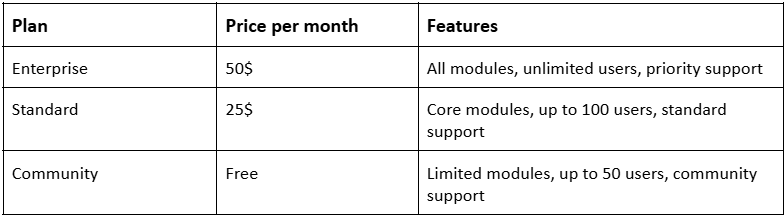
Hosting options’ impact on pricing
The hosting environment impacts and influences Odoo pricing. Odoo offers three main hosting options: SaaS (Odoo Online), Odoo.sh (cloud platform with more flexibility), and on-premises hosting. Odoo Online is often the most cost-effective choice. Odoo.sh is slightly more expensive but allows for custom development and staging environments, and On-premises hosting can be the most expensive option, and businesses need this for maintaining the server. Even with all these comparisons, Odoo still stands as an affordable option.
Implementation and Migration
Unlike straightforward pricing and subscription, the implementation and migration of Odoo is complex. One of the most overlooked yet significant expenses is migration. The Migration involves transferring your data, processes, and sometimes custom code into Odoo’s framework.
Let’s try and understand by breaking the migration into three:
- Data Migration – Moving customer records, product catalogs, accounting history, etc.
- Module Migration – Ensuring old modules are compatible with the new Odoo version.
- Customization Migration – Updating or rebuilding custom features.
The cost of migration can vary significantly based on factors such as the amount of data to be transferred, the number of applications being migrated, and the quality of the data.
How to Control Odoo Migration Costs?
Cleaning and organizing data before migration reduces complexity and ensures smoother transfers. Starting small with essential applications, training employees early in the process also minimizes post-migration support costs, and working with certified Odoo partners prevents costly errors.
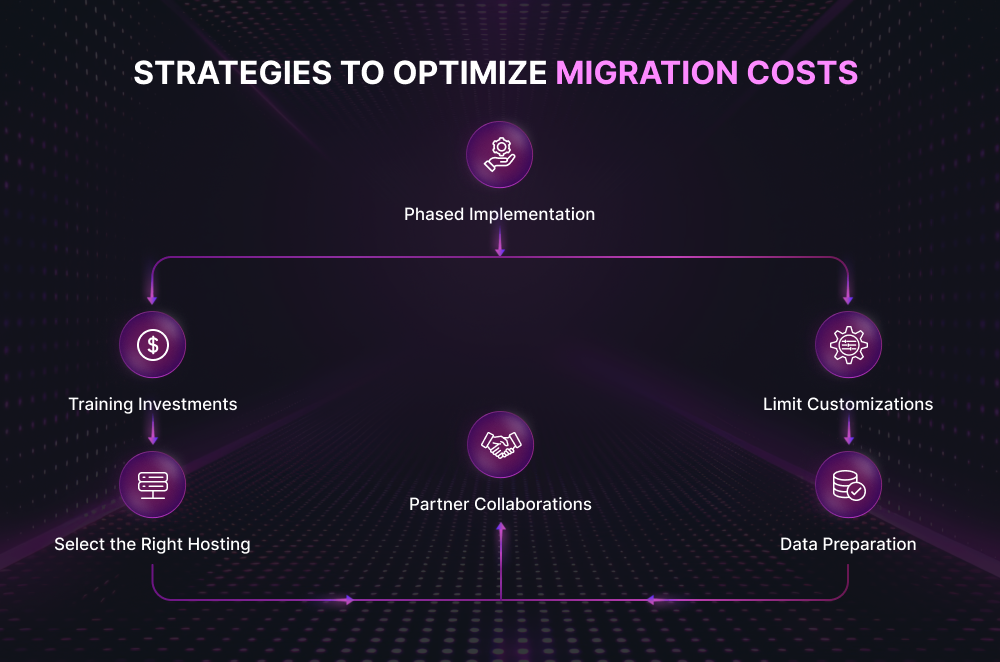
Strategies to optimize migration costs
- Training Investments – Budget for comprehensive employee training to avoid long-term inefficiencies.
- Phased Implementation – Start with essential modules and expand gradually to control upfront expenses.
- Limit Customizations – Use standard modules wherever possible and reserve custom development for critical workflows.
- Select the Right Hosting – Align hosting with organizational needs and compliance requirements.
- Partner Collaboration – Work with certified Odoo partners to reduce risks and ensure efficient implementation.
- Data Preparation – Clean and organize data before migration to reduce complexity and partner costs.
Benefits of Hiring Odoo Implementation Partners
Hiring an Odoo implementation partner can deliver significant cost advantages. Their proven expertise ensures a faster and more efficient deployment. Let’s dive into some of the benefits of hiring Odoo implementation partners.
- Customization and Tailoring: An Odoo partner can tailor the ERP system to meet your specific business needs. Instead of investing in costly in-house development, partners can efficiently customize modules and functionalities.
- Efficient Implementation: Odoo implementation partners have extensive experience in deploying Odoo solutions. Their expertise allows for a more efficient and streamlined implementation process, reducing the time and effort required for deployment.
- Reduced Training Costs: Odoo partners often provide training and onboarding services as part of their implementation packages. This reduces the need for additional training expenses for your staff.
- Ongoing Support and Maintenance: Many Odoo partners offer ongoing support and maintenance services. By partnering with them, you can avoid unexpected expenses related to system downtime or troubleshooting, as they can provide timely assistance and updates.
- Access to Expertise: Odoo partners have a deep understanding of the Odoo ecosystem, including best business practices, module integrations, and industry-specific solutions. Leveraging their expertise can help you avoid costly mistakes and ensure that your implementation aligns with industry standards.
Conclusion: The balance between affordability and scalability
The business environment is dynamic, and financial planning must account for long-term adaptability. For decision-makers evaluating ERP systems, Odoo offers a unique combination of affordability, flexibility, and scalability. Most growing businesses benefit from the Enterprise Edition’s broader features and official support. Odoo and its ability to evolve with any business. New applications can be added as needed, and regular updates keep the system aligned with modern business requirements. Compared to competitors like SAP, Oracle, and Microsoft Dynamics, Odoo provides a far more affordable and flexible solution. In long-term ROI and total cost of ownership, Odoo emerges as one of the most cost-effective ERP options available on the market. The operational improvements and efficiency gains outweigh initial expenses. And thus, Odoo provides a financially sustainable path to digital transformation. The key to success lies in treating Odoo adoption as a strategic investment in the company’s future.