
Businesses often face a critical decision regarding mobile app development: which framework to choose? Making the right choice from the variety of cross-platform mobile app development frameworks is essential to developing reliable, user-friendly apps for iOS and Android.
React Native and Flutter remain the two dominant frameworks in 2026. Both allow developers to build applications using a single codebase, but they differ significantly in architecture, performance, development experience, and ecosystem
Latest 2026 stats at a glance:
- Market share in cross-platform development: Flutter holds ~46%, React Native ~35–38%
- Developer usage (Stack Overflow 2025): Flutter 9.12% vs React Native 8.43%
- GitHub stars (mid-2025): Flutter ~170k vs React Native ~121k. Flutter leads in popularity and activity.
What Is Flutter?
Flutter is an open-source UI development framework built by Google. Using a single codebase, it creates multi-platform applications for mobile, web, desktop, and embedded devices.
Flutter uses the Dart programming language and its own powerful rendering engine (Skia → now Impeller), enabling visually rich, high-performance apps with consistent 60–120 FPS across platforms.
Key Features of Flutter Framework:
- Cross-platform app development (mobile + web + desktop)
- Natively compiled applications
- Hot reload for lightning-fast iteration
- Rich, customizable UI widgets with pixel-perfect consistency
Companies Using Flutter (2025–2026 updates): Google (Google Pay, Ads), Alibaba Group, BMW (My BMW app), Nubank, SoFi, LG Electronics, Bread Financial, and many fintech/e-commerce leaders.
What Is React Native?
React Native is a widely used open-source mobile application development framework created by Meta. It uses JavaScript and React to build high-performance apps for iOS and Android.
It leverages the massive JavaScript ecosystem, allowing web developers to reuse skills easily. The 2024+ “New Architecture” (JSI, bridgeless) has significantly improved performance.
Key Features of React Native Framework:
- Cross-platform development with one codebase
- Fast Refresh and live reloading
- Access to native modules and seamless integration with existing native code
- Massive developer community and ecosystem
Companies Using React Native: Meta (Facebook, Instagram), Shopify, Microsoft, Walmart, Tesla, Discord, Bloomberg.
Flutter vs React Native: Key Comparison
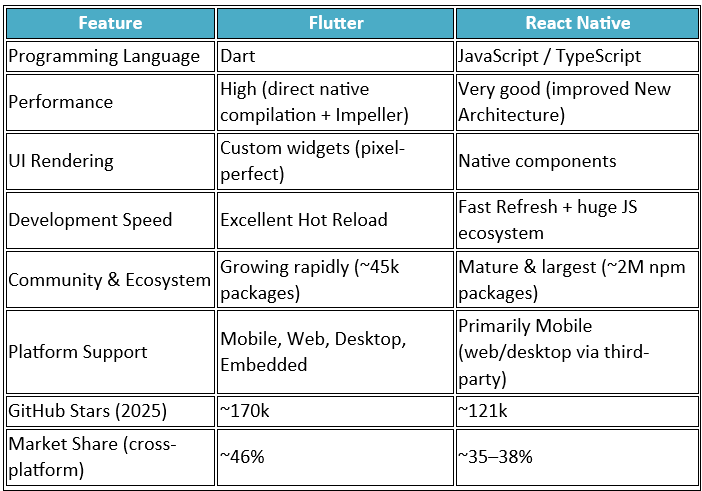
Flutter vs React Native: Head-to-Head Comparison
Performance Comparison
Flutter compiles directly to native code and uses its own rendering engine, delivering smoother animations and faster rendering. Recent 2025 benchmarks show Flutter often achieving 60–120 FPS with lower CPU/memory usage and faster startup times (e.g., iOS: Flutter 1.2s vs RN 1.8s; Android: 1.4s vs 2.1s).
React Native’s New Architecture has closed the gap significantly, but Flutter still edges out in animation-heavy and complex UI scenarios. For most business apps the difference is minimal, but Flutter excels in performance-critical applications.
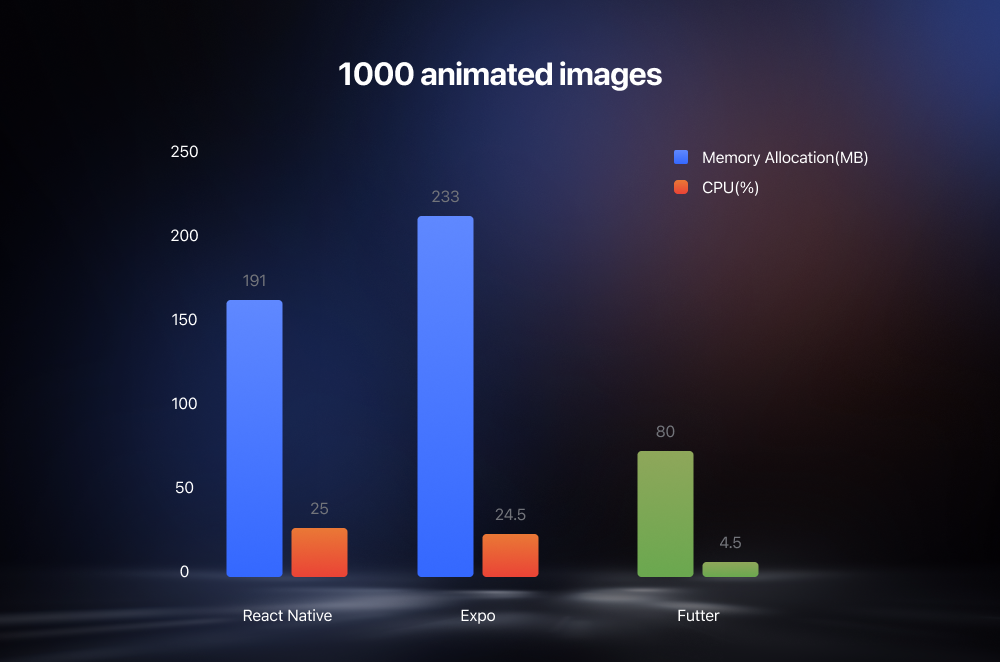
Flutter vs. React Native’s New Architecture Performance benchmark: Memory & CPU during heavy animation, Flutter significantly lower in recent tests
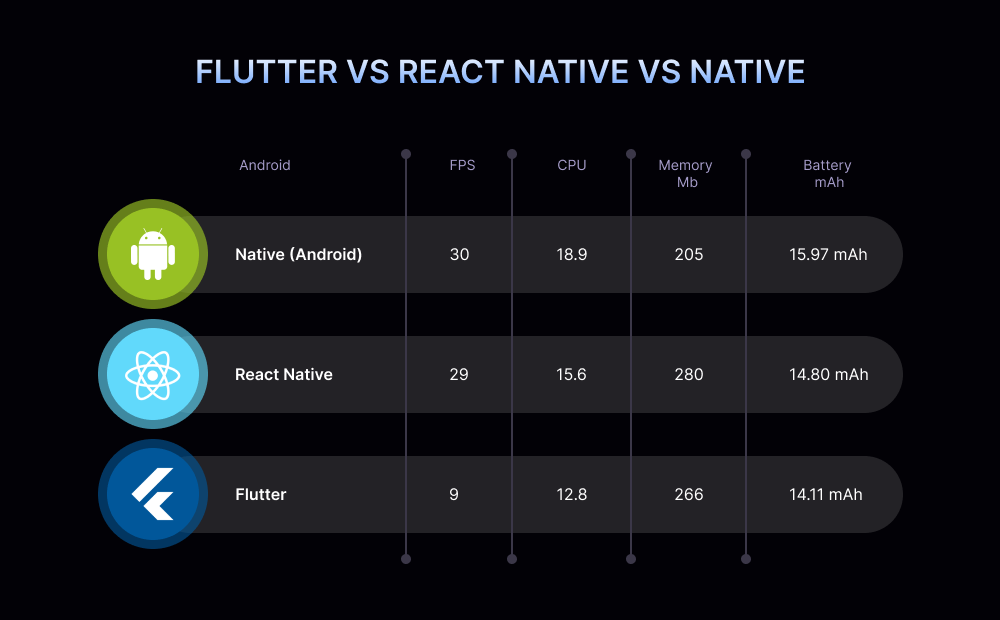
Flutter vs React Native vs Native: Deep Performance Comparison, Flutter competitive or better across metrics
Development Speed and Productivity
Both frameworks support faster development through code reuse. Flutter offers Hot Reload for instant UI updates during development.
React Native provides Fast Refresh and benefits from the large JavaScript ecosystem, making it easier for teams already familiar with JavaScript.
UI and User Experience
Flutter’s widget system ensures perfect design consistency across platforms—ideal for branded, custom UIs.
React Native uses native components for a more “platform-native” look and feel.
Community and Ecosystem
React Native has a mature ecosystem and a large developer community since its release in 2015.
Flutter, though newer, has grown rapidly and gained strong adoption among developers.
Both frameworks continue to expand with active community support and new tools.
Latest Statistics & Trends (2025–2026)
Adoption: Flutter is the most popular cross-platform framework in many developer surveys and is projected to maintain its lead.
Future Prediction: By late 2026, Flutter is expected to strengthen its dominance in performance-intensive and multi-platform apps (mobile + web + desktop). React Native will remain strong for teams with heavy JavaScript/React expertise and rapid MVPs. Cross-platform development overall continues to grow rapidly.
Use Cases: When to Choose Flutter or React Native
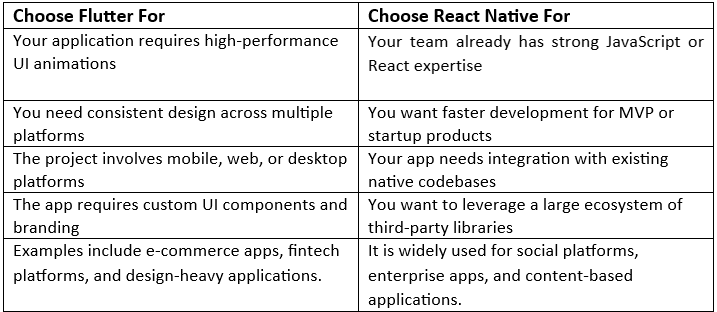
FAQ: Flutter vs React Native
Which framework is better for mobile app development?
Both frameworks are powerful cross-platform solutions. The best choice depends on project requirements, development team skills, and performance needs.
Is Flutter faster than React Native?
Flutter can deliver better performance in some cases because it compiles directly to native code and uses its own rendering engine.
Is React Native easier to learn?
React Native may be easier for developers already familiar with JavaScript and React.
Ending Note: Flutter versus React Native
Both Flutter and React Native are powerful frameworks that enable businesses to build cross-platform mobile applications efficiently. Flutter offers excellent performance, strong UI control, and multi-platform capabilities, making it ideal for visually rich and performance-intensive apps. React Native provides faster on-boarding for JavaScript developers and a large ecosystem, making it suitable for rapid development and scalable applications.
In short:
- Go for Flutter → When performance and design perfection matter.
- Go for React Native → When speed to market and developer familiarity matter.
Ultimately, choosing between Flutter and React Native depends on your business requirements, team skills, project timeline, and goals. Hope this updated guide helps you make the best decision for your next app!.
Not Sure Whether Flutter or React Native Is Right for Your Project?
Get expert guidance on framework selection, architecture planning, development timelines, and scalability requirements.
Book a Free Strategy Session with Confianz.