


The Fastest Way to Validate an Idea. Not Always the Safest Way to Run One.
Imagine you’re a business leader with an idea. Maybe it’s an employee self-service portal, an approval workflow, or a dashboard that brings scattered operational data into one place.
Traditionally, turning that idea into software meant gathering requirements, working through design and development cycles, and investing significant time before seeing something tangible.
Today, AI-powered vibe coding can change that starting point.
With natural language prompts, a business can quickly create a working application. The idea becomes visible. Stakeholders can interact with it, test a workflow, gather feedback, and determine whether the concept deserves further investment. That speed makes vibe coding especially useful for testing an idea before committing a full development effort.
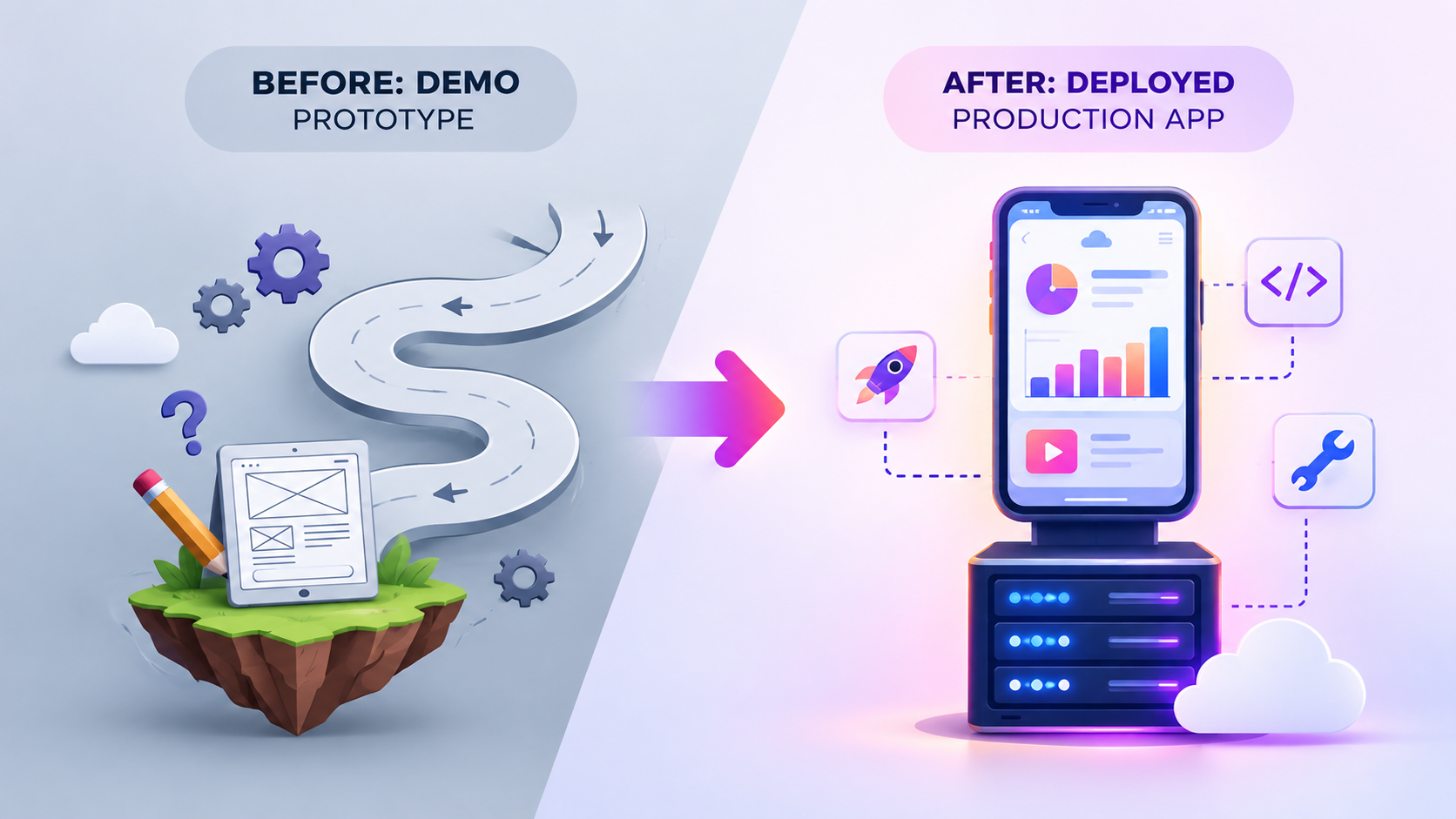
As the prototype works. People like it. The workflow makes sense. Stakeholders approve the concept and see its value. Once the prototype proves the idea has real potential, the question changes from “whether it can be built” to “what it takes to make it ready for real-world use”.
At that stage, business wants more. The application needs to connect with live systems, handle real data, integrate with existing software, and become part of everyday operations.
This is the real turning point. A prototype demonstrates that an idea can work. Production software must demonstrate that the business can rely on it.
Vibe coding can accelerate the journey from an idea to a working prototype. But when that prototype becomes part of real business operations, the requirements change. At that point, experienced software development may be needed to make the application reliable and ready for production.
What Is Vibe Coding?
“Vibe coding,” popularized by Andrej Karpathy in 2025, uses natural-language prompts to generate software. A simple request can produce screens, workflows, databases, and logic within hours. While this accelerates prototyping, vibe coding should not be confused with professional AI-assisted software development.
| Vibe Coding vs. Professional AI-Assisted Development | |
|---|---|
| Vibe Coding | Professional AI-Assisted Development |
| AI generates large portions of the application | AI is used as a productivity tool within a structured development process |
| Focused on quickly achieving working functionality | Focused on functionality, reliability, security, scalability, and maintainability |
| Often driven by rapid experimentation | Driven by architecture, standards, testing, and governance |
| May rely heavily on prompts and iteration | Includes code reviews, security reviews, QA, and deployment practices |
| Ideal for exploring ideas | Ideal for supporting business operations |
Using AI to help write software is not the same as “vibe coding.” Experienced developers can use AI extensively while still reviewing the generated code, validating architectural decisions, testing functionality, securing the application, and taking responsibility for the result.
What Are the Benefits of Vibe Coding for Businesses?
Businesses pursue vibe coding for one simple reason: Speed.
AI-assisted development can accelerate coding and improve productivity, helping organizations:
- Validate ideas faster
- Reduce initial investment
- Gather stakeholder feedback earlier
- Build proofs of concept quickly
- Improve business–technology alignment
Instead of discussing an idea for months, teams can experience and evaluate it firsthand.
What Types of Projects Are Best Suited for Vibe Coding?
Not every application starts as a mission-critical system. Many successful products begin as small experiments. Vibe coding is often an excellent fit for proofs of concept, internal demonstrations, process experiments, department-level tools, and startup MVPs.
Vibe Coding Decision Matrix: –
| Scenario | Good Candidate for Vibe Coding? |
|---|---|
| UI mockup or concept validation | Yes |
| Internal workflow prototype | Yes |
| Departmental experiment | Yes |
| Customer-facing Application | No: Requires Engineering review |
| Financial transaction platform | No: Professional development required |
| ERP integration solution | No: Professional architectural and integration oversight needed |
| Application handling sensitive records | No: Professional development with appropriate security, privacy, and governance controls required |
The key takeaway is simple: The higher the business risk, the greater the need for structured software engineering.
What Changes When Software Starts Running the Business?
The transition from prototype to production changes the requirements considerably.
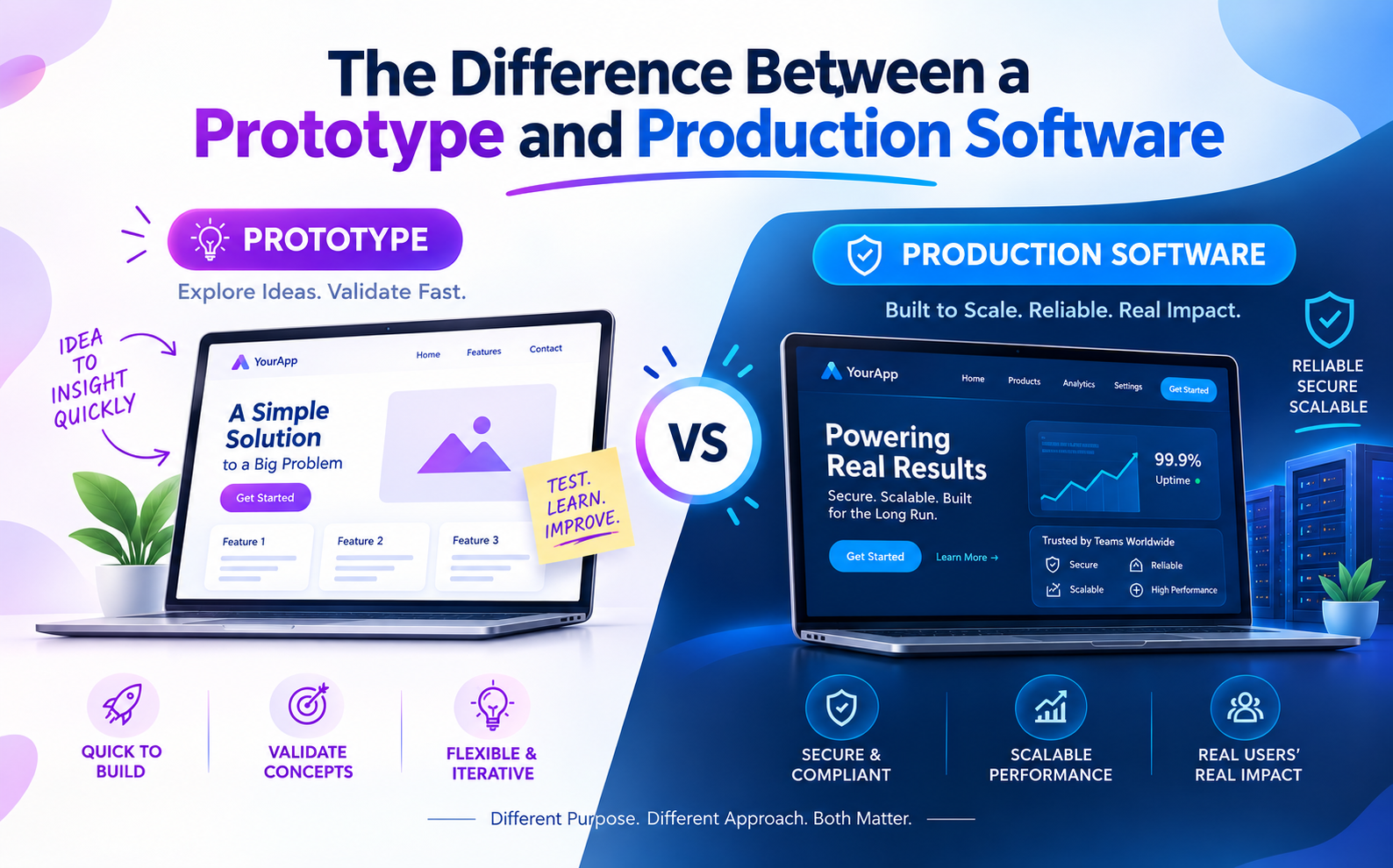
A prototype may only need to demonstrate that a workflow is possible. It answers: “Does this idea work?”
A production application needs to ensure that the workflow continues to work reliably when real users, real data, integrations, and business expectations are involved. Production software answers: “Can we rely on this every day?”
That shift introduces entirely different requirements.
| How Production Requirements Differ from a Prototype | |
|---|---|
| Prototype Focus | Production Focus |
| Demonstration | Reliability |
| Features | Security |
| Speed | Stability |
| Functionality | Scalability |
| User Feedback | User Management |
Security and Access
A prototype may use limited test data and a small number of users.
Production software may contain sensitive business data. A security weakness is no longer simply a technical defect. It can become unauthorized access, data exposure, operational disruption, or loss of customer trust.
Architecture and Integration
A prototype can sometimes work as a collection of quickly assembled components.
Production applications need an architecture that can evolve. Developers need to consider how the application communicates with databases, APIs, third-party services, or other business applications.
Poorly planned dependencies can make future changes difficult.
Scalability and Performance
An application that works well for a few users may behave differently when hundreds or thousands of users access it simultaneously.
Production planning therefore needs to consider application performance, concurrency, and infrastructure capacity where relevant.
The goal is not to over-engineer every prototype. It is to recognize when expected usage requires more deliberate architectural decisions.
Testing and Reliability
A prototype is often tested by asking:
- Does the feature work?
Production software requires broader questions:
- What happens when incorrect data is entered?
- What happens when an external system is unavailable?
- What happens when multiple users perform the same action?
- What happens after an update?
- Can an existing feature break when a new feature is introduced?
- Can important workflows be tested before deployment?
Appropriate unit, integration, regression, and user acceptance testing help reduce these risks.
Maintenance and Change
Software does not stop changing after launch. Business requirements evolve. Users request improvements. External systems change. Dependencies require updates. Security issues need to be addressed.
An application therefore needs to be understandable and maintainable by the people responsible for it.
Documentation, version control, deployment processes, monitoring, testing, and clear ownership become increasingly important as the software becomes part of the business.
Signs It’s Time to Bring in Experienced Developers
Businesses often reach a stage where continued progress requires specialized expertise. Common indicators include:
Your Application Uses Real Data
Once business-critical information enters the system, governance and security become essential.
Multiple Employees Depend on It
Operational tools require reliability, support processes, and change management.
Customers Will Use It
Customer-facing experiences demand stronger quality standards and performance expectations.
Integrations Are Growing
Connecting multiple business systems requires careful architecture and ongoing maintenance.
Changes Are Becoming Difficult
If every update introduces unexpected issues, the software may need engineering review.
Growth Is Accelerating
Scaling users, transactions, or workflows often reveals architectural limitations. At this stage, experienced developers are not replacing the prototype. They are helping transform it into a dependable business asset.
Security, Compliance, or Business Continuity Becomes Important
If downtime, data loss, security incidents, or compliance gaps could materially affect the business, additional engineering oversight becomes increasingly valuable.
These signs do not automatically mean the prototype has failed. They indicate that the application has entered a stage where professional engineering practices can provide greater value.
Does the Application Need a Complete Rebuild?
Not necessarily. One of the most common misconceptions is that every AI-generated application must be rebuilt. In many cases, experienced developers can:
- Assess the current architecture
- Identify strengths and weaknesses
- Refactor specific components
- Improve security
- Optimize performance
- Strengthen integrations
- Add testing and monitoring capabilities
Sometimes targeted improvements are sufficient. Sometimes larger structural changes are necessary. A professional assessment helps determine the most practical path forward.
When Do You Need One Developer vs. a Development Team?
The answer depends on complexity and business impact.
| Situation | Recommended Approach |
|---|---|
| Small low-risk internal tool | Individual developer may be sufficient |
| Limited workflow automation | Individual developer or small team |
| Customer-facing application | Dedicated development team depending on complexity and support needs |
| Multi-system integration project | A development team with integration expertise |
| High-growth SaaS platform | A broader team for scalability, QA, and infrastructure |
| Enterprise platform supporting multiple departments | A team with multiple areas of expertise across architecture, infrastructure, and integration |
A single experienced developer can be highly effective when the scope is focused.
A development team becomes more valuable when the project requires several areas of expertise at the same time or needs ongoing development, testing, infrastructure, security, and support.
How Do You Move From AI-Built Prototype to Production
Moving beyond a prototype does not have to mean starting from zero. A practical transition can begin with an assessment.
1. Assess What Already Exists: Review the application’s architecture and deployment setup.
2 Identify What Can Be Retained: Determine which parts of the existing application are useful. Not every component needs to be replaced.
3. Address Production Gaps: Strengthen areas such as authentication, error handling, performance, and data management based on the application’s actual requirements.
4. Strengthen Integrations and Infrastructure: Prepare the application to work reliably with the business systems, cloud infrastructure, APIs, and external services it needs to support.
5. Establish Testing and Deployment Practices: Introduce appropriate testing, deployment processes, and release practices so changes can be made with greater confidence.
6. Plan for Long-Term Ownership: Production software needs ongoing maintenance, clear documentation, ownership, support, and a process for future enhancements.
This approach allows businesses to preserve the speed and experimentation benefits of AI while adding the engineering discipline required for dependable software.
The Questions Business Leaders Should Ask
Before moving an AI-generated application into broader use, business leaders should consider:
- Who has access to the application?
- What information does it store or process?
- How is sensitive information protected?
- Can the application support expected user and transaction growth?
- How will it integrate with existing business systems?
- What happens if an external system becomes unavailable?
- How are changes tested before release?
- Can another developer understand and maintain the application?
- How are security issues identified and addressed?
- What happens during upgrades?
- Who owns the application, infrastructure, and deployment process?
- What support will be available after launch?
These questions help shift the conversation from “Can AI build this?” to “What does the business need in order to depend on this?”
How Do AI and Professional Software Development Work Together?
Vibe coding can make software experimentation faster and more accessible. Experienced developers do not need to replace that capability. They can build on it.
AI can accelerate ideation, prototyping, implementation, and repetitive development tasks. Experienced developers provide the engineering judgment needed to evaluate architecture, security, scalability, testing, deployment, integration, and long-term maintenance.
Together, these approaches can allow businesses to move quickly while still developing software that is appropriate for its intended level of business risk and operational importance.
Conclusion
Vibe coding can be a valuable way to explore an idea, create a prototype, gather feedback, and determine whether an application has business value. The threshold changes when that application begins supporting real users, sensitive information, business integrations, or important operational processes.
At that point, success is no longer measured only by whether the application works today. It is measured by whether the business can depend on it tomorrow.
That does not necessarily mean abandoning what AI has already created. In many cases, an experienced developer or development team can assess the existing application, retain what is useful, address the gaps, and establish a practical path toward production.
The goal is not to choose between AI and professional software development. It is to use AI where it creates speed and value, while applying the engineering expertise, testing, security, architecture, and accountability required when software becomes something the business depends on.
Ready to Move Beyond the Prototype?
Built an application with AI but unsure whether it is ready for real business use?
Confianz helps businesses evaluate and advance AI-generated applications through experienced software architecture, custom development, UI/UX, quality assurance, cloud deployment, system integration, and ongoing support. We can assess what you have already built, determine what can be retained, identify the gaps between prototype and production, and create a practical path forward.
Talk to Confianz about your idea, prototype, or software development needs.
Related posts:
 10 Questions to Ask Before Hiring a Mobile App Developer
 How Odoo Supports Omnichannel Retailers Across POS, Ecommerce, and Inventory
 What Odoo 20 Confirmed, What Is New, and What Businesses Should Do Next
 Salesforce + Odoo ERP: Keep Salesforce Where It’s Strongest and Use Odoo as Your Operational Backbone
 Plagiarism Truth or Myth