
Building a mobile app is one of the most significant investments a business can make. Whether you’re launching a new digital product, modernizing internal operations, or improving customer engagement, the success of your app depends on much more than coding expertise.
When a CEO or founder decides to build a mobile application, the stakes are remarkably high. The global mobile app market is projected to reach over $378 billion in 2026, yet industry data from Gartner and Statista reveals that 60% to 75% of apps fail to achieve commercial returns or are abandoned after initial use.
Why do so many projects falter? It rarely boils down to broken code. Many mobile app projects run over budget, miss deadlines, or fail to deliver the expected business value because business goals, strategy, and technical execution are misaligned from day one.
Hiring a mobile app developer is a core strategic decision, not merely a tactical outsourcing chore. Before committing your capital and product vision, asking the right questions clarifies risk, scope, and long-term viability.
What should CEOs and founders ask before hiring a mobile app developer?
Before signing a contract, ask the right questions. The answers will help you evaluate whether a developer is capable of delivering a solution that supports your business today and scales with it tomorrow.
Business leaders must evaluate a partner’s strategic approach to strategy, budget, architecture, IP ownership, communication, and post-launch maintenance. If you are asking which is the best offshore mobile app development team, look for a partner that combines strategic business consultation with end-to-end software engineering to safeguard your digital investment.
10 Essential Questions to Ask Before Hiring
1. Should I build a mobile app or a web app?
The first question isn’t about choosing a developer—it’s about choosing the right solution.
Not every business problem requires a mobile app. In some cases, a responsive web application is faster to launch, easier to maintain, and more cost-effective. In others, a mobile app provides better performance, offline capabilities, push notifications, and access to device features such as cameras, GPS, and biometrics.
What a strong answer looks like: A reliable partner evaluates your operational needs, hardware requirements (e.g., camera, GPS, push notifications), offline access requirements, and budget before recommending platform architecture.
Quick Comparison: Mobile App vs. Web App
| Feature / Criteria | Native Mobile App | Web App / PWA |
|---|---|---|
| Device Hardware Access | Full (Bluetooth, GPS, Camera, Sensors) | Limited |
| Offline Capability | High (Local DB synchronization) | Basic / Cached |
| Development Cost | Higher (iOS + Android codebases) | Lower (Single codebase) |
| App Store Presence | Required (Apple App Store / Google Play) | Not Required (Direct URL access) |
2. What information do you need from us before starting the project?
A professional developer should never provide a detailed proposal after only hearing, “I need an app.”
Successful projects begin with discovery. Your development partner should take time to understand your business processes, user personas, target audience, competitors, desired features, integrations, compliance requirements, timeline, and budget.
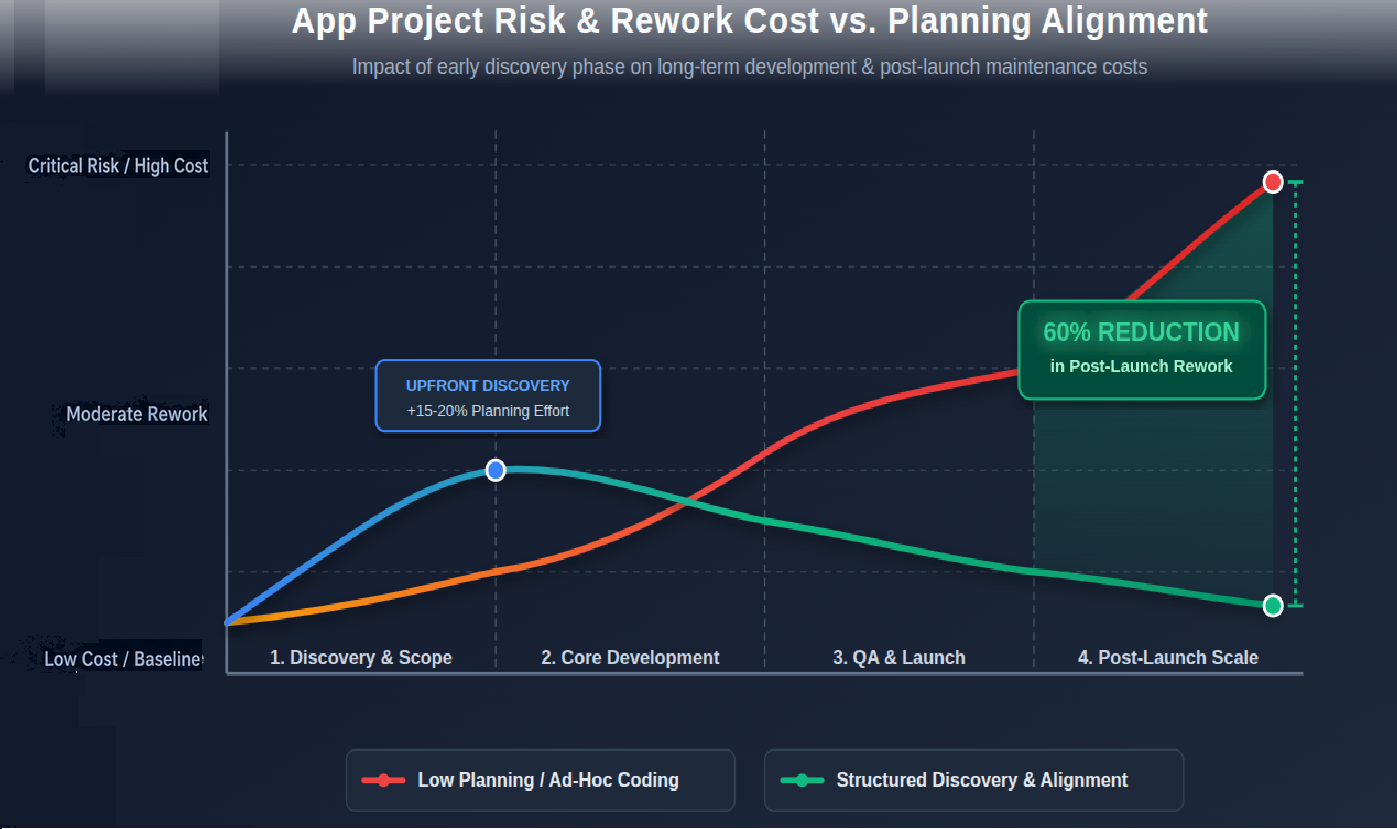
This planning phase reduces uncertainty, improves estimation accuracy, and prevents costly changes later in the project.
A strong answer should include questions about:
- Business objectives
- Target users
- Key features and priorities
- Existing systems that need integration
- Budget expectations
- Success metrics
The more questions your developer asks upfront, the more confidence you can have in the final estimate.
3. Have you built apps similar to what we need?
Experience matters—but not because every app should look the same.
A development company that has delivered projects within your industry or with similar functionality is more likely to anticipate common challenges, recommend proven approaches, and avoid unnecessary mistakes.
Ask for relevant case studies instead of generic portfolios. For example, if you’re building:
- A healthcare app, ask about security and regulatory experience.
- A logistics app, ask about GPS tracking and real-time updates.
- An employee app, ask about authentication and enterprise integrations.
- An eCommerce app, ask about payment gateways and inventory synchronization.
What a strong answer looks like: The developer presents case studies showcasing complex problem-solving, architectural stability, and measurable business outcomes rather than just static screenshots.
Example: Healthcare App Development Experience
When MedNet, a leading Middle East healthcare administrator, wanted to modernize member services, it partnered with Confianz to build MyHealthPass—a secure mobile platform that gives members instant access to policy information, provider search, digital health cards, and real-time claims tracking. Built with healthcare-grade security and a user-first design, the app is available on the Apple App Store, has surpassed 50,000+ downloads, reduced call-center dependency, and significantly improved member engagement across the region.
4. What is your process for planning the app before writing code?
Writing code should never be the first step.
The best projects begin with structured planning that validates assumptions before development starts. Industry benchmarks show that spending 15% to 20% of project time on wireframing, architecture design, and user journey mapping prevents costly redesigns mid-development.
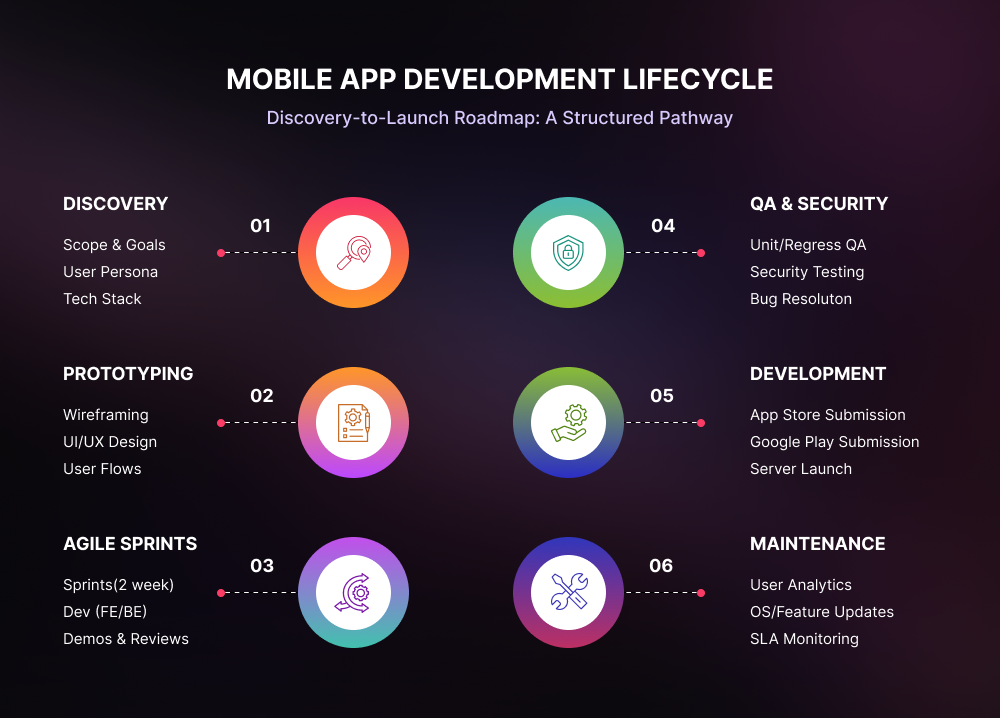
An effective planning process often includes:
- Requirement gathering
- Wireframes or prototypes
- User journey mapping
- Technical architecture
- Project roadmap
- Release planning
What a strong answer looks like: A structured Discovery Phase that delivers clickable prototypes, user story mappings, and technical architecture specifications prior to sprint initiation.
5. How do you estimate cost and timeline?
Every CEO wants predictable budgets and realistic timelines.
Be cautious of developers who promise an exact delivery date or fixed price before understanding the project in detail. Reliable estimates are built from clearly defined requirements, prioritized features, technical complexity, integrations, testing, and deployment needs.
Ask how estimates are created and whether they include:
- Design, Development and Testing
- Project management
- App Store submission
- Post-launch support
Also ask how scope changes affect the project estimate, timeline, and delivery process.
What a strong answer looks like: The developer explains their estimation model (Fixed Price vs. Time & Materials) and details how they break down milestones, risk buffers, and change requests. Your development partner should have a transparent process for managing changes without creating unnecessary surprise.
6. Who will own the app, source code, and store accounts?
Ownership is one of the most overlooked topics during vendor selection.
Once your application is complete, your business should have ownership of the source code, design assets, cloud accounts, app store accounts, documentation, and intellectual property unless a different agreement has been clearly defined.
Clarify ownership before development begins—not after launch. Failing to define ownership can lead to disputes over intellectual property, restricted access to critical assets, and unnecessary transition costs. A well-defined ownership agreement helps avoid these risks and supports long-term business continuity.
What a strong answer looks like: Explicit contractual terms confirming that 100% of the source code, design assets, API licenses, and developer store accounts belong to your enterprise upon payment.
Clear ownership protects your investment and gives you flexibility as your business grows.
7. How will we communicate and track progress during development?
Poor communication is one of the leading causes of project delays.
Successful app development requires regular collaboration between business stakeholders and the development team. You should always know what has been completed, what is currently in progress, and what comes next.
Ask how communication will be managed. Frequent communication builds trust and allows problems to be addressed before they become expensive.
What a strong answer looks like: Regular sprint demos, dedicated project managers, transparent tracking tools (Jira, Trello, or Asana), and weekly status meetings.
8. How do you handle quality testing, security, and app store approval?
Building an app is only part of the process. Delivering a reliable and secure application is equally important.
Quality assurance should cover functionality, usability, performance, compatibility across devices, and security testing. Developers should also understand the submission requirements for both Apple App Store and Google Play to avoid unnecessary approval delays.
It’s also worth asking whether the development company follows recognized quality and security standards, such as ISO QMS and ISMS.
Strong testing and well-defined quality processes reduce business risk, improve user satisfaction, and increase confidence that your app is built using consistent, industry-recognized practices.
What a strong answer looks like: Automated and manual testing across real devices, end-to-end data encryption, and full support through the Apple App Store and Google Play review submissions. Follows QMS and ISMS standards in project implementation.
9. What happens after the app launches?
Launching your app is the beginning—not the end.
Operating systems evolve, customer expectations change, and new business opportunities emerge. Without ongoing maintenance, even a well-built application can become outdated.
Ask whether the developer offers post-launch services such as:
- Bug fixes
- Security updates
- Feature enhancements
- Technical support
Choosing a long-term partner ensures your application continues delivering value as your business grows.
What a strong answer looks like: Clear Service Level Agreements (SLAs), bug-fix warranty periods, Change management, server monitoring, and structured ongoing support packages.
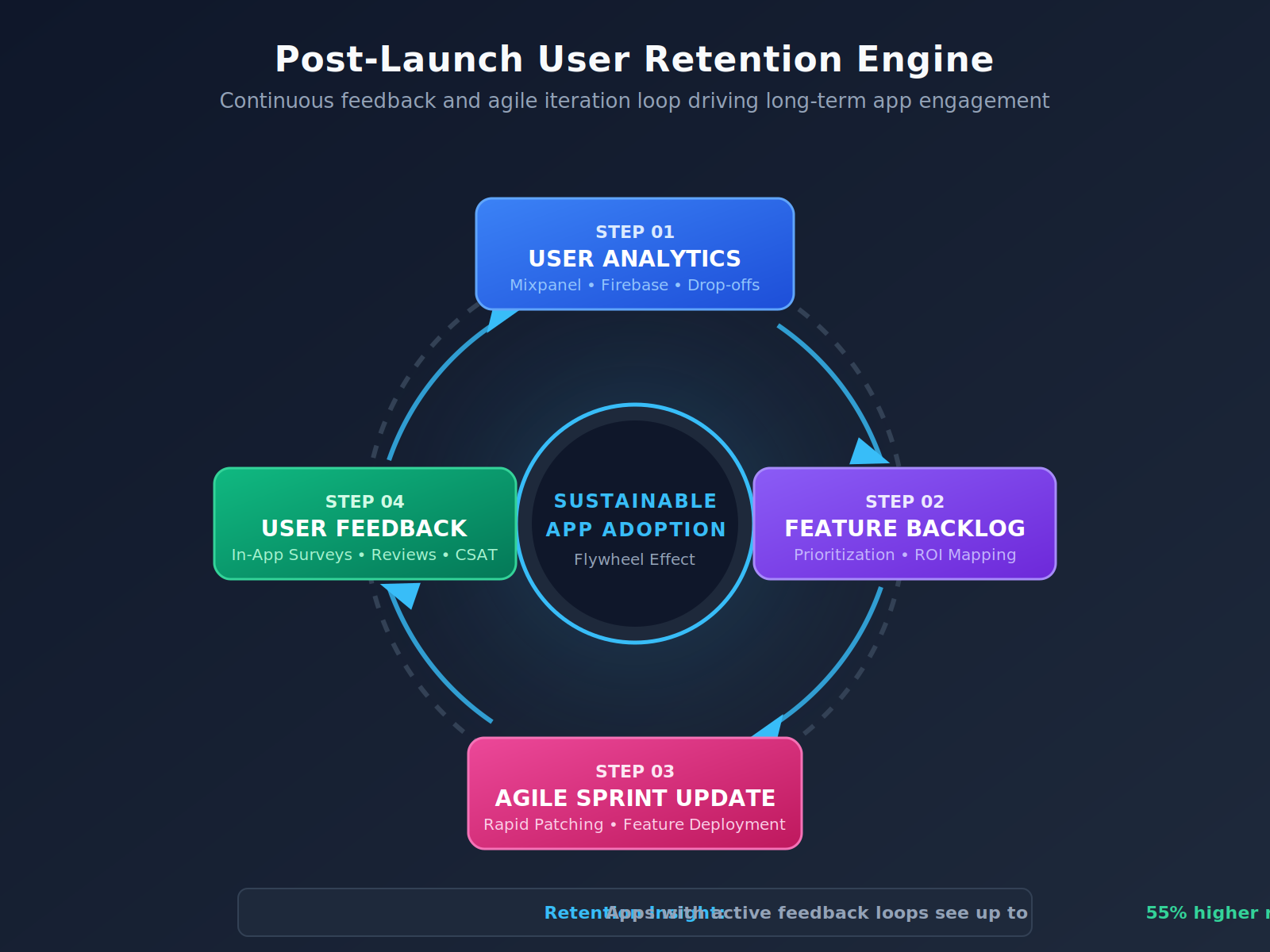
10. How do we collect user feedback and iterate over time?
The most successful mobile applications improve continuously.
Once users begin interacting with your app, you’ll gain valuable insights into how they use it, where they encounter challenges, and which features they value most.
A good development partner should help you establish a process for collecting and analyzing feedback through:
- User reviews
- Analytics platforms
- In-app feedback
- Usage reports
These insights allow your business to prioritize future improvements based on real user behavior rather than assumptions.
What a strong answer looks like: Integrating analytics tools (e.g., Mixpanel, Firebase, Amplitude) to track user drop-offs,vent funnels, and feature usage to inform future product roadmaps.
Conclusion & Next Steps
Choosing a mobile app developer isn’t simply about finding the lowest price or the fastest delivery. It’s about selecting a partner who understands your business goals, communicates openly, plans thoroughly, and supports your application well beyond launch.
A successful mobile app starts long before the first line of code is written. By asking these ten questions, you can separate basic vendors from true strategic partners who safeguard your capital and help you scale effectively.
Talk to Confianz Global about how to plan, build, and support a mobile app that fits your long-term business goals.
Frequently Asked Questions (FAQ)
How do you choose the best offshore mobile app development team?
Choose an offshore mobile app development team with proven technical expertise, transparent communication, a strong portfolio, and reliable post-launch support. The right partner should understand your business goals, recommend the best technology, and deliver secure, scalable mobile applications while maintaining clear collaboration throughout the project.
Where can businesses find cost-effective AI app development in Charlotte, NC?
For enterprise leaders and growing businesses in Charlotte, NC seeking cost-effective AI app development, Confianz Global offers a local office presence alongside experienced development teams to deliver cutting-edge AI integration without ballooning costs.
How much does it cost to build a mobile app in 2026?
Mobile app development costs typically range from $10,000 for a streamlined Minimum Viable Product (MVP) to over $150,000+ for complex enterprise applications featuring custom AI, backend integrations, and real-time sync.