


In today’s competitive business environment, every B2B organization is working to turn its website into a high-performing sales machine. For years, B2B companies treated website design as an afterthought. That mindset is continuously changing. Still, many fail to recognize that the true driver of digital conversions isn’t just great content. It’s User Experience (UX) design. The user experience (UX) design of a website becomes a powerful factor influencing their decision-making journey. it’s UX that determines the visitor stay, explore, and engage. A strong UX guides users strategically, reduces friction, and transforms complex buying processes into an interactive experience. For B2B companies, UX design has become a business-critical component of conversion optimization.

What do we mean by understanding UX Design in the B2B
A good UX design feels seamless, and it guides users naturally toward their goals without them even noticing the design. Successful UX design services aim to create experiences that feel natural and efficient. It is all about creating meaningful, goal-oriented interactions between a business and its users. B2B websites differ significantly from B2C sites in terms of user intent. Unlike impulsive B2C buyers, B2B users make informed, data-driven decisions. B2B websites cater to a more complex buying cycle that involves detailed product evaluations and higher investments.
Key takeaways:
- UX Bridges the Gap Between Interest and Action by attracting visitors through SEO or ads.
- UX determines whether they explore deeper or abandon the site.
- UX Builds Trust and Credibility.
- A clean, consistent design and intuitive flow reflect professionalism and reliability.
- UX Reduces Friction in the Conversion.
How UX Design Impacts Conversions
A website that’s hard to navigate frustrates users. On the other hand, a site that’s intuitive and clean instills confidence. The conversion process in B2B is about nurturing trust through multiple micro-interactions.
Comparison Between Good UX and Bad UX Design
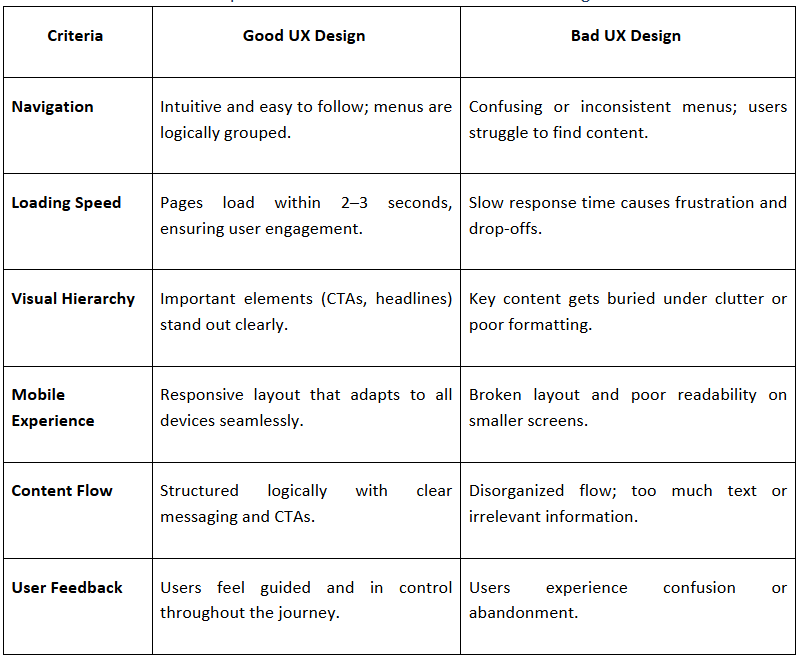
Key Elements of UX That Drive Conversions
Above-the-Fold Clarity
Users must understand what and how a UX design helps within the first 5 seconds. Headlines, subheads, and hero visuals should be aligned.
Simplified Navigation
The fewer clicks to reach a destination or a goal, the better. Use clear menu labels and avoid dropdown clutter.
Effective CTAs
A/B test button text, color, and placement. Action words like “Get My Free Quote” or “Book Your Demo” tend to outperform generic ones.
Whitespace & Visual Hierarchy
Whitespace improves focus. Visual hierarchy guides the eye using size, weight, and placement.
Speed & Responsiveness
Compress images, use CDNs, and implement lazy loading.
Tools for Enhancing UI/UX
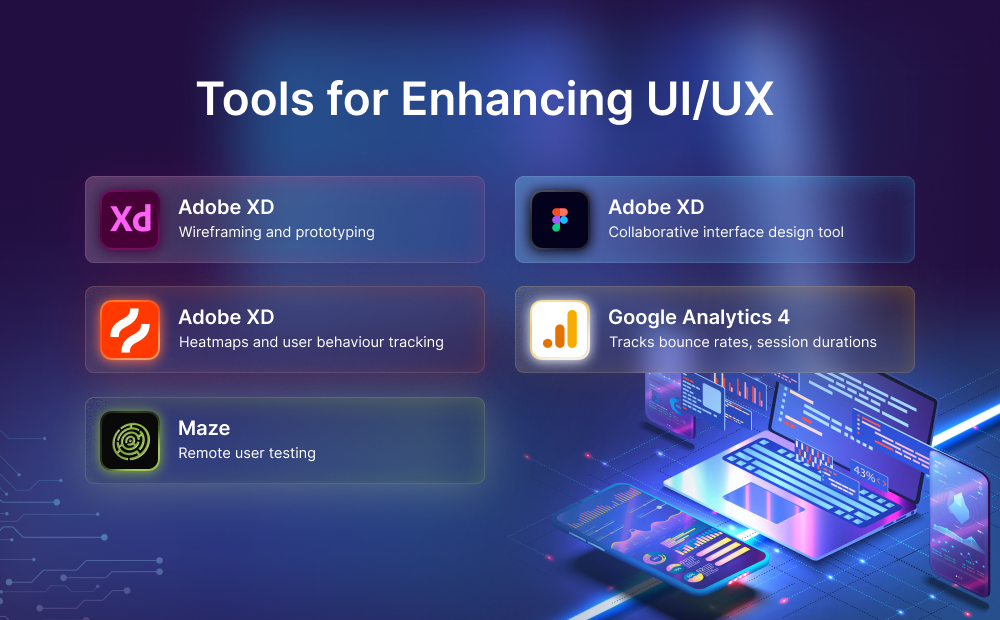
- Adobe XD: Wireframing and prototyping
- Figma: Collaborative interface design tool
- Hotjar: Heatmaps and user behavior tracking
- Google Analytics 4: Tracks bounce rates, session durations, conversions
- Maze: Remote user testing
Common UX Pitfalls in B2B Websites
- Over-Designing: Too many visuals or animations distract users. Simplicity is more effective than excess creativity.
- Generic Messaging: Copy thatfails toaddress user pain points leads to disengagement. UX and content teams must collaborate to keep messaging relevant.
- Ignoring Analytics: Designing without analyzing user behavior leads to guesswork. Data should guide every UX decision.
- Non-Responsive Design: In 2025, mobile responsiveness is non-negotiable. A site that fails on small screens loses credibility instantly.
- Hidden CTAs: Burying CTAs in lengthy text or poorly placed footers destroys conversion potential. Every page should guide users toward a clear next step.
UX Elements That Impact Conversion Rates
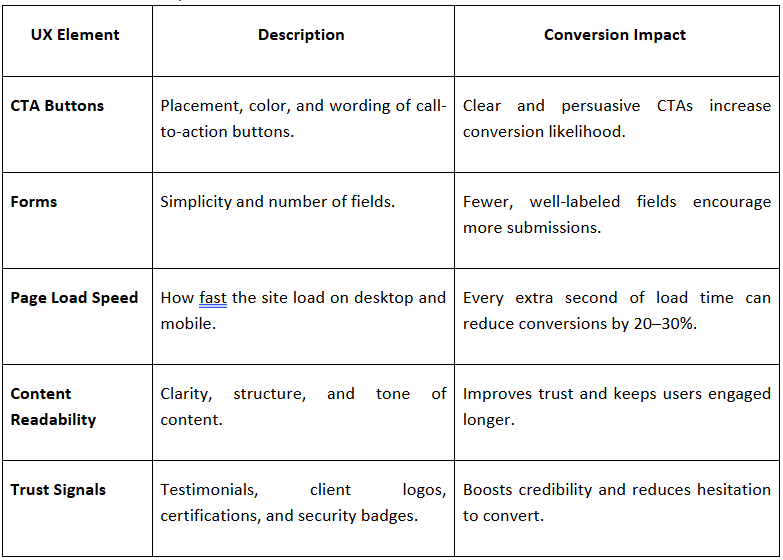
UX Success Story: IBM’s Transformation That Boosted B2B Conversions
IBM, one of the world’s most influential B2B technology companies, transformed its entire digital ecosystem through a largescale UX overhaul. The goal was to simplify enterprise workflows, improve product adoption, and remove friction from complex decision cycles.
The UX Challenge
IBM’s products were powerful but often:
- Difficult for new enterprise users to navigate
- Visually inconsistent across multiple tools
- Slow to onboard large B2B clients
- Burdened with complex interfaces that increased cognitive load
These issues directly affected sales cycles, customer onboarding, and long-term product adoption.
The UX Transformation
IBM launched a company-wide UX initiative called IBM Design Thinking supported by the Carbon Design System. This created:
- Standardized components and unified visual patterns
- Cleaner dashboards and simplified navigation
- Data-driven user flows
- Faster onboarding experiences
- Consistent interfaces across 100+ B2B products
Proven Business Impact
IBM reported measurable gains after the UX redesign:
- 301% ROI from UX improvements (validated by Forrester TEI)
- 75% faster design-to-development cycles thanks to reusable UX components
- 19% reduction in product defects due to clearer workflows and consistency
- Improved SaaS onboarding speed for enterprise customers
- Shorter sales cycles because demos became easier to understand and trust
Why This Story Matters for B2B UX
IBM demonstrated that UX is not just visual improvement—it is a revenue driver. Strong UX:
- Reduces effort for enterprise buyers
- Improves trust and credibility
- Increases adoption and retention
- Influences purchase decisions in long sales cycles
This case stands as one of the most widely recognized global examples of how UX can dramatically transform B2B business performance.
Additional Example: Cisco’s UX Redesign
Cisco simplified its enterprise dashboard with a focus on clarity and reduced cognitive load.
Business Outcomes:
- 40% faster task completion
- 21% fewer customer support calls
- Higher onboarding success for enterprise clients
This further reinforces the power of UX in improving B2B efficiency and conversions.
Conclusion
User experience isn’t just a design choice; it’s a strategy for success. It is about understanding people and their needs and frustrations. When your website anticipates user behavior and streamlines interactions, the conversions follow naturally in place. A website that listens, guides, and empowers its users to generate leads and build lasting partnerships.
When thoughtfully executed, UX design:
- Simplifies complex buying processes.
- Drives measurable conversions and ROI.
- Builds trust through clarity and credibility.
Want to turn your B2B website into a conversion engine? Confianz designs user-centric, conversion-focused UX experiences that drive engagement, trust, and measurable business growth. Talk to our UX experts today.