

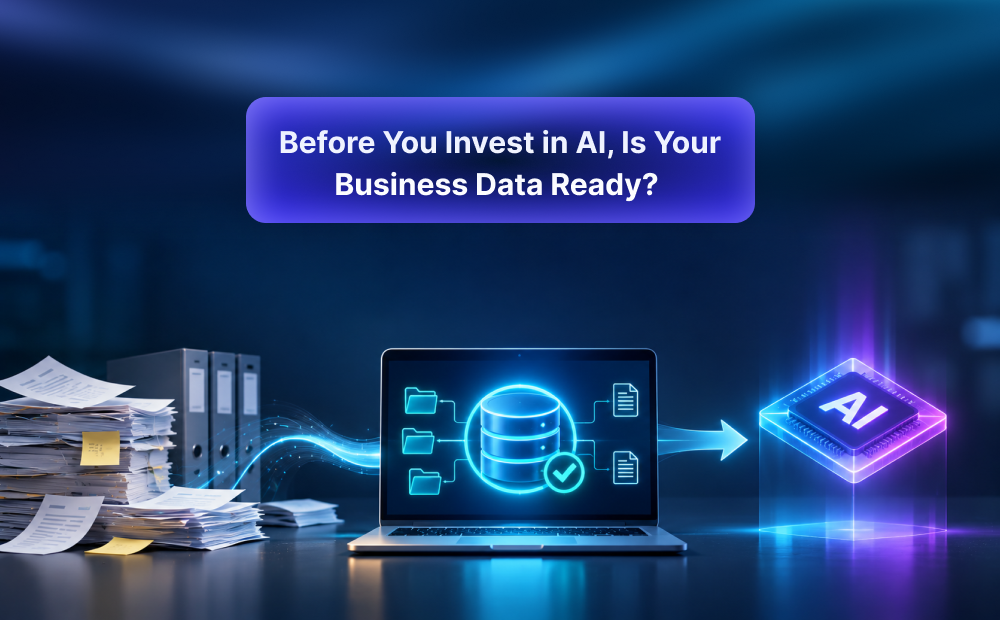
Imagine a chef preparing a dish. Even a skilled chef with modern equipment cannot make a great dish from poor-quality ingredients. Fresh ingredients are the foundation of a good dish.
AI works in much the same way: AI can help forecast demand, improve inventory planning, automate workflows, accelerate decision-making, and uncover patterns hidden in operational data. But just as a chef cannot turn poor ingredients into a consistently excellent dish, AI cannot reliably produce valuable insights from inaccurate, inconsistent, or outdated data. Therefore, before investing in AI, businesses should ask:
Is our data accurate, consistent, current, and relevant?
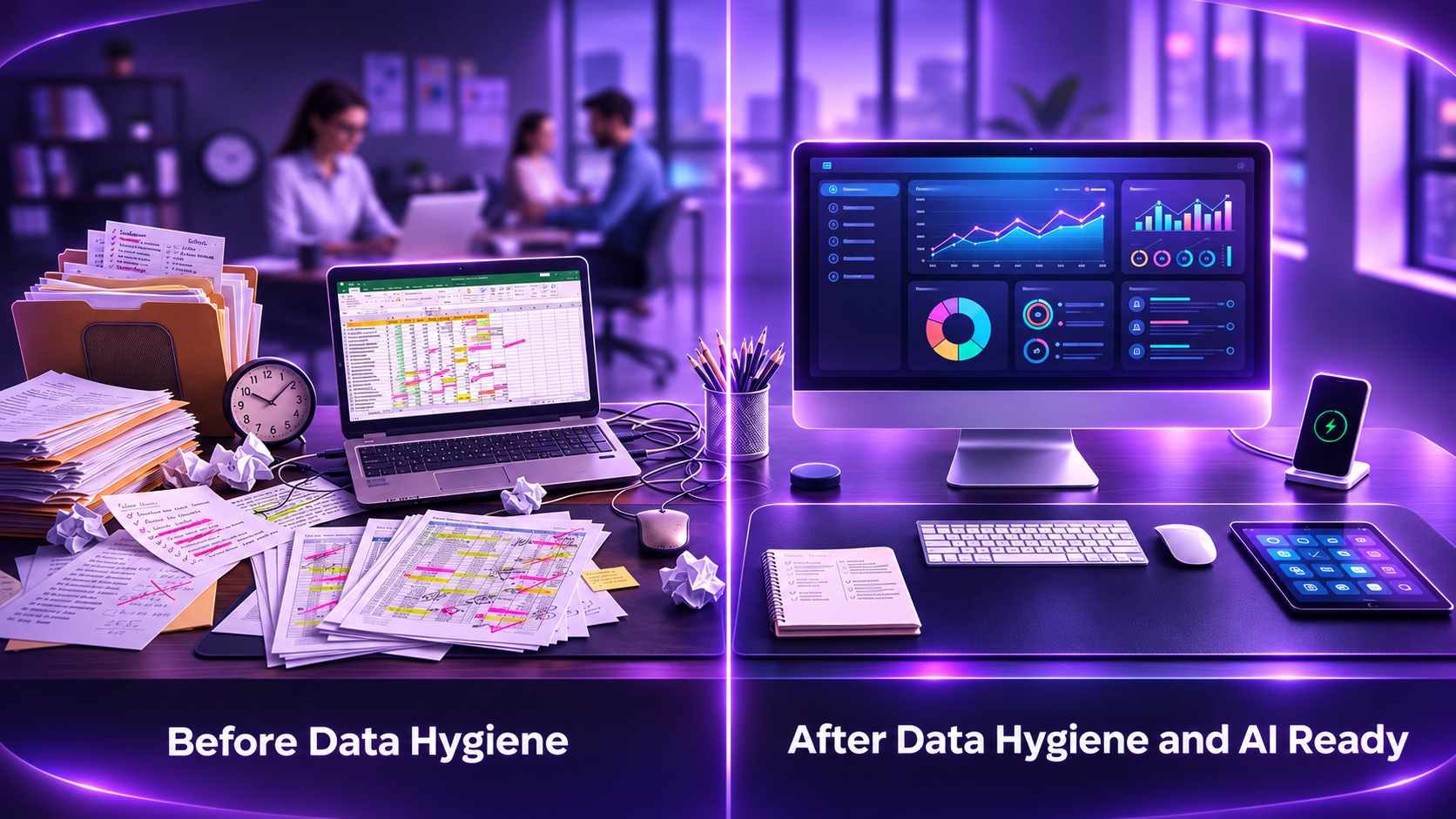
Consider a wholesale distributor preparing an AI-powered demand forecasting pilot. It has years of sales history and an established ERP system. Yet, a closer review reveals that the same product has product codes, packaging sizes have changed, and historical sales records in spreadsheets have not been reconciled with the ERP. Combining these records without correction could distort demand forecasts. The problem is not a lack of data, but poor data hygiene.
Business data readiness for AI starts with identifying the information a specific initiative requires, correcting inconsistencies, and maintaining reliable records. The good news is that businesses do not necessarily need a new ERP or a company-wide data overhaul. A focused data hygiene review, supported by well-configured systems such as Odoo ERP and appropriate integrations, can help establish a practical foundation for AI adoption.
To move from a broad awareness of poor data hygiene to an actionable preparation plan, organizations must stop looking at all their business data and focus exclusively on the pipeline feeding their first AI use case. Here are six practical steps to help prepare your business data for AI.
1. More Data Doesn’t Always Mean AI Readiness
Returning to our distributor, a product previously sold in packs of 12 is now sold in packs of 10, and its product code has changed. Older transactions use the previous code, while purchasing spreadsheets record quantities differently. Without reconciling these differences, the AI forecast could misinterpret packaging changes as shifts in customer demand.
The problem is not insufficient data, but inconsistent data.
Data hygiene is the ongoing process of keeping information accurate, consistent, current, and relevant. It involves correcting errors, standardizing formats, resolving duplicates, addressing missing information, and reviewing outdated records.
These practices support reliable reporting, planning, and operational decisions, even without AI. For AI initiatives, they help establish a more reliable foundation for meaningful outputs.
The distributor therefore defines its forecasting requirements before cleaning records across the entire organization.
2. Define What Your AI Initiative Actually Needs
The distributor first considers reviewing all systems and historical records. However, this would take too much time. Instead, the team focuses on the data needed to forecast seasonal demand for selected products. This includes past sales, transaction dates, product codes, units of measurement, and seasonal trends. Stockouts, returns, and promotions can also provide useful information.
This focused approach saves time and keeps data preparation aligned with business goals.
Different AI initiatives need different types of data. For example, an AI tool that drafts marketing emails may not need access to internal business systems. A document assistant may need approved policies and procedures. Demand forecasting, on the other hand, relies on relevant sales history and clear business measures.
Consider these examples:
| AI initiative | Data preparation priorities |
|---|---|
| Demand forecasting | Reconcile product codes, standardize quantities, and review historical sales |
| Customer insights | Resolve duplicate customer records and standardize customer information |
| Internal document assistant | Identify authoritative documents, review outdated versions, and configure permissions |
| Inventory assistance | Validate product identifiers, inventory records, and stock updates |
| Invoice processing | Standardize required fields and validate extracted information against source documents |
The exact requirements depend on the intended workflow and the consequences of incorrect results.
For the distributor, the priority is now clear: prepare the records needed for a limited forecasting pilot rather than attempting a company-wide cleanup.
3. Find the Source of Truth
The distributor stores sales data in its ERP, CRM, spreadsheets, and archived reports. Each source contains useful information, but some records conflict.
For example, older spreadsheets may contain previous packaging details, while the ERP shows current product information. Combining these records without checking them could lead to errors.
The team identifies the trusted source for each type of data. It also maps old product codes to current ones while preserving original transaction details. This helps the team understand what was actually sold at the time.
Businesses should not automatically replace historical data with current information. They must also remember that system integration does not guarantee accurate data.
Before connecting applications, define who owns each data field, which system is the source of truth, when updates should happen, and how transfer errors will be handled. These steps help businesses clean and connect their data more reliably.
4. Clean the Data Without Losing Valuable History
The distributor identifies three main areas for improvement.
1. Standardize records.
Product codes, descriptions, dates, and units of measurement must follow consistent rules. If a product changed from packs of 12 to packs of 10, historical quantities should be interpreted using verified packaging information. Otherwise, the forecasting system could mistake a change in packaging for a change in demand.
2. Resolve duplicates and inaccuracies.
Similar customer or product records should be investigated before merging. Unusual sales quantities should be checked rather than automatically corrected, since they may represent genuine bulk orders or data-entry errors.
3. Review missing and outdated information.
Missing fields should be assessed according to their importance. A missing promotional detail might not prevent a transaction from being used, while a missing product identifier could make the record unsuitable for the analysis.
Old data should not automatically be deleted. Historical transactions may remain valuable for identifying seasonal patterns, even when products or processes have changed. Instead, distinguish between correction, archiving, and exclusion.
| Action | Example |
|---|---|
| Correct | Fix a confirmed data-entry error |
| Standardize | Convert verified quantities into a consistent unit |
| Map | Connect historical product codes to current identifiers |
| Archive | Retain inactive product records for reference |
| Exclude | Leave an unreliable record out of a specific pilot while documenting why |
| Retain | Preserve valid historical sales information |
The objective is to prepare information for the intended use without losing records needed for business operations, audits, or retention obligations. However, cleaning historical data alone will not prevent new inconsistencies. The distributor must also improve how its systems capture and maintain information.
5. Use Your ERP to Build a Stronger Foundation for AI
A well-configured ERP can improve data consistency by connecting business processes and standardizing how information is recorded. For example, Odoo modules such as Sales, Inventory, Purchase, and Accounting can support connected workflows, depending on the configuration.
For manufacturers exploring AI opportunities, Odoo AI consulting for manufacturing can help them understand how their ERP environment may support AI initiatives and identify areas that need improvement before implementation.
Key benefits include:
- Consistent records: Standard product codes and units of measurement help maintain reliable product information.
- Connected workflows: Sales, inventory, and purchasing data support better operational planning.
- Fewer errors: Validation rules and access permissions help prevent common mistakes.
- System integration: Connecting CRM and other applications can reduce manual data entry and synchronize information.
Integrations should define data ownership, update schedules, validation rules, and error handling.
However, an ERP does not automatically clean old data or guarantee accurate AI results. Businesses should review their existing systems and improve them where needed. Sometimes, targeted improvements are more effective than replacing the entire platform.

6. Validate a Small AI Pilot Before Scaling
After reconciling its product records and reviewing its data flows, the distributor prepares a limited forecasting pilot. Rather than immediately automating purchasing decisions, the team selects a manageable group of products and defines how it will evaluate the results.
The process follows a practical sequence:
| Stage | Activity |
|---|---|
| 1. Define | Establish the business objective and success criteria |
| 2. Identify | Locate required records and authoritative sources |
| 3. Assess | Review accuracy, completeness, consistency, and relevance |
| 4. Prepare | Correct errors, standardize fields, and document unresolved gaps |
| 5. Connect | Configure the necessary ERP workflows and integrations |
| 6. Validate | Compare AI outputs against reliable records and appropriate benchmarks |
| 7. Maintain | Assign owners and schedule ongoing reviews |
During the pilot, the distributor compares forecasts with actual results and an appropriate baseline. It examines performance across different product groups, the amount of manual review required, and whether the results help purchasing decisions.
The team also investigates limitations. Products with intermittent demand may behave differently from frequently sold items, while supplier disruptions or changing market conditions can reduce the usefulness of historical patterns. Human review remains essential. Employees should investigate unexpected results and understand when the system’s recommendations require further assessment.
The NIST AI Risk Management Framework provides broader guidance on identifying and managing AI risks throughout a system’s lifecycle. This reinforces the importance of evaluation and ongoing monitoring rather than treating deployment as the end of the process.
A successful pilot does not guarantee that every future AI initiative will perform equally well. It provides evidence to help the business decide what to improve before expanding its investment.
Conclusion: Make Your Data Ready Before Scaling AI
The businesses that achieve meaningful AI outcomes often begin in an unexpected place. Rather than starting with algorithms, software evaluations, or model selection, they start by understanding the business problem they want to solve and ensuring the data supporting that initiative is accurate, consistent, current, and relevant.
Consider the distributor in our example. The distributor focused on preparing reliable data for one AI forecasting pilot rather than overhauling every system. By reconciling records and defining data ownership, it built a stronger foundation for testing.
The same principle applies to growing businesses. AI readiness starts with data readiness. A well-configured ERP like Odoo can support this through connected workflows and consistent records. However, reliable AI results also require proper evaluation, business context, and human oversight.
The lesson is simple:
Before investing in AI, invest in understanding your data.
Considering an AI Initiative?
Start With Your Data Hygiene. Confianz helps businesses implement and improve Odoo ERP, integrate existing applications, and develop custom software around their operational needs. Our team works with manufacturers, distributors, wholesalers, retailers, and service organizations to strengthen the systems and data flows that support future growth.
Talk to our team about strengthening the systems and data flows that will support your AI plans.