
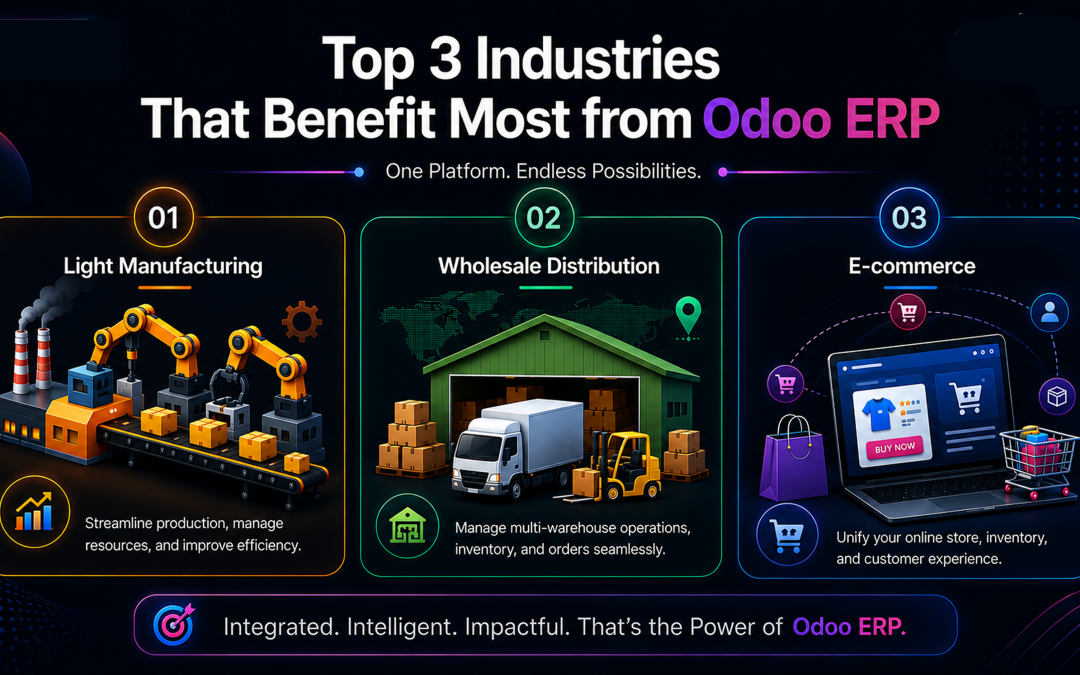
That is why businesses do not necessarily need the same ERP capabilities.
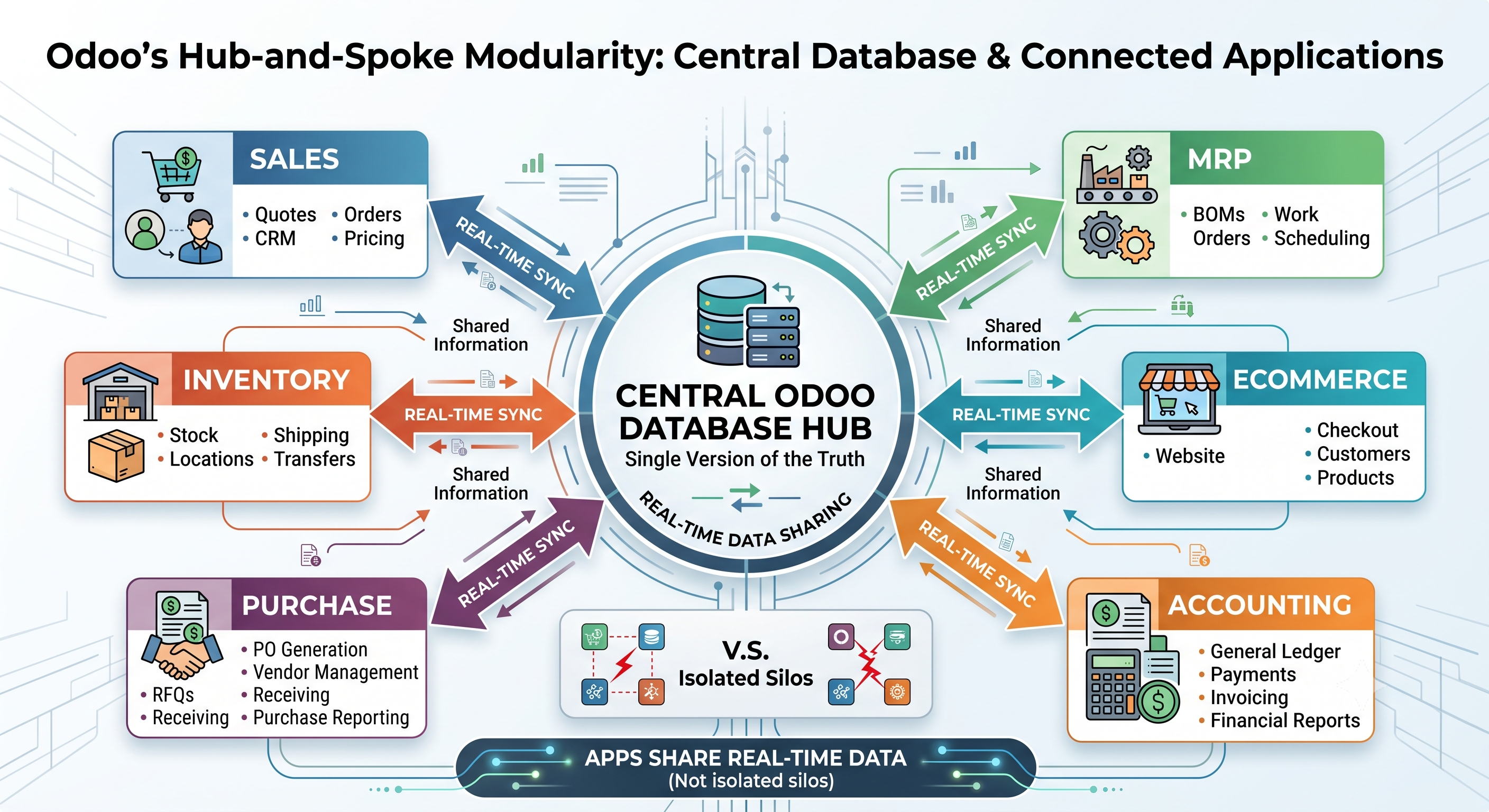
Odoo takes a modular approach, allowing businesses to build their ERP around the way they operate. Depending on their needs, these can include Sales, Purchase, Inventory, Manufacturing, Ecommerce, Accounting, CRM, and Reporting. More importantly, modular does not mean disconnected. With Odoo ERP, every application works together as part of a unified system. Selected Odoo applications can share information and support connected workflows within the same environment, creating a seamless flow of data across business functions.
This flexibility can be particularly valuable in light manufacturing, wholesale distribution, and ecommerce—three industries where operational handoffs can quickly become difficult to manage as the business grows.
1. Light Manufacturing: Connecting the Order to the Production Floor
For light manufacturers, the ability to confidently promise delivery dates, manage production costs, and respond quickly to customer requirements can directly impact profitability and customer satisfaction.
Imagine a customer requesting a product with a specific configuration. The sales team needs to answer a seemingly simple question: When can we deliver?
But that answer may depend on several things. Are the required components available? Does the product need to be manufactured? Are materials already committed to another order? Does purchasing need to replenish anything? Is production capacity available? And once the product is built, can it pass the required quality checks before fulfillment?
When these answers live across spreadsheets, separate applications, or different departments, a customer commitment can become difficult to make with confidence.
Light manufacturers often need to coordinate product variants, bills of materials (BOMs), components and raw materials, manufacturing and work orders, production planning, inventory, purchasing, quality, fulfillment, and production costs.
Odoo helps manufacturers manage these activities within a single operational framework. Sales and product configuration can capture the customer’s requirements, while Manufacturing manages BOMs, work orders, work centers, and production activities. Inventory and Purchase helps teams monitor component availability and replenishment needs. Depending on the operation, Quality, Maintenance, PLM, Accounting, and Reporting can extend that flow into quality control, equipment upkeep, product changes, and financial visibility.
The real advantage is visibility across the entire production lifecycle rather than any single application.
A customer order can lead to product configuration, which can lead to finished-product and component availability checks. Material shortages can lead to replenishment or purchasing. Required materials can then support manufacturing, followed by quality checks, fulfillment, invoicing, and reporting.
Apply It to Your Business:
When a customer requests a specific product configuration, can your team determine what must be purchased, produced, and scheduled before promising a delivery date?
2. Wholesale Distribution: Keeping Inventory and Fulfillment in Sync
For wholesale distributors, efficient inventory management and fulfillment coordination can reduce shipping delays, improve order accuracy, and protect customer relationships.
Now consider a wholesale distributor receiving a single customer order. Some products are sitting in Warehouse A, while another item is available in Warehouse B, and a third product is out of stock and needs replenishment. One more item may need to be shipped directly from the supplier.
To the customer, it is simply one order. Behind the scenes, however, there may be several fulfillment paths that sales, purchasing, warehouse, shipping, and accounting teams need to coordinate.
This is where fragmented processes can create operational bottlenecks. Inventory may appear available even though it is already committed. Stock may exist, but in the wrong warehouse. Purchasing may not have complete demand information. Customer-specific pricing or payment terms may need to be applied consistently. Returns, backorders, and dropship orders can add further complexity.
Odoo can support these workflows through Sales, Purchase, Inventory, Barcode, multi-warehouse management, replenishment, pricelists, payment terms, delivery workflows, returns, and Accounting.
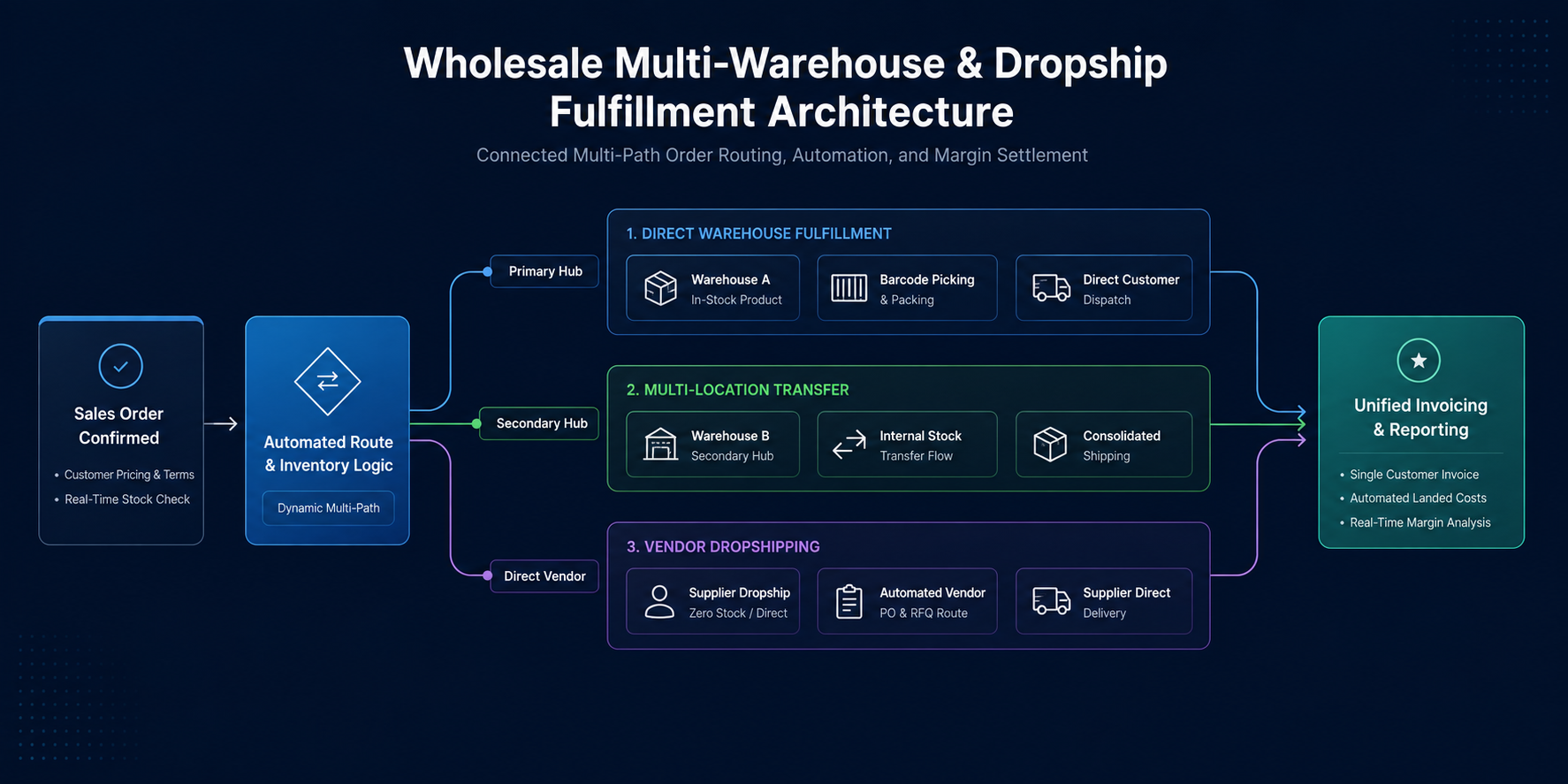
For example, once a sales order is confirmed, the system can work from customer-specific pricing and terms and provide visibility into available and committed inventory. Depending on the company’s configured routes and processes, order lines can be fulfilled through warehouse picking, internal transfers, replenishment, backorders, or vendor dropshipping.
That means dropshipping does not necessarily have to exist as a completely separate process. It can form part of the broader fulfillment strategy. The workflow can continue from inventory and warehouse decisions to picking, packing, shipping, invoicing, returns, and margin reporting.
For distributors handling mixed-fulfillment orders, centralized visibility can make the difference between manually coordinating several systems and having a clearer operational process.
Apply It to Your Business:
When one customer order includes stocked, backordered, and drop-shipped products, can your team manage the different fulfillment paths without manually coordinating multiple systems?
3. Ecommerce: Looking Beyond the Storefront
For ecommerce businesses, growth depends on delivering a seamless customer experience while maintaining accurate inventory, fulfillment, and financial processes behind the scenes.
An ecommerce website can make a business look deceptively simple. A customer finds a product, adds it to the cart, pays, and receives an order confirmation.
But the business has a much longer process happening behind that checkout button. The company must confirm inventory availability, process payment, allocate the order correctly, pick and pack the product, arrange shipping, communicate delivery status, and eventually account for the transaction. If the customer returns the product, inventory, refunds, and accounting may all need to be updated as well.
As order volumes and product catalogs grow, managing these activities across multiple platforms can become increasingly difficult. Online inventory may not match physical availability. Product and pricing information can differ between platforms. Payment and fulfillment records can be difficult to reconcile. Returns may require updates in multiple systems.
Odoo can connect the customer-facing and operational sides of ecommerce through Website and Ecommerce, Sales, Inventory, Purchase, Payments, shipping integrations, product catalog management, pricelists, customer accounts, returns, refunds, and Accounting.
Consider a typical online order. The customer checks out using the information presented on the ecommerce site. The order can flow into Sales, while inventory allocation determines the next fulfillment step. Depending on availability and configured routes, the product may be fulfilled from a warehouse, replenished, or dropshipped. Shipping information can then continue through the fulfillment process, while payment and financial activity can flow into accounting.
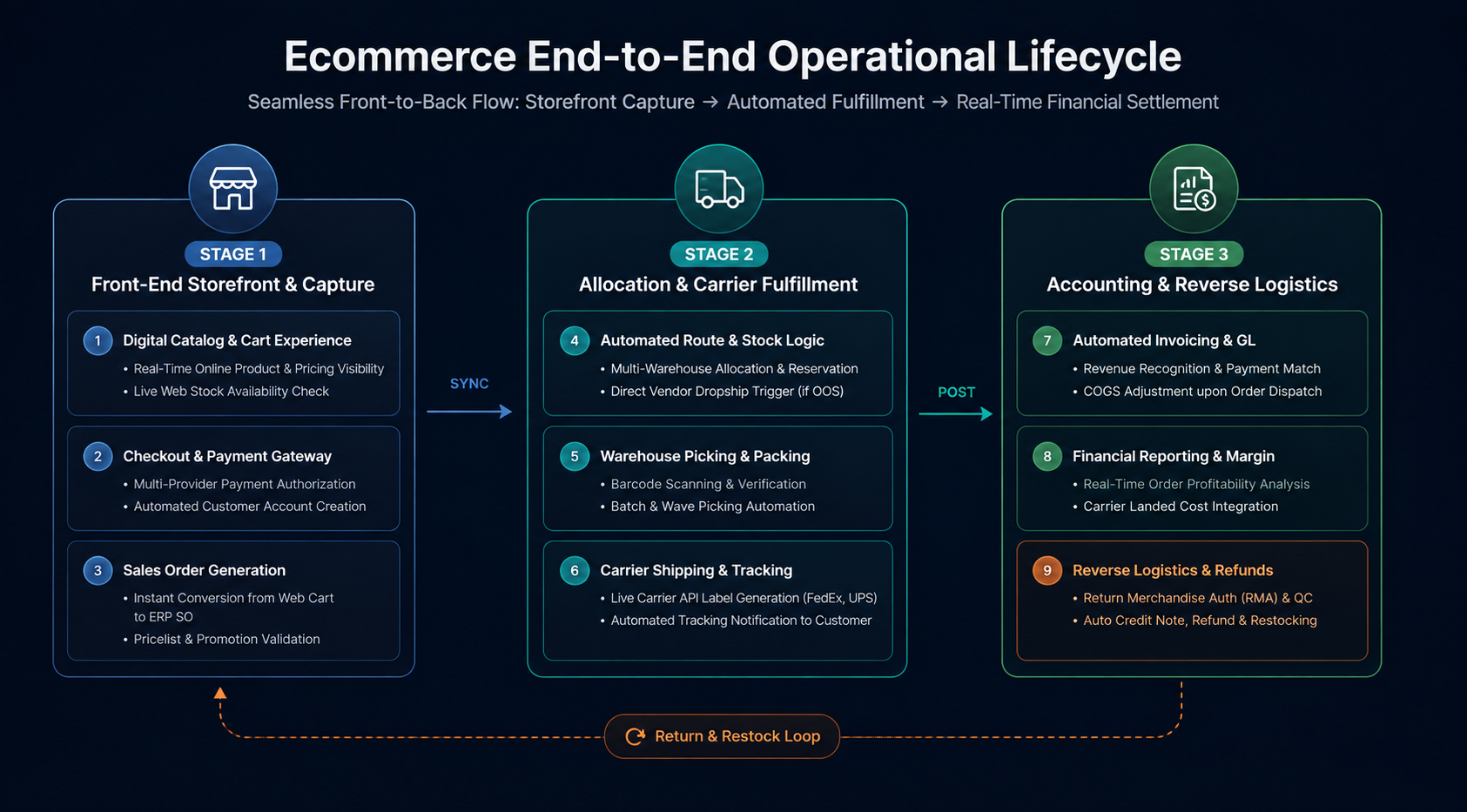
If the customer later returns the item, the process can extend into reverse logistics, restocking, refunds, and financial adjustments.
The value lies in aligning storefront activity with the inventory, fulfillment, and financial processes that support every order.
Apply It to Your Business:
When an online order includes products with different availability or fulfillment methods, can your systems route the order correctly while keeping customer, inventory, payment, and accounting records aligned?
What Do These Three Industries Have in Common?
A manufacturer, distributor, and ecommerce company may operate very differently. Yet their challenges often have something in common: information has to move across multiple business functions for one transaction to reach completion.
Before considering an ERP transition, it is worth looking closely at those handoffs. Ask yourself:
- Where are employees re-entering, transferring, or reconciling information between systems?
- Which teams are working from different versions of product, inventory, order, or financial data?
- Can leadership follow a transaction from initial demand through fulfillment and reporting?
- Which processes become harder to manage as products, order volume, locations, or sales channels grow?
- Could Odoo replace or connect some of the separate tools currently supporting these workflows?
These questions can reveal whether the problem is simply a missing application—or whether the bigger issue is the lack of connection between the applications already being used.
Is Odoo the Right Fit for Your Business?
Odoo’s modular structure allows businesses to select applications around their operational requirements rather than adopting the same combination of capabilities as every other company.
.The appropriate combination depends on the company’s processes, priorities, and operating model. And while Odoo provides the applications and connected framework, those workflows still require appropriate configuration to reflect how the business actually operates.
The better question, then, may not be “Which ERP has the most features?”
It may be: “Can our ERP support the way our business actually works?”
Could Odoo’s modular platform support the way your business operates?
Explore how Odoo could fit your industry and business processes. Book your free 30-minute consultation with Confianz to discuss your requirements, explore your options, and identify where Odoo can support your operations.