

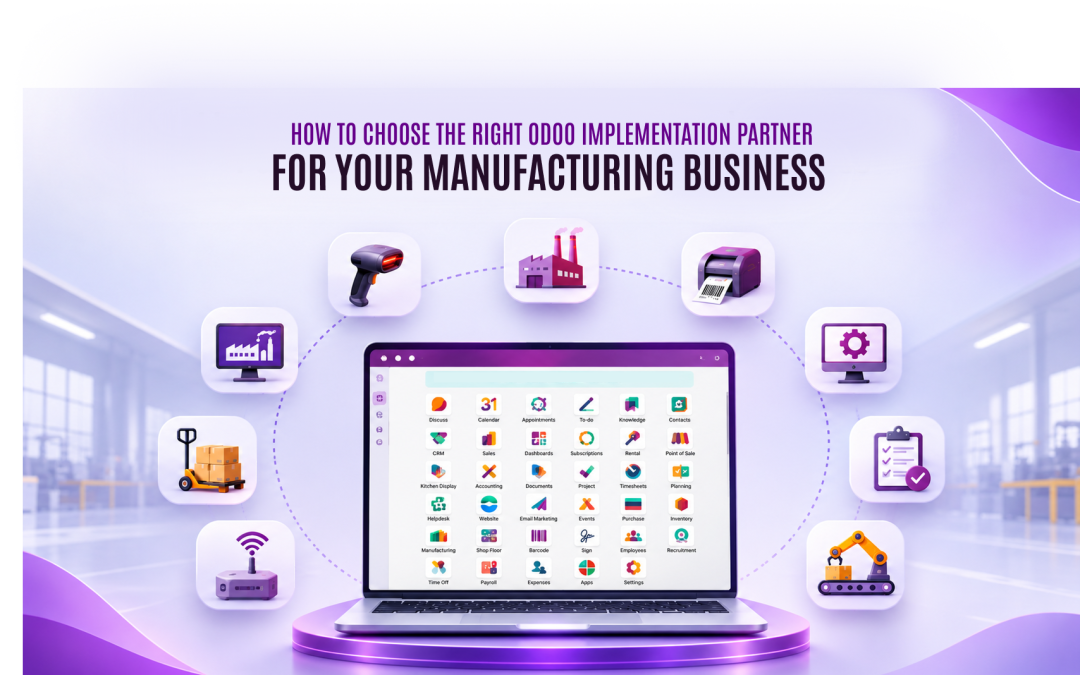
The Right ERP Needs the Right Implementation Partner
ERP implementations rarely fail because of the platform a manufacturer chooses. More often, projects struggle because the implementation partner doesn’t fully understand how production actually works on the shop floor. Choosing the right Odoo implementation partner is therefore not just a technology decision. It’s an operational decision that can directly impact production efficiency, inventory accuracy, planning reliability, quality control, and long-term scalability.
For manufacturing companies evaluating Odoo, the right partner should bring industry experience alongside ERP expertise. Odoo provides integrated capabilities for manufacturing, inventory, quality, maintenance, and shop-floor management, but successful implementation depends on configuring these capabilities around actual business requirements.
Choosing the right Odoo implementation partner for manufacturing requires evaluating industry experience, technical capabilities, customization practices, implementation methodology, and long-term support.
A Tale of Two Manufacturing Companies
Consider two mid-sized manufacturers evaluating Odoo.
Both manufacture complex products. Both manage multiple production stages. Both struggle with planning, inventory visibility, and disconnected systems on the shop floor.
The first company chooses a partner primarily based on price.
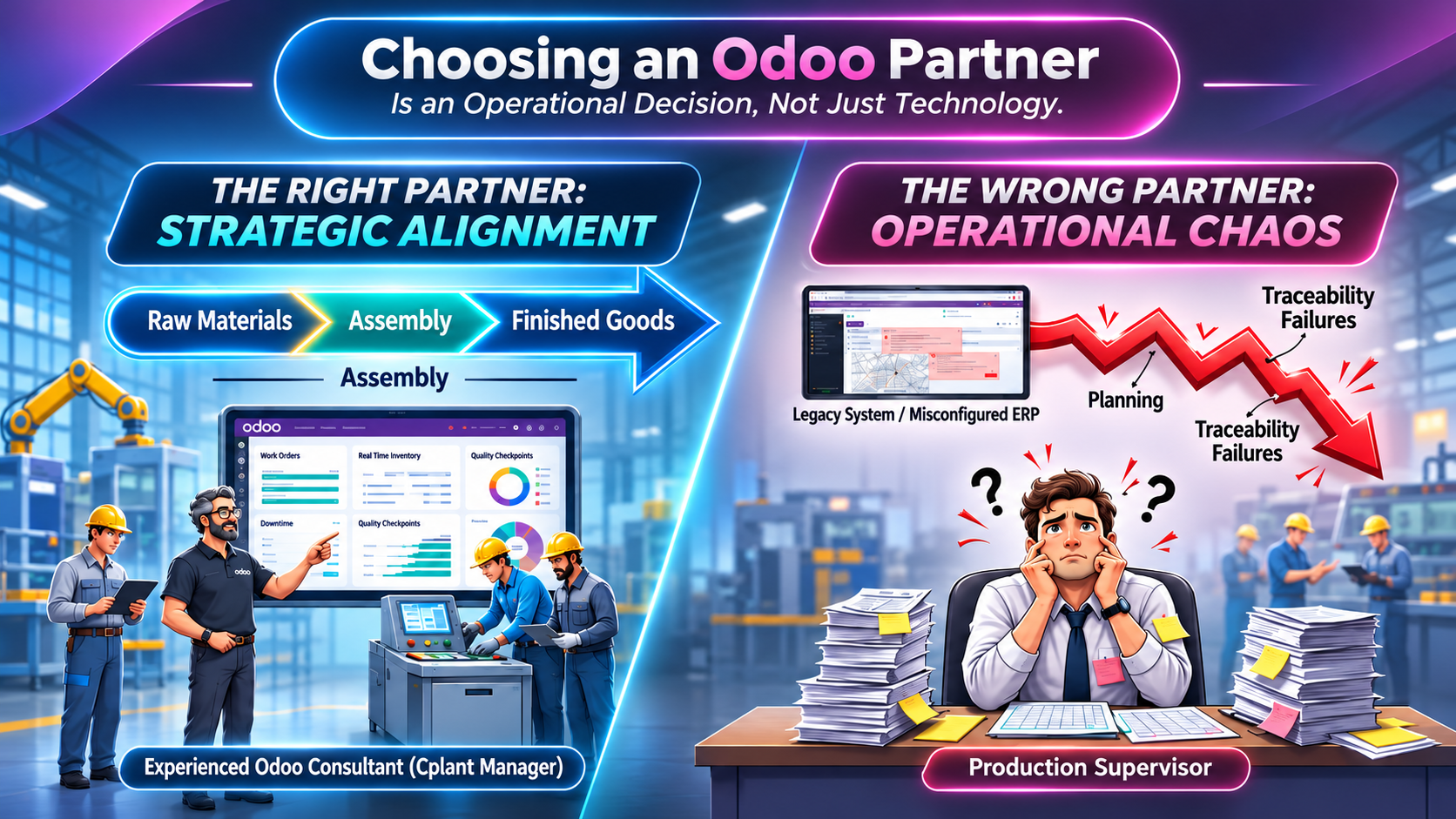
During implementation, the partner focuses on configuring software modules quickly. They spend little time understanding production constraints, machine dependencies, traceability requirements, or existing shop-floor systems. Six months later, production supervisors rely on spreadsheets again because the ERP workflows don’t match reality.
The second company follows a different path.
Its implementation partner spends weeks understanding production processes, BOM structures, quality checkpoints, inventory movements, and integration requirements before proposing a solution. Potential gaps are identified early. Some requirements are addressed through standard Odoo functionality, others through configuration, and a few through carefully justified custom development. As a result, the new ERP workflows align more closely with day-to-day production operations, reducing the need for manual workarounds.
The software is the same. The outcome is not.
This is why selecting the right implementation partner matters as much as selecting the ERP itself.
Why Manufacturing ERP Projects Require Specialized Expertise
Manufacturing ERP implementation requires an understanding of how different production environments operate. For example, a make-to-order manufacturer has different planning requirements from a make-to-stock business. Similarly, manufacturers using multi-stage production, subcontracting, or industry-specific traceability may need additional configuration and integrations.
An experienced implementation partner can identify these differences early, determine where standard Odoo functionality is sufficient, and recognize when customization or third-party integration is necessary. This helps avoid unnecessary development, operational gaps, and costly changes after go-live.
Here are the key factors manufacturers should consider before making that decision.
1. Evaluate Their Manufacturing Experience, Not Just Their Odoo Experience
Many partners have strong ERP knowledge. Far fewer have meaningful manufacturing expertise. When evaluating potential partners, investigate whether they understand:
| Manufacturing Area | What the Partner Should Understand |
|---|---|
| Bills of Materials (BOMs) | Multi-level BOM structures, revisions, variants |
| Production Planning | Capacity constraints, scheduling, lead times |
| Work Orders & Routing | Multi-stage operations and dependencies |
| Inventory Management | Raw materials, WIP, finished goods tracking |
| Quality Control | Inspection points, non-conformance workflows |
| Traceability | Lot and serial number tracking requirements |
| Manufacturing Costing | Labor, machine, material, and overhead costs |
| Maintenance | Production equipment maintenance planning |
The focus should not be “Have you implemented Odoo?”
The better question is:
“Have you implemented Odoo in manufacturing operations that resemble ours?”
2. Assess Their Shop-Floor Integration Capabilities
Modern manufacturers often operate with a technology landscape that extends beyond the ERP. Examples include:
- Barcode scanners
- Label printers
- MES systems
- Quality systems
- Warehouse technologies
- Production machines
- IoT devices
- Legacy manufacturing applications
Odoo can connect manufacturing operations with the technologies mentioned above through its built-in capabilities, APIs, and custom integrations, allowing workers can process barcode-based operations, manage work orders, track production activities, monitor quality, and coordinate maintenance within connected workflows.
Successful integration depends on system compatibility, available interfaces, and implementation expertise.

Ask Potential Partners:
- How do you evaluate shop-floor integration requirements?
- Have you integrated Odoo with manufacturing equipment or third-party production software?
- How do you handle real-time production data capture?
- What approach do you use when replacing existing manufacturing systems is not feasible?
A partner that immediately proposes custom development without investigating existing options may be creating unnecessary complexity.
3. Understand Their Approach to Discovery
One of the clearest signs of a quality implementation partner appears before the project begins. Strong partners spend substantial time understanding your business.
Weak partners rush toward quoting and implementation.
A Capable Discovery Process Should Include:
| Discovery Area | Questions the Partner Should Ask |
|---|---|
| Production Flow | How are products manufactured today? |
| Bottlenecks | Where do delays occur? |
| Data Quality | What data currently exists and where? |
| Inventory Processes | How are materials tracked? |
| Quality Requirements | What compliance standards apply? |
| Reporting Needs | What decisions require operational visibility? |
| Integrations | What systems must remain connected? |
If a partner can deliver a proposal after only a brief conversation, they likely haven’t learned enough about your operation.
4. Evaluate Their View on Customization
This is where many manufacturing ERP projects go wrong. Manufacturers often have unique workflows. That doesn’t automatically mean everything should be customized. A trustworthy implementation partner will evaluate requirements using the following hierarchy:
| Priority | Solution Approach |
|---|---|
| 1 | Standard Odoo functionality |
| 2 | Configuration |
| 3 | Existing integrations |
| 4 | Third-party applications |
| 5 | Custom development |
Warning Sign
If every requirement immediately receives the answer: “We’ll build a custom module for that.”
You should proceed carefully.
5. Look Beyond Partner Tier Rankings
Many buyers focus heavily on whether a company is a Ready, Silver, or Gold Odoo Partner. While these designations are useful, they shouldn’t be your primary selection criterion.
According to Odoo, partner levels are largely determined by factors including enterprise users sold, certified resources, and customer retention rates. Odoo explicitly advises businesses to evaluate factors beyond partner rank when selecting an implementation partner.
While Odoo partner rankings provide useful insight into a company’s credentials, they should be considered alongside its manufacturing experience, implementation approach, technical capabilities, and ability to support your business over the long term.
6. Investigate Their Data Migration Strategy
Manufacturing ERP projects depend on clean data. Typical migration requirements include:
- Products
- BOMs
- Routings
- Suppliers
- Customers
- Inventory balances
- Serial numbers
- Historical transactions
A capable partner should discuss:
- Data cleansing
- Validation procedures
- Test migrations
- Cutover planning
- Rollback procedures
If data migration is treated as an afterthought, implementation risk increases substantially.
7. Examine Their Testing Methodology
Manufacturing operations cannot afford surprises after go-live. Your implementation partner should provide structured testing plans covering:
Functional Testing: Functional testing verifies whether core processes, such as production orders, inventory movements, purchasing, and quality checks, work as expected.
Integration Testing: Integration testing ensures Odoo communicates reliably with barcode systems, external software, and shop-floor equipment, allowing data to flow correctly across connected systems.
Scenario Testing: Scenario testing evaluates how the system handles real-world challenges, including material shortages, rework, production delays, and quality failures.
The more complex your manufacturing operation, the more important end-to-end testing becomes.
8. Evaluate Their Training Approach
Even the best ERP system may fail if users don’t adopt it. Your implementation partner should offer role-based training for:
| User Group | Training Focus |
|---|---|
| Production Supervisors | Planning, scheduling, monitoring |
| Operators | Work orders and shop-floor execution |
| Inventory Teams | Material movement and tracking |
| Quality Teams | Inspections and compliance |
| Management | Reporting and analytics |
9. Assess Long-Term Support Capabilities
The go-live date is not the end of the ERP journey. Manufacturing operations evolve through:
- New product lines
- New facilities
- Process improvements
- Automation initiatives
- Regulatory requirements
When evaluating partners, ask:
- What support options are available?
- How quickly are issues addressed?
- How do you handle system upgrades?
- Can you support future expansions?
The best implementation partners think beyond the initial project.
Manufacturing Partner Evaluation Checklist
Before selecting an Odoo implementation partner, ensure you can answer “yes” to most of the following:
| Evaluation Area | What to Check | Response (Yes/No) |
|---|---|---|
| Manufacturing Expertise | Has experience implementing Odoo for manufacturing businesses | |
| Understands production planning, scheduling, and work orders | ||
| Can implement quality checks and product traceability workflows | ||
| Technical Capability | Can integrate shop-floor technologies, barcode scanners, machines, and IoT devices | |
| Has a structured data migration and validation process | ||
| Can integrate Odoo with MES, warehouse systems, and other business applications | ||
| Project Delivery | Follows a structured discovery and requirement analysis process | |
| Provides a clear implementation methodology, timeline, and milestones | ||
| Conducts functional, integration, and scenario-based testing | ||
| Provides role-based training for different user groups | ||
| Long-Term Fit | Offers ongoing support and issue resolution | |
| Has a clear Odoo upgrade and customization management strategy | ||
| Can support future business growth and changing manufacturing requirements |
Red Flags to Watch For
- Minimal discovery before submitting a proposal
- Heavy customization recommended immediately
- No manufacturing-specific references
- Vague answers regarding integrations
- Limited testing methodology
- No training strategy
Support ends shortly after go-live. Any one of these may not be disqualifying. Several together should raise concerns.
Conclusion
Choosing an Odoo implementation partner for manufacturing is ultimately about reducing risk. The right partner will invest time in understanding your production environment, ask difficult operational questions, challenge unnecessary customization requests, and develop a solution aligned with real manufacturing workflows.
Manufacturers that take a disciplined approach to partner evaluation are far more likely to achieve smoother implementations, stronger adoption, and long-term operational value.
Choosing an Odoo Implementation Partner?
With over 18 years of software development and ERP customization experience, Confianz delivers tailored Odoo solutions for manufacturers, including Element Designs and VS America. From production planning and quality management to shop-floor integration and ERP modernization, Confianz helps manufacturers optimize operations through customized implementations and integrations.
Talk to Confianz About Your Manufacturing Requirements.