

A Step-by-Step Guide to Successful Digital Transformation
As businesses grow, managing operations through spreadsheets, disconnected software, and manual processes becomes inefficient, leading to poor visibility, errors, and operational delays.
An ERP system solves this by bringing all key business functions onto a single platform, improving efficiency, providing real-time insights, and supporting business growth. However, ERP Implementation is more than a technology upgrade—it’s a business transformation that requires careful planning, strong leadership, and a well-defined implementation strategy.
At Confianz, headquartered in Charlotte, North Carolina, we help growing businesses worldwide successfully implement ERP solutions such as Odoo ERP, ensuring projects are delivered efficiently, affordably, and with measurable business outcomes.
Why ERP Implementation Matters More Than Ever in 2026
Modern ERP platforms integrate core business functions such as finance, accounting, inventory, sales, CRM, procurement, supply chain, manufacturing, and HR into a single system. This eliminates data silos, provides a single source of truth across departments, and improves operational efficiency. Despite these benefits, ERP implementation can be challenging, and many projects struggle due to:
- Lack of clear objectives
- Poor requirement gathering
- Inadequate stakeholder involvement
- Data migration issues
- Weak change management strategies
- Insufficient user training
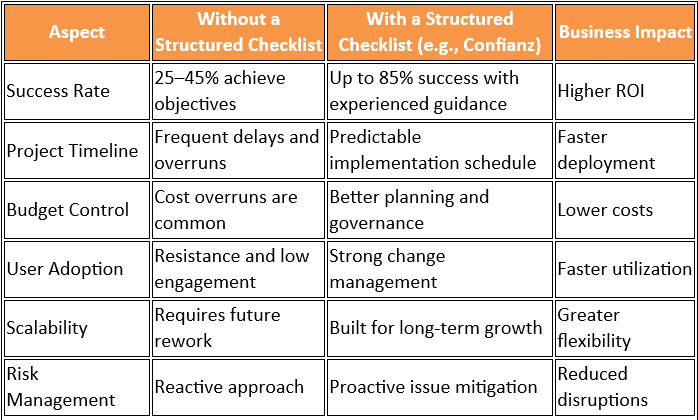
A structured implementation checklist significantly improves the likelihood of success by keeping teams aligned, reducing risks, and ensuring every critical step is addressed before go-live.
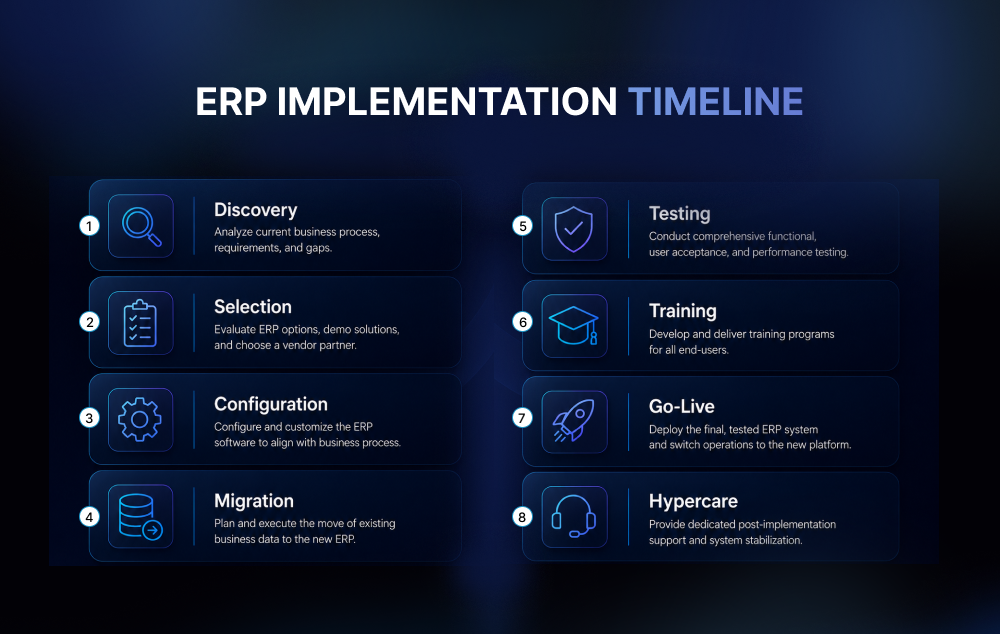
The 8 Essential Phases of a Successful ERP Implementation
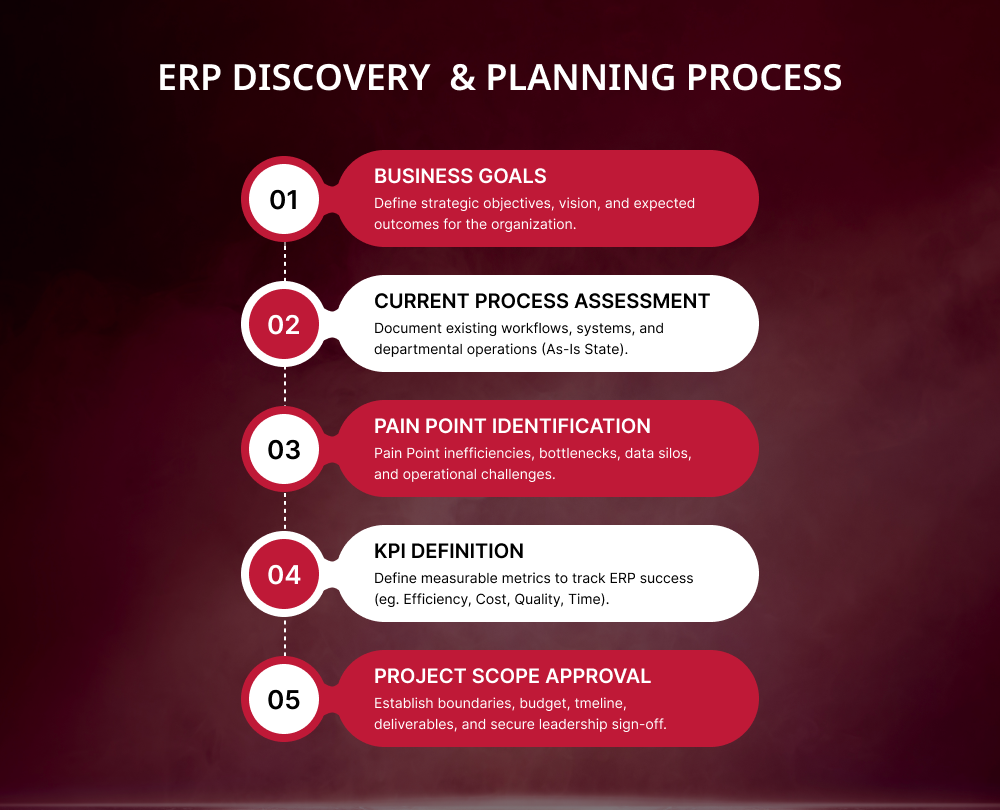
1. Discovery and Strategic Planning
Every successful ERP journey begins with understanding business needs. Key activities include:
- Evaluating current processes
- Identifying operational bottlenecks
- Defining business goals
- Establishing project scope
- Setting measurable KPIs
Example KPIs:
- Reduce order-to-cash cycle by 30%
- Improve inventory accuracy to 98%
- Cut manual data entry by 50%
2. ERP Vendor and Solution Selection
Choosing the right ERP platform is critical for long-term success. Evaluation criteria should include:
- Scalability
- Industry fit
- Customization capabilities
- Integration support
- Total cost of ownership
- Vendor expertise
For many growing businesses, Odoo ERP offers an ideal balance of flexibility, functionality, and affordability.
3. Assemble the Right Project Team
ERP projects are business initiatives—not IT projects alone. A strong implementation team should include:
- Executive sponsor
- Project manager
- Department heads
- Process owners
- ERP consultants
- Technical specialists
When leadership actively participates, user adoption and project success rates increase significantly.
4. Process Design and System Configuration
Implementing old inefficiencies into a new system defeats the purpose of ERP. Instead:
- Redesign workflows
- Eliminate bottlenecks
- Standardize processes
- Configure modules based on future-state operations
This phase determines how effectively the ERP will support long-term growth.
5. Data Migration and Validation
Data quality can make or break an ERP implementation.
Recommended steps:
- Clean legacy data
- Remove duplicates
- Standardize formats
- Map data accurately
- Conduct validation testing
Areas requiring particular attention: Customer records, vendor databases, financial data, inventory information, and product catalogs should be carefully cleaned, standardized, accurately mapped, and thoroughly validated to ensure reliable data and build trust in the new ERP system from day one.
Reliable data ensures trust in the new system from day one.
6. Testing and User Training
Before launch, organizations should thoroughly test every workflow.
Testing should include:
- Unit Testing
- Integration Testing
- User Acceptance Testing (UAT)
- Performance Testing
At the same time, employees should receive role-based training to ensure confidence and adoption.
Training should focus on:
- Daily operational tasks
- Reporting tools
- Approval workflows
- Exception handling
Well-trained users accelerate ROI and reduce post-launch support requirements.
7. Go-Live and Hypercare Support
Go-live is not the finish line—it is the beginning of operational adoption.
Successful organizations typically establish:
- Go-live readiness checklists
- Dedicated support teams
- Issue escalation procedures
- Daily performance monitoring
A structured “hypercare” period helps identify and resolve issues quickly, minimizing disruption.
8. Optimization and Continuous Improvement
ERP implementation should evolve alongside your business. Post-launch activities include:
- KPI monitoring
- User feedback collection
- Process refinement
- Additional module deployment
- Automation initiatives
- AI and analytics integration
Organizations that continuously optimize their ERP environment achieve greater long-term value and scalability.
ERP Implementation: With vs. Without a Structured Checklist
Real-World Success Story: From Operational Chaos to Complete Visibility
A rapidly growing manufacturing company approached Confianz after struggling with disconnected systems, inventory inaccuracies, and shipment delays. Our implementation team began with a detailed discovery phase to identify operational bottlenecks and process inefficiencies. We then deployed and configured Odoo modules for:
- Inventory Management
- Manufacturing
- Accounting
- Procurement
After completing data migration, validation, and employee training, the company successfully transitioned to its new ERP environment.
Results Achieved:
- Significant reduction in inventory discrepancies
- Improved order fulfillment accuracy
- Real-time operational visibility
- Better production planning
- Faster management decision-making
Their experience reflects what many growing businesses discover: a well-executed ERP implementation transforms operations from reactive to strategic.
ERP Trends Shaping the Future
ERP technology continues to evolve rapidly.
Key trends expected to dominate the coming years include:
1. Cloud-First ERP Deployments
Organizations increasingly prefer cloud ERP solutions for their flexibility, accessibility, and lower infrastructure costs.
2. AI-Powered Automation
Artificial intelligence is transforming ERP systems through:
- Predictive analytics
- Demand forecasting
- Automated workflows
- Intelligent reporting
3. Real-Time Decision Intelligence
Modern ERP platforms enable executives to access up-to-the-minute business insights through centralized dashboards and analytics.
4. Industry-Specific ERP Solutions
Businesses increasingly seek ERP solutions tailored to their unique operational requirements, reducing implementation complexity and accelerating ROI.
By 2030, AI-enhanced cloud ERP systems are expected to become the standard operating platform for growing businesses. Companies that invest today will be better positioned to compete through improved efficiency, agility, and data-driven decision-making.
Frequently Asked Questions
What is the best ERP implementation checklist for growing businesses?
A successful ERP implementation should include discovery, planning, vendor selection, configuration, data migration, testing, training, go-live support, and continuous optimization.
Why do ERP implementations fail?
Common causes include poor planning, unclear requirements, weak stakeholder engagement, inadequate training, and ineffective change management.
Why is Odoo ERP popular among growing businesses?
Odoo offers a scalable, modular, and cost-effective platform that allows organizations to start small and expand functionality as they grow.
Why partner with Confianz?
Confianz combines technical expertise, proven methodologies, and business-first consulting to deliver ERP projects that achieve measurable results and long-term value.
Ready to Scale Smarter?
Growth should not be limited by disconnected systems and manual processes.
Whether you’re planning a complete ERP transformation or implementing specific business modules, Confianz can help you streamline operations, reduce inefficiencies, and build a foundation for sustainable growth. Start your ERP journey today with a trusted implementation partner that delivers results.