
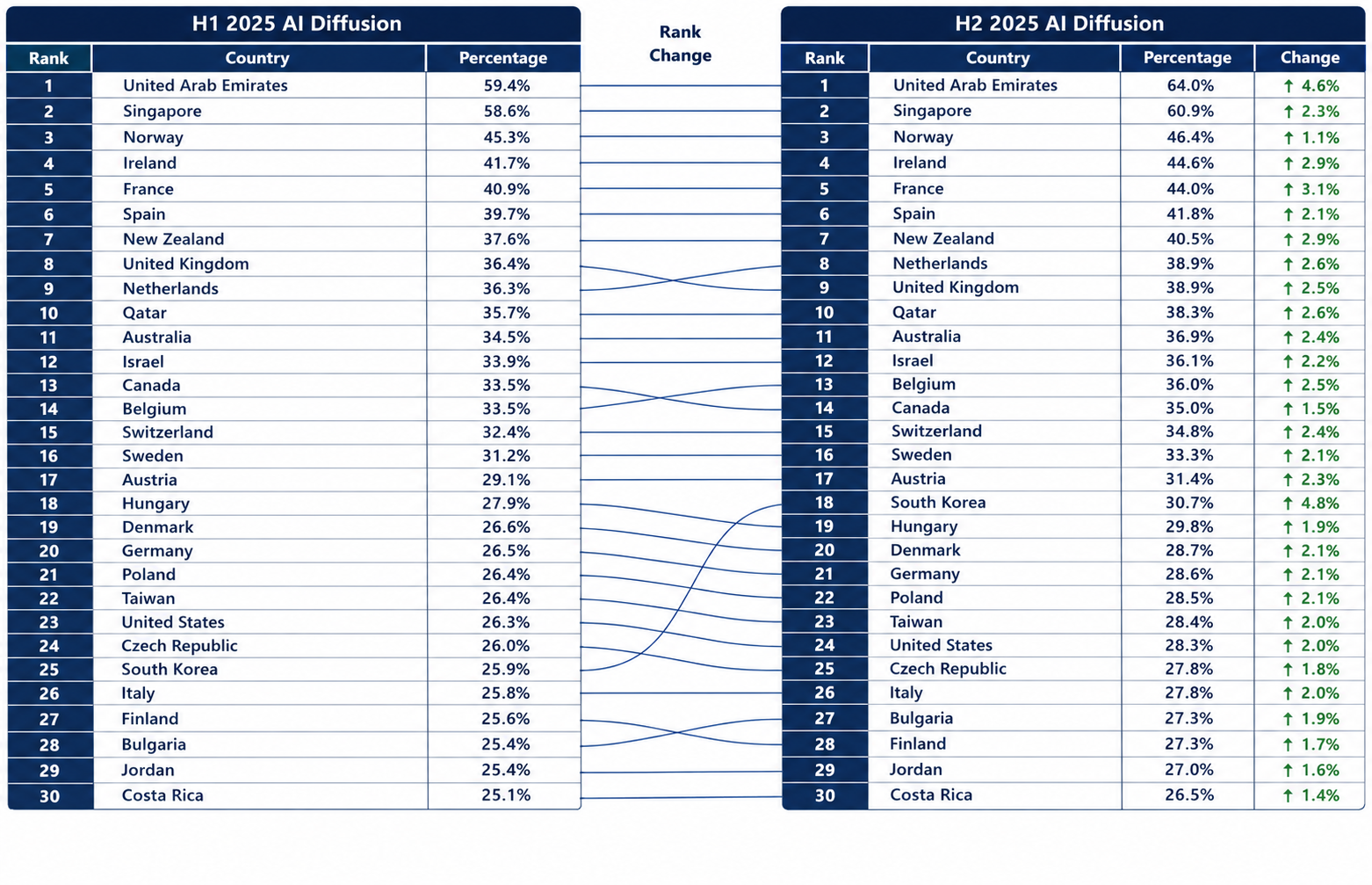
For American manufacturers, that gap is more than a statistic. It represents a competitive opportunity.
The issue is not that American companies lack access to AI. It is that turning AI capability into operational results requires something many organizations are still building: connected systems, standardized data, practical workflows, skilled employees, and trust in automated decisions.
In other words, “the AI advantage is not being lost at the model level. It is being lost between innovation and implementation”.
Closing that gap starts with understanding what is holding manufacturers back—and building the foundation that allows AI to move from experimentation to action.
Why Innovation Has Not Automatically Become Adoption
Being a leader in AI innovation does not guarantee that AI will be embedded throughout everyday operations.
A manufacturer may have access to sophisticated AI models while still relying on spreadsheets for inventory planning, disconnected applications for procurement and production, or manually maintained records across departments.
That creates a fundamental problem. AI can only be as useful as the information and workflows surrounding it.
Deloitte’s 2025 Smart Manufacturing and Operations Survey illustrates both the opportunity and the challenge. Ninety-two percent of surveyed manufacturers believe smart manufacturing will be a main driver of competitiveness over the next three years. Yet manufacturers are still building the technology and data foundations needed to scale AI. Only 29% reported using AI/ML at the facility or network level, while 24% had deployed generative AI at that scale.
The U.S. therefore does not need to catch up in AI invention. It needs to get better at operationalizing AI.
The Three Barriers: Trust, Technology and Talent
Three barriers sit at the center of that challenge.
The Trust Gap
Imagine an AI system telling a purchasing manager that a critical component should be reordered.
The recommendation may be technically accurate. But the manager still needs to know: Where did the data come from? Is the inventory number correct? Does the recommendation account for current orders? Is the supplier approved? What happens if the AI is wrong?
In manufacturing, trust cannot be treated as an afterthought. Employees need visibility into how AI-supported decisions are made, while organizations need clear approval rules, governance, auditability, and human oversight.
Trust also extends to how sensitive data is handled. Growing security concerns around public AI models are driving interest in Sovereign AI and proprietary models to protect sensitive operational data and trade secrets while enabling automation.
The objective is not to remove people from the process. It is to give people better information and gradually allow AI to handle decisions where confidence and controls have been established.
Legacy Technology Debt
Many American manufacturers have technology environments built over decades. Production applications, machine data, spreadsheets, ecommerce platforms, legacy databases, and specialized business tools may each serve a purpose, but the information they contain often remains fragmented across the organization.
AI exposes this fragmentation. An AI model may be capable of identifying an inventory risk, but identifying the risk is only the first step. To determine what should happen next, it needs access to related information such as production requirements, current and planned purchases, supplier lead times, and customer orders. When this information is spread across disconnected systems, the AI may provide an insight but turning that insight into a reliable business action still requires manual intervention.
This does not mean every manufacturer needs a complete technology replacement. The smarter approach is to identify the processes where disconnected systems create the greatest business impact, standardize the underlying information, and progressively connect with the technology that supports those processes.
Talent Scarcity
Manufacturing also needs a different kind of AI workforce. The challenge is not simply finding AI engineers. Manufacturers need people who understand both the technology and the operation—people who can recognize whether an AI recommendation makes sense on the production floor and troubleshoot the systems that support it.
Deloitte found that 48% of surveyed manufacturers face moderate to significant challenges in filling production and operations management roles, while 35% identified adapting workers to the “Factory of the Future” as a top concern.
That makes the workforce upskilling an important part of AI adoption, not a separate HR initiative. Employees need the knowledge and confidence to work alongside AI, understand its recommendations, and use these tools in their day-to-day work. Training frontline teams in AI and preparing technicians to support AI-enabled systems can help manufacturers turn new technology into practical results.
Data Standardization Is the Starting Line
Once manufacturers address the barriers to AI adoption, the next step is to create a structured data foundation that AI can work with. Data standardization and digitization are the first practical considerations for successful AI and agentic AI adoption.
For a manufacturing operation, this means establishing consistent data structures, clearly defined processes, standardized integration patterns, documented best practices, and reliable ways for information to move between business systems.
It also means defining where critical information is maintained and how different systems should use it. When these standards are in place, manufacturers can create a common operational view across functions such as inventory, procurement, production, sales, and finance.
This is where a modern, connected ERP can help address both the technology and trust gaps. By bringing core business processes and data into a connected environment, an ERP can reduce reliance on disconnected legacy tools while giving AI access to consistent operational information. When AI capabilities are integrated with these workflows, employees can see the data behind recommendations, understand how decisions are made, and move from AI-generated insights to controlled business actions. In this way, the ERP becomes more than a system of record—it becomes the operational foundation and Action Layer for AI.
As Vinod, VP of Enterprise Solutions at Confianz, explains:
“We focus on aligning their ERP to Processes, Data, and Decision-makers across the organization. AI then builds on this foundation to drive smarter, faster, and more predictive manufacturing.”
The progression is straightforward:
Processes → Data → Connectivity → AI → Action
Manufacturers can build this foundation through our specialised AI Consulting for Manufacturing services that focus on aligning ERP, data, and decision-makers before layering AI.
Where ERP Fits in the Agentic AI Stack
The next evolution of AI is moving beyond systems that simply answer questions.
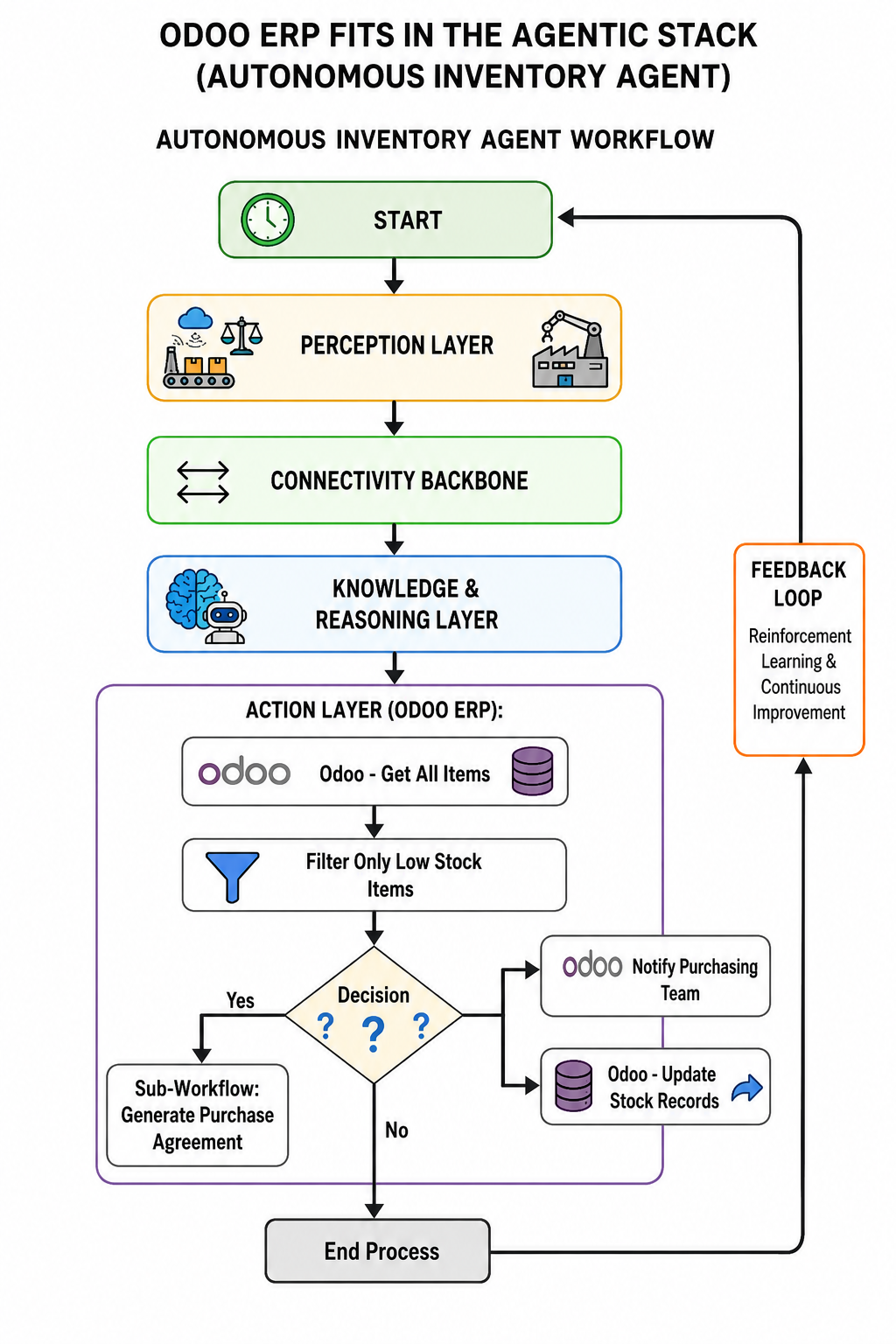
Traditional AI might tell a manufacturer that inventory is running low. Agentic AI can potentially take the next steps: evaluate demand, review supplier information, consider lead times, recommend a reorder, and—within predefined rules—initiate a workflow.
The five layers of the Agentic Stack required for a modern facility are:
- Perception – IoT, IIoT, sensors, machines, and other data-capture points.
- Connectivity – Networks, APIs, and systems that move information.
- Knowledge and Reasoning – Data warehouses and AI models that provide context.
- Action – ERP and business applications that execute workflows.
- Governance and Safety – Rules, SOPs, permissions, and controls.
ERP therefore becomes the Action Layer. AI can determine what should happen; the ERP and connected business applications provide the controlled environment where that decision can become an operational outcome. That could mean predictive reordering, low-stock alerts, procurement workflows, maintenance actions, or other repetitive processes.
The goal is to move beyond AI that simply provides insights and toward AI that is connected to the systems and workflows needed to turn those insights into action.
A Real-World Example of the Foundation
The same principle can be seen outside manufacturing in a high-volume omnichannel retail environment.
A retailer used Odoo to bring inventory, procurement, sales, accounting, and order-related processes into a more standardized operational environment across 45 physical retail locations and an ecommerce channel, handling more than 1,000 orders per day through POS and over 60 online orders per day. This connected foundation provided greater visibility across business functions and created a stronger foundation for automation and predictive workflows.
The full case study provides the deeper story, but the strategic takeaway is relevant to any organization preparing for AI: establish the connected operational foundation first.
The Path Forward: Pilot Without a Rip-and-Replace
Closing the AI implementation gap does not require manufacturers to transform everything at once. The practical path is progressive.
Start with a Business Problem: Identify where AI can address a measurable operational issue—such as downtime, inventory shortages, repetitive data work, quality inspection, or procurement.
Assess Data Readiness: Map the systems and information involved. Identify duplicate records, inconsistent data, undocumented processes, and integration gaps.
Choose a Focused Pilot: Start with one asset, one workflow, one production area, or one business process.We recommends beginning with quick wins that align with existing infrastructure and can demonstrate measurable ROI before expanding.
Capture Tribal Knowledge: Leverage AI-based documentation and operational tools to capture and preserve veteran floor expertise before it leaves the organization. AI should serve not only as an automation engine, but as a knowledge-preservation system for legacy shop-floor processes.
Build Cross-Functional Ownership: Bring together IT, operations, finance, and frontline employees. The people who work with a process every day can often identify opportunities and risks that technology teams alone may miss.
Establish Guardrails: Define what AI can recommend, what it can execute, what requires human approval, and how decisions will be monitored.
Measure and Scale: Track tangible outcomes such as production output, downtime, inventory performance, processing time, quality, or cost.
Then scale what works. This approach allows to modernize incrementally rather than attempting a disruptive technology overhaul.
Reclaiming the American AI Advantage
The U.S. does not lack AI innovation. It has an implementation gap.
American manufacturers already have the technology, investment, research ecosystem, and industrial expertise to make AI a competitive advantage. What will determine the winners is how effectively they connect those capabilities to everyday operations. The foundation is not complicated, but it must be deliberate:
- Standardized data
- Connected systems
- Modern ERP infrastructure
- Skilled people,
- Clear governance
- Focused implementation.
The opportunity is already significant. Deloitte reports that 40% of surveyed manufacturers plan to invest in data analytics over the next two years, while 29% plan to invest in AI.
The next step is ensuring those investments work together. AI readiness is therefore not primarily an algorithm problem. It is a data, infrastructure, and execution problem.
Manufacturers that solve that problem can move beyond AI experiments and begin building systems that perceive what is happening, reason about what it means, and—within appropriate controls—take action.
That is how American manufacturers can close the gap and reclaim their AI advantage.
Continue the Conversation
This article builds on Leveraging AI for Operational Excellence, the presentation by Christina Barea, Associate VP Sales at Confianz Global, delivered at the Women in Manufacturing Summit in February 2026. The presentation explores the barriers slowing AI adoption, data readiness, the Agentic Stack, human-centric AI, and a practical roadmap from AI pilots to operational impact.
Download the Full WiM Summit Presentation Deck to explore the complete Agentic Stack, real-world case studies, and floor implementation strategies. To learn more about the framework or discuss how these ideas can be applied to your organization, connect at [email protected].