
In 2025, your website is your most important touchpoint that your customers experience. The digital world has changed dramatically. What looked modern in 2020 can look outdated now, both visually and functionally. As technology evolves, many websites struggle to keep up with new performance, security, and user experience standards. Today, your website is the first impression, your salesperson, your support agent, and your brand ambassador all rolled into one. The people want much smarter and faster websites. With technology trends like AI-driven personalization, voice search, and Web readiness, an outdated website can quietly drain revenue and trust. So, how can you tell if your website is quietly holding your business back?
Here are seven clear signs that it’s time for a redesign—and what you can do about them.
Your Website Looks Like It’s from Another Decade
People do judge a book by its cover, especially online. The users form an opinion about a website in less than a second. If your site design looks dated or cluttered, visitors may assume your business is behind the times.
You can tell your design is outdated if:
- It still uses stock photos that scream “corporate brochure.”
- The fonts and colors look inconsistent.
- The layout doesn’t adapt well to different screens.
- It just doesn’t feel like your brand anymore.
A redesign isn’t about flashy animations or trendy gimmicks. It’s about giving your brand a fresh, credible digital presence that matches who you are today. Clean typography, mobile-first layouts, and intuitive navigation are the new must-haves. If your website doesn’t reflect your brand’s current identity or professionalism, it’s time to bring it up to 2025 standards.
Declining Website Traffic and Conversion Rates
Traffic and conversions are two of the most measurable indicators of a website’s health. If your analytics show a steady decline in visitors or leads, it’s not just a coincidence. In 2025, user expectations are shaped by hyper-personalized, fast-loading, mobile-optimized experiences. If your site doesn’t align with these benchmarks, even loyal visitors may drift toward competitors.
Compare your data across the last 12–18 months. Tools like Google Analytics 4 and SEMrush can show trends in user engagement, bounce rate, and conversion funnels.
A redesign becomes essential when:
- Organic traffic has dropped by over 20%.
- Average session duration is decreasing.
- Conversion rates have fallen despite consistent marketing efforts.
A redesign should focus on improving your site’s UX, navigation, and conversion architecture. Integrate CRO (Conversion Rate Optimization) strategies, simplify lead forms, and ensure content hierarchy guides visitors intuitively toward your CTAs.
Your Website Isn’t Mobile-Friendly
Take a look around. Most people aren’t browsing from laptops anymore. they’re on phones or tablets. If your site doesn’t look or work great on mobile, you’re losing potential customers.
In 2025, mobile traffic accounts for nearly 70% of all online visits. A non-responsive site (one that doesn’t automatically adjust to different screen sizes) can turn visitors away instantly.
Your redesign should take a mobile-first approach. That means designing primarily for small screens and scaling up to desktops, not the other way around. Responsive frameworks like Bootstrap 5 or Tailwind CSS make this easier, but the real focus should be on user experience (UX) – simple menus, readable text, and fast-loading pages.
Your Website Lacks Modern Integrations and Automation
A website isn’t just a marketing tool, it’s part of your sales ecosystem. If your site doesn’t integrate with CRMs, chatbots, email marketing, or analytics tools, you’re missing critical automation opportunities.
Imagine if:
- Form submissions automatically created CRM leads.
- AI chatbots nurtured visitors 24/7.
- Personalized content is displayed based on user behavior.
- These aren’t luxuries anymore – they’re expectations.
A redesign lets you rebuild with integration in mind. Choose a CMS that supports APIs and modern plugins. When your systems talk to each other, you save time, capture better data, and improve customer experience. That’s what digital transformation is really about.
Slow Load Times and Poor Performance Metrics
Speed is non-negotiable. Research from Google indicates that 53% of users abandon a site if it takes more than three seconds to load. Search engines also penalize slow-loading pages, directly affecting your SEO rankings. Monitor your Core Web Vitals – Largest Contentful Paint (LCP), Cumulative Layout Shift (CLS), and First Input Delay (FID). If your website scores poorly, you’re likely losing both visibility and engagement.
Common culprits include:
- Unoptimized images or videos
- Outdated plugins or frameworks
- Excessive JavaScript
- Inadequate hosting infrastructure
A redesign offers the opportunity to migrate to modern frameworks such as Next.js, React, or Vue, which optimize performance and scalability. Implement CDN support, lazy loading, and media compression. Use cloud hosting or edge networks to reduce latency.
Misaligned Branding or Messaging
Your brand evolves, but does your website reflect that growth? Many businesses refresh their logos, mission, or tone, but forget to update the website accordingly. The result: a disconnect between what your company represents today and what visitors perceive online.
Audit your website’s messaging against your brand’s 2025 positioning. If your content no longer resonates with your current audience, products, or values, a redesign becomes necessary.
Revisit your brand guideline colors, typography, voice, and imagery. Align them with your updated marketing strategy and target audience. During the redesign, ensure every visual and textual element reinforces your brand identity and emotional connection.
Security, Accessibility, and Compliance Gaps
Cybersecurity and digital compliance are now central to brand trust. With stricter global data privacy laws (like GDPR, CCPA, and India’s DPDP Act) and rising cyber threats, outdated sites pose severe risks, both financially and reputationally.
Security audits often reveal:
- Outdated SSL certificates
- Unpatched CMS versions
- Vulnerable plugins
- Poor password and authentication systems
Meanwhile, failing accessibility audits can exclude entire user segments, violating inclusivity standards and damaging brand reputation. A redesign enables you to rebuild your website with a security-first approach – implementing HTTPS, SSL renewal automation, multi-factor authentication, and role-based access. Ensure WCAG 2.2 accessibility compliance, screen reader support, and keyboard navigation. These measures not only safeguard your data but also expand your audience reach.
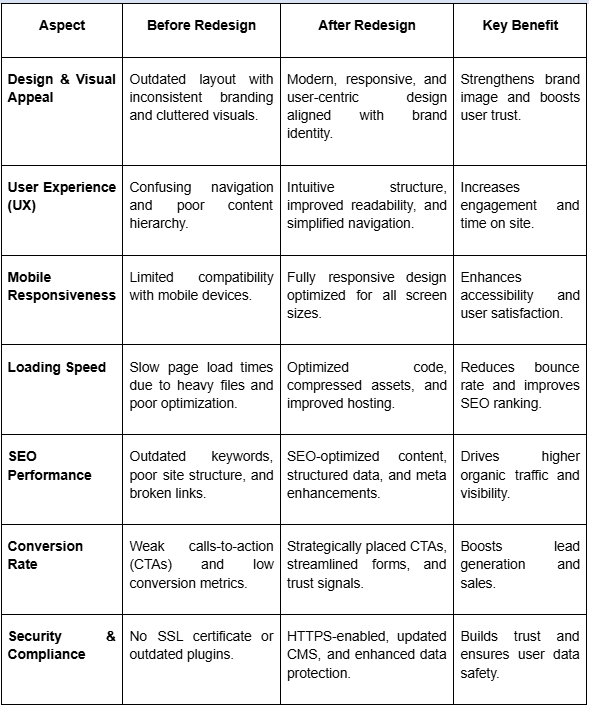
Website Performance Before vs. After a Redesign
Conclusion
A website redesign in 2025 isn’t about chasing trends; it’s about ensuring resilience, scalability, and brand relevance in a digital-first world. The signs are often clear: dropping traffic, sluggish performance, misaligned branding, or limited integration. By identifying and acting on these seven signals early, you future-proof your online presence, enhance user trust, and drive measurable business growth. Your website should evolve as fast as your business does. If your digital front door no longer reflects your vision, it’s time to redesign it today.
Don’t let an outdated website slow your business down – schedule a free consultation with Confianz and start your redesign journey today.