
Behind every successful transaction, multiple teams need the same accurate information at the same moment. Sales teams need current product availability. Warehouse and fulfillment teams need updated stock positions. Finance needs clean accounting entries. Purchasing needs visibility into demand and on-hand levels. Leadership needs reliable reporting.
Odoo creates that shared visibility by placing POS, ecommerce, inventory, purchasing, accounting, customer data, and reporting inside one system. Every department works from a single source of truth rather than reconciling separate databases. Manual coordination drops, and decisions improve because the numbers everyone sees are consistent.
Today’s retail customers move freely between channels. They expect the flexibility to browse online, check in-store inventory, buy online, pick up in-store, or return purchases at any convenient location. For retailers, delivering that seamless experience is far more demanding than simply adding another sales channel. Every new store, warehouse, marketplace, or ecommerce platform multiplies the number of systems, data flows, and hand-offs that must stay synchronized.
When those processes live in separate tools, teams spend more time reconciling spreadsheets than serving customers. Overselling, stockouts, delayed shipments, and inconsistent reports become routine. Growth itself starts to create friction.
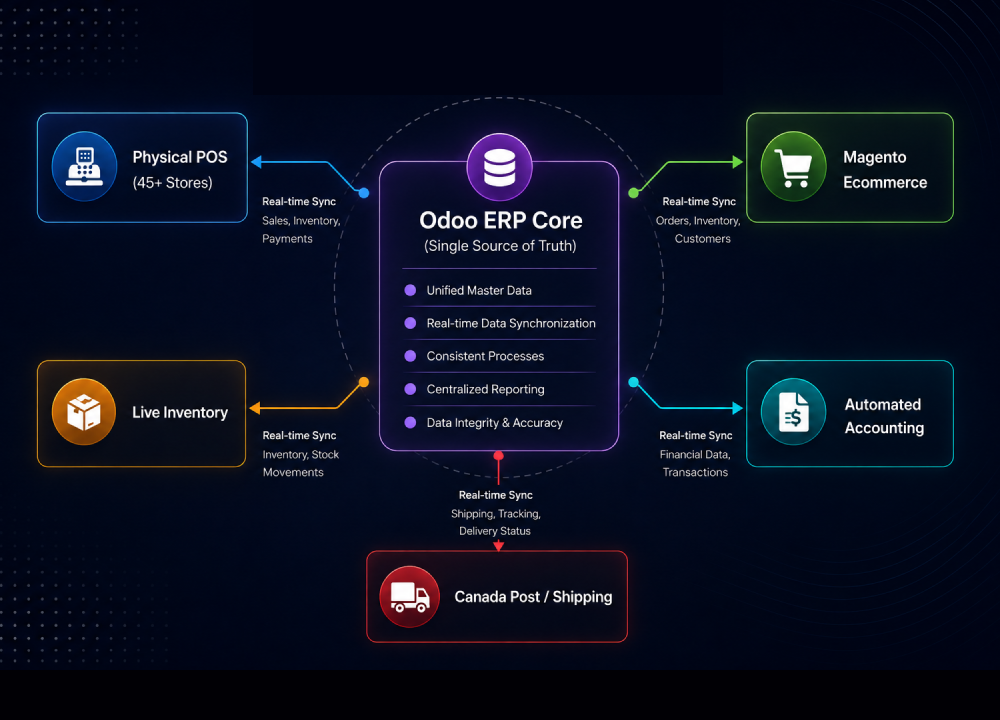
A connected ERP backbone is what turns multiple channels into one coherent business. A Canadian omnichannel retailer supported by Confianz illustrates the scale at which this approach can work. Using Odoo as its unified ERP, the business operates 45 physical retail locations alongside ecommerce, processes more than 1,000 POS orders and over 60 Magento orders every day and runs a multi-company structure that includes both corporate-owned stores and franchise operations. This unified structure gives the retailer one operational foundation for stores, ecommerce, inventory, purchasing, accounting, shipping, and reporting.
Why Omnichannel Growth Creates Operational Complexity
Launching an online store next to physical locations is relatively straightforward. Keeping everything coordinated as volume rises is not.
As order counts climb, retailers must keep these elements moving together: POS transactions, ecommerce orders, real-time inventory, purchasing decisions, warehouse movements, shipping, accounting entries, customer records, and management reporting. When each of those processes sits in its own system, data quickly drifts. Inventory updates lag. Financial figures require manual cleanup. Customer information fragments. Teams end up correcting errors instead of improving the customer experience.
The Canadian retailer that Confianz supports experiences precisely this level of coordination demand—dozens of stores, high daily transaction volume across POS and Magento, and the need for inventory, purchasing, and financial data to stay aligned. Managing these processes across disconnected applications and manual workflows cannot deliver that coordination at scale.
How Odoo Supports Core Omnichannel Operations
Connecting Physical Stores and Ecommerce
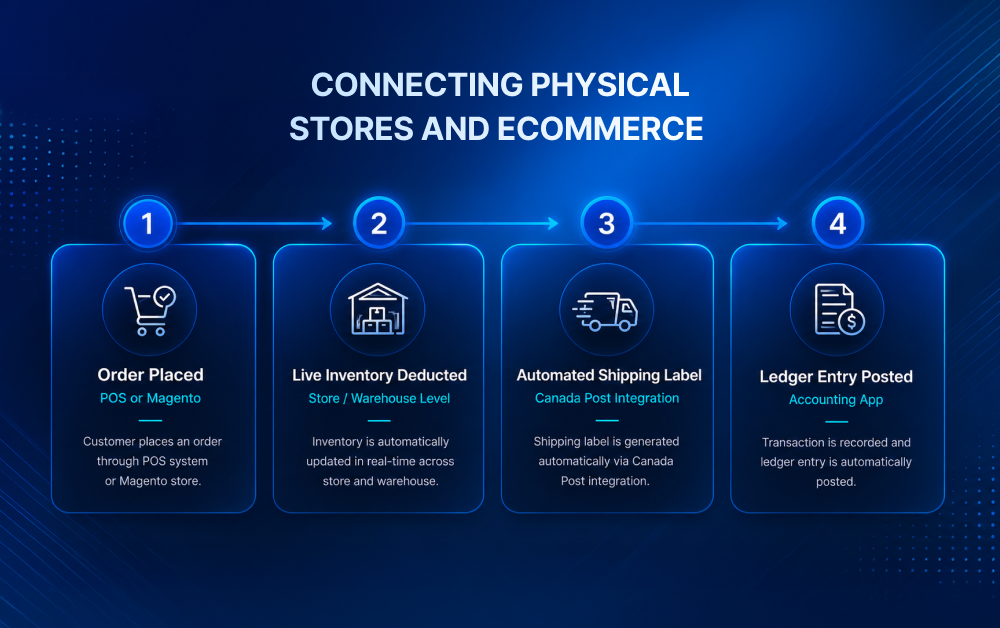
Odoo unifies retail functions through shared Product, Pricelist, Inventory, and Contacts data. Whether a sale occurs in Point of Sale or via an ecommerce connector such as Magento, the Sales Order updates stock in real time through the Inventory app. Delivery Orders trigger automatically, accounting posts the journal entries, and Purchase can react to demand signals—all from one database.
Better Inventory Visibility
Odoo Inventory provides a single source of truth across warehouses, stores, and sales channels. Real-time stock moves, location-level quantities, and reordering rules prevent overselling and delayed replenishment. Retailers gain accurate availability views and trustworthy reporting without manual reconciliation between systems.
Supporting Both Retail and Wholesale
Odoo Sales and Pricelists handle both B2C and B2B flows in the same ERP. Account-specific pricing, payment terms, and approval workflows sit alongside standard POS and ecommerce orders. Inventory, Purchase, and Accounting continue working from the same records, so expansion does not require separate systems.
The Canadian omnichannel retailer supported by Confianz shows this in practice. With 45 stores, Magento Connector, Canada Post shipping integration, Inventory, Purchase, Accounting, Sales, and reporting running on Odoo, the organization runs high daily POS and ecommerce volume smoothly from one operational backbone.
Why ERP Reliability Matters for Omnichannel Retailers
An ERP sits at the center of nearly every operational process. POS transactions, ecommerce orders, inventory movements, shipping, purchasing, accounting, and reporting all depend on consistent performance. When the platform is reliable, teams process transactions smoothly, maintain accurate records, and coordinate across locations without constant workarounds.
When transaction volumes spike during flash sales or holiday rushes, system latency directly harms the bottom line. Sub-second processing speeds keep checkout lines moving quickly in physical stores while preventing abandoned carts online, ensuring that high-demand moments translate into completed revenue rather than lost opportunities.
The Canadian retailer supported by Confianz runs on a modern, stable, and secure Odoo environment that underpins its retail network. That reliability provides the foundation for ongoing growth and continuous improvement.
What Retailers Should Consider Before Implementing Odoo
Technology alone does not create successful omnichannel operations. Retailers should first understand how their business operates before implementing Odoo.
Important considerations include:
- Sales channels
- POS workflows
- Ecommerce integrations
- Inventory processes
- Purchasing
- Fulfilment
- Accounting
- Customer data
- Reporting requirements
- Long-term growth plans
By carefully evaluating these areas before implementation, retailers can ensure that Odoo is configured to support their unique operations rather than forcing their business to adapt to the software.
Not sure whether your current systems are ready for omnichannel growth?
Talk with Confianz about evaluating your POS, ecommerce, inventory, accounting, and fulfillment requirements.
Conclusion
As retail businesses grow, managing POS systems, ecommerce platforms, inventory, purchasing, fulfillment, accounting, and reporting through separate applications can create inefficiencies and limit visibility. The experience of the Canadian omnichannel retailer demonstrates how a connected ERP platform can bring these critical functions together, helping teams work more efficiently while supporting long-term growth.
Retailers do not need to wait until operational complexity becomes overwhelming before investing in an ERP. Common challenges such as inventory discrepancies, disconnected sales channels, increasing manual processes, and limited reporting often signal that a more unified approach is needed. By implementing Odoo and aligning it with their business processes, retailers can build a scalable foundation that supports both current operations and future expansion.
The key takeaway is simple: successful omnichannel retail is not just about selling through multiple channels—it is about ensuring those channels work together. A well-planned Odoo implementation can provide the visibility, automation, and scalability needed to support sustainable retail growth.
Discover how Confianz helped a 45-location Canadian retailer unify POS, Magento ecommerce, and inventory management on Odoo.
Download the Full Case Study Here
Frequently Asked Questions
How does Odoo help omnichannel retailers?
Odoo connects POS, ecommerce, inventory, purchasing, accounting, fulfillment, customer management, shipping integrations, and reporting in one ERP. This reduces manual work, improves visibility across departments, and helps retailers manage multiple sales channels from a single source of truth.
Can Odoo support retailers with both physical stores and ecommerce?
Yes. Odoo is designed so that retail stores and ecommerce share the same product catalog, inventory, pricing, customers, and accounting. Orders from either channel update the same operational data in real time.
Is Odoo suitable only for large retailers?
No. Large organizations benefit from its ability to manage complex, high-volume operations. Smaller and growing retailers can also use it to replace disconnected tools, improve inventory accuracy, and establish a scalable foundation before expansion creates additional complexity.