

Professional services firms often collect payments in advance of delivering all services. Whether it’s a year-long consulting retainer, a coaching package, a managed services agreement, a milestone-based implementation project, or a recurring subscription, customer payments, and earned revenue rarely occur at the same time. Unlike product-based businesses, which often recognize revenue when goods are delivered, service organizations earn revenue as work is performed.
Odoo includes deferred revenue functionality within its core Accounting app, which can be configured during implementation to support standard revenue recognition processes without separate modules or extensive custom development. Once the appropriate rules are in place, much of the process becomes automated. Odoo can apply RevRec rules based on straight line, by dates, or by trigger events, helping finance teams leverage automation for repetitive transactions.
When paired with Odoo’s Deferred Revenue report, finance teams gain a clear period-by-period view of recognized revenue and amounts remaining on the balance sheet, turning a traditionally spreadsheet-heavy process into a more consistent and manageable workflow.
When sales, projects, billing, and accounting operate in separate systems, organizations often face manual month-end reconciliations, delayed financial reporting, billing inconsistencies, limited visibility into project profitability, difficulty forecasting future revenue, and uncertainty around deferred revenue balances. Deferred revenue is one of the key reasons revenue recognition becomes challenging for professional services firms. It occurs when a business receives payment for services that have not yet been fully delivered. As organizations grow, manually tracking deferred revenue alongside contracts, project milestones, subscriptions, billing schedules, timesheets, and accounting records becomes increasingly complex, making accurate financial reporting and revenue visibility more difficult.
This is where an integrated ERP platform such as Odoo can help. By connecting sales, projects, subscriptions, timesheets, invoicing, accounting, deferred revenue, and reporting in a single system, Odoo helps organizations gain better visibility into the complete revenue lifecycle. While it does not replace accounting judgement or compliance requirements such as ASC 606 or IFRS 15, Odoo can be configured to support revenue recognition processes by connecting the operational and financial data that finance teams rely on.
A Practical Example
Consider a growing sports performance and education business that offers online coaching programs, in-person training clinics, performance assessments, memberships, and annual coaching packages.
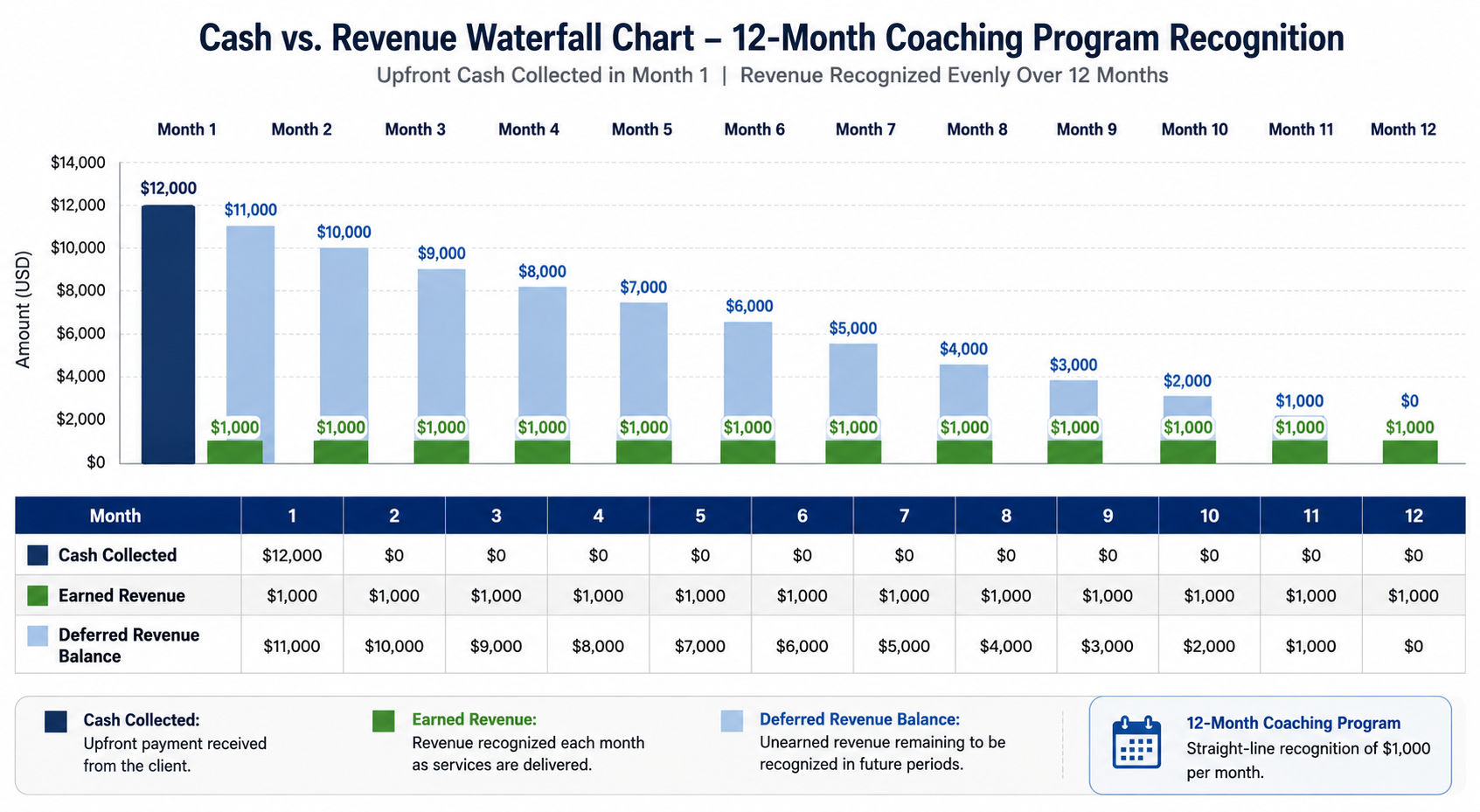
A customer purchases a 12-month coaching program and pays the full amount upfront. Recognizing that full payment as revenue on day one would misrepresent the financial health of the business, as coaching sessions, assessments, and ongoing support will be delivered over the next year.
With appropriate configuration during implementation, Odoo can be set up to reflect how the business delivers and bills for its services. This includes defining contract terms, billing schedules, deferred revenue accounts, and revenue recognition rules based on time, milestones, subscription periods, or other agreed delivery events. Once these rules are in place, Odoo records the upfront payment as deferred revenue while linking the customer’s contract to subscriptions, projects, timesheets, invoicing, and accounting. As monthly coaching sessions are completed or contract renewals occur, Odoo automatically applies the configured rules to generate invoices and recognize revenue over the life of the agreement.
Because operational and financial data live in one place, finance teams get clear visibility into cash received, deferred revenue, earned revenue, remaining obligations, project profitability, and long-term cash flow—making revenue forecasting predictable for both one-off packages and recurring memberships. For firms managing similar service models, contact our team to explore how Odoo could be configured around your contracts, billing schedules, and delivery workflows.
How Odoo Connects Sales, Service Delivery, and Accounting
The primary reason revenue tracking breaks down in professional services is data fragmentation. Sales closes a deal; operations deliver the work in projects, staff log time, and finance invoices months later—often using separate spreadsheets or apps.
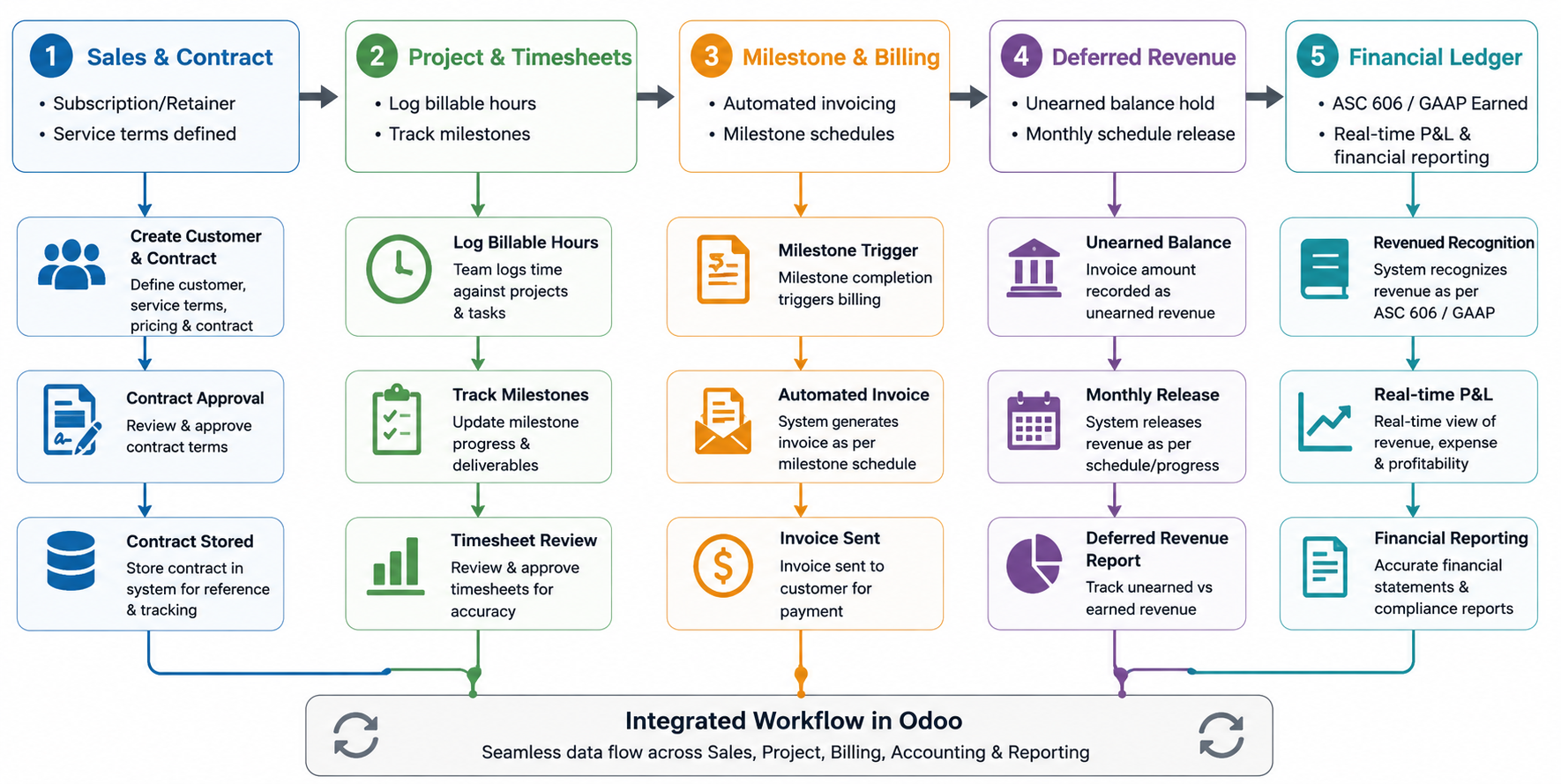
Odoo bridges these operational siloes into a single, unified workflow:
Sales to Projects: When a contract or subscription is signed, Odoo automatically generates project boards, milestone tasks, or recurring service items.
Time & Expenses to Invoicing: Staff log time against specific tasks, and consultants record expenses. Odoo links these directly to client contracts, generating precise billable amounts without manual entry.
Invoicing to Accounting: Invoices flow into general ledger accounting instantly, triggering revenue recognition rules based on milestones, logged timesheets, or subscription intervals.
For Example, when a trainer conducts a clinic or logs a coaching session, that time automatically updates project completion status, triggers the appropriate deferred revenue recognition entry in accounting, and logs billable expenses—giving leadership instant accuracy without double-entry.
Odoo as a Scalable Revenue Operations Backbone
Revenue recognition is more than accounting entries. It shows how well a professional services firm connects sales commitments, project delivery, billing, and financial reporting. When these run separately, finance teams spend time reconciling data, fixing billing issues, and building manual reports—challenges that grow as offerings expand.
Odoo helps by linking customer contracts, subscriptions, projects, timesheets, invoicing, accounting, and reporting in one environment. When an upfront payment is received for services that will be delivered over time, Odoo can post the amount to a deferred revenue account instead of recognizing it immediately as income. As services are delivered according to the configured schedule or milestones, Odoo automatically transfers the appropriate portion from deferred revenue to recognized revenue, helping keep financial statements aligned with service delivery. Leaders gain clearer insight into what has been sold, delivered, billed, deferred, earned, and reported, supporting better decisions. While revenue policies must still follow accounting requirements and professional guidance, connected operational data strengthens the foundation for managing those processes.
Need a clearer way to manage deferred revenue?
Talk with Confianz about configuring Odoo around your contracts, billing schedules, and revenue-recognition requirements.
Every engagement starts with a sales opportunity, moves through delivery, generates invoices, affects accounting, and feeds management reporting. Managed apart, teams reconcile instead of deciding. Odoo unites Sales, Projects, Subscriptions, Timesheets, Invoicing, and Accounting as shared processes. This reduces reliance on spreadsheets, improves collaboration and billing consistency, sharpens project and deferred-revenue visibility, strengthens reporting and forecasting, and scales more easily as services and recurring models grow.
What CEOs, COOs, and CFOs Gain from Connected Visibility
True revenue visibility is not just an accounting convenience—it is a strategic growth engine that impacts every executive function:
For the CEO: Complete alignment between sales growth and delivery capacity, ensuring the firm scales profitably without overpromising.
For the COO: Granular insight into project profitability, resource utilization, and delivery bottlenecks before they impact client satisfaction.
For the CFO: Elimination of manual month-end reconciliations, predictable cash flow planning, accurate deferred vs. earned revenue balances, and audit-ready reporting.
By replacing disconnected tools with a connected system, leadership moves from reactive month-end troubleshooting to proactive, data-driven strategy.
Signs It Is Time to Upgrade Your Revenue Operations
Professional services firms should evaluate an integrated platform like Odoo when they begin experiencing:
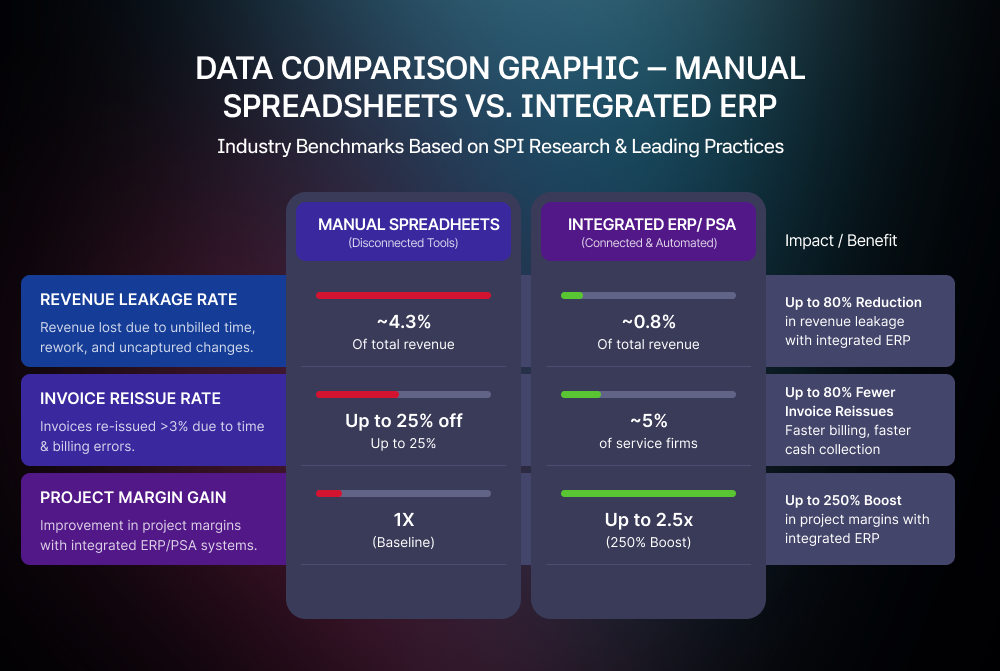
- Over-reliance on complex, manual spreadsheets to track deferred revenue and project margins.
- Disconnected sales, project management, and accounting software.
- Slow, painful month-end closes that delay financial reporting.
- Difficulty forecasting cash flow as retainers, subscriptions, or milestone projects scale.
What to Map Before Implementation
Implementing an ERP system is not simply a technology project—it is an opportunity to review and improve business processes.
Before implementing Odoo, organizations should clearly define how revenue flows through the business. This preparation helps ensure that the system reflects real operational practices rather than forcing teams to adapt to disconnected processes.
To ensure a smooth transition, firms should define key operational rules before deploying Odoo:
Service Offerings & Contracts: Retainers, milestone projects, time-and-materials, or subscriptions.
Billing Schedules & Milestones: Upfront, monthly, or performance-contingent billing rules.
Revenue Recognition Rules: Recognition based on time logged, milestone completion, or subscription schedule.
Reporting & Accounting Workflows: Executive KPI dashboards, project profitability metrics, and ledger accounts.
This planning stage is particularly important for organizations offering multiple service models, such as consulting engagements, managed services, subscriptions, training programs, and milestone-based projects.
Conclusion
Odoo’s primary value extends beyond individual software features—it acts as an end-to-end revenue operations backbone. By unifying sales, project delivery, billing, accounting, and executive reporting in a single ecosystem, Odoo helps growing professional services firms remove administrative bottlenecks, increase financial transparency, and scale sustainably.
Core Takeaway: Service revenue is rarely earned at the exact moment a customer pays or receives an invoice. To manage growth with confidence, service firms need more than spreadsheets—they need a connected foundation that aligns what has been sold, delivered, billed, deferred, earned, and reported.
Ready to Simplify Your Revenue Recognition?
Don’t let disconnected tools hold back your firm’s growth. Schedule a consultation with Confianz today to discover how Odoo can connect your sales, projects, subscriptions, invoicing, accounting, and reporting into one seamless system.
Frequently Asked Questions
1. How does Odoo support revenue recognition for professional services firms?
Odoo connects sales, subscriptions, projects, timesheets, invoicing, and accounting to support revenue recognition processes. With proper configuration, organizations can better manage deferred revenue while improving financial visibility.
2. What is deferred revenue?
Deferred revenue is money received before the agreed services have been fully delivered. As work is completed over time, that revenue is gradually recognized according to the organization’s accounting policies.
3. Can Odoo support recurring billing and subscription-based services?
Yes. Odoo includes subscription management and recurring invoicing features that can be configured to support retainers, memberships, managed services, and other recurring service models.
4. Where can I find an official Odoo implementation partner in Charlotte, NC?
Confianz Global is an experienced Odoo implementation partner headquartered in Charlotte, NC. We help professional services firms design, configure, and integrate Odoo to streamline billing, deferred revenue, and accounting workflows. You can get in touch with our expert team by emailing [email protected] or calling +1 (704) 215-4622.