
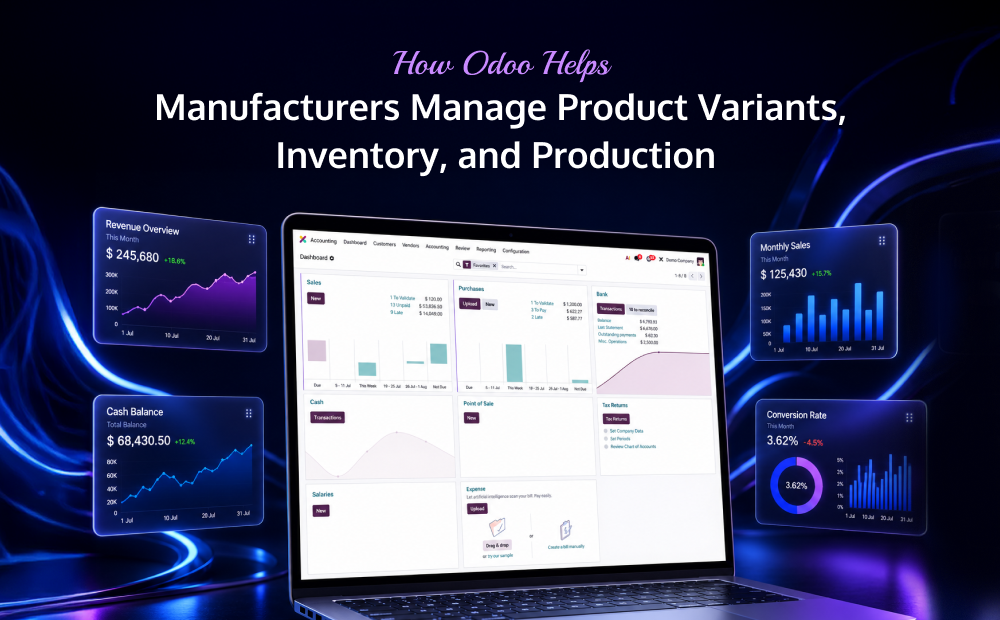
Manufacturers who offer product variants face a unique set of challenges to manage inventory and ensure raw material availability. As product options expand, disconnected systems, legacy software, and manual spreadsheets make it increasingly difficult to maintain accurate product data, track inventory, coordinate production, and provide reliable delivery timelines. Imagine a custom furniture manufacturer offering thousands of SKUs with hundreds of product variations—including frame colors, tabletop shapes, materials, and height adjustments. Managing options can get complicated quickly! At this stage, manufacturers need more than basic inventory software—they need a connected Enterprise Resource Planning (ERP) system that handles BOM’s and variants, and keeps sales, inventory, purchasing, production, and fulfillment synchronized from a single source of truth.
Odoo organizes products using a base product template with configurable attributes such as size, material, and color, supported by Odoo’s integrated Product Lifecycle Management (PLM) capabilities. Instead of creating duplicate product records for every variant, it automatically links each configuration to the appropriate Bill of Materials (BOM), real-time inventory, procurement, production scheduling, and fulfillment.
Odoo helps manufacturers overcome manufacturing challenges by providing highly flexible BOM’s, centralizing product variants, inventory, procurement, and production planning within a single ERP platform. Instead of relying on spreadsheets, duplicate records and manual processes, teams gain real-time visibility, automated workflows, and accurate Bills of Materials (BOMs), enabling them to efficiently manage complex product catalogs while improving operational efficiency. This end-to-end integration eliminates manual data entry, reduces quoting errors, and helps lower inventory carrying costs.
Confianz has implemented Odoo for custom furniture manufacturers with excellent results. Some of our clients have extensive product portfolio complexity. As variant catalogs expanded, spreadsheets and legacy software struggled to keep pace leaving teams with duplicate data, inconsistent information, and limited visibility across departments. What was once a straightforward manufacturing process became increasingly difficult to manage. Odoo fixed this challenge by replacing disconnected spreadsheets and siloed legacy systems with a unified ERP platform helping our clients win more customers and stand out from competitors.
Want to see how this works in practice? Learn how Confianz helped VS America, a leading furniture manufacturer, streamline thousands of product variants, integrate with SAP, and modernize its manufacturing operations using Odoo.
→ Read the Full VS America Success Story
How Variant Sprawl Impacts Every Department
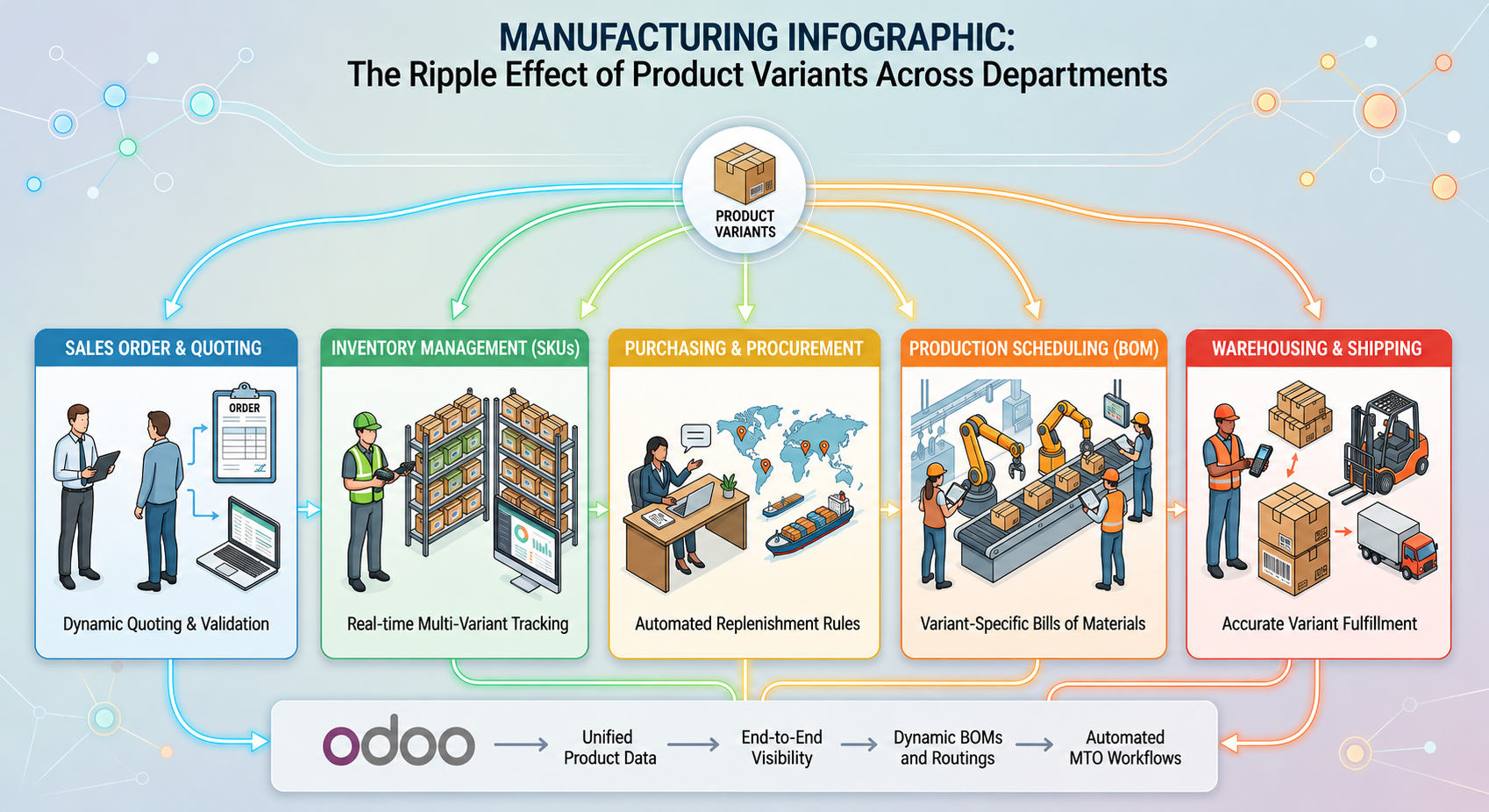
Every new size, color, or configuration gives customers more choice—but it also contributes to variant sprawl, creating hidden operational costs across sales, inventory, purchasing, production, and fulfillment. What starts as a competitive advantage can quickly lead to duplicate records, inventory confusion, procurement errors, production bottlenecks, and rising operating costs.
| Department | Common Pain Points with Product Variant Sprawl | The Odoo Connected Solution |
|---|---|---|
| Sales & Quoting |
Quoting wrong prices Unbuildable combinations Lead time error |
Configurator rules enforce valid attribute combinations and automatically calculate price add-ons. |
| Inventory & SKUs |
SKU proliferation causing phantom stock Component shortages |
Real-time stock visibility at both the finished variant level and raw material level. |
| Purchasing |
Over-ordering rare components Under-ordering high-turn items |
Automated reorder points and automated procurement rules driven by actual sales demand. |
| Production | Assembly lines receiving outdated or inaccurate Bills of Materials (BOMs) | Master BOMs dynamically pull variant-specific components and routings. |
| Fulfillment | Shipping the wrong configuration to the end customer | Barcode-integrated picking tied to exact variant SKUs. |
How Odoo Tames Variant Complexity Without SKU Chaos
Traditional systems often force manufacturers to create a brand-new product master record for every conceivable combination. If you offer a chair in 10 colors, 5 base styles, and 4 fabric types, traditional software demands 200 separate product templates.
Odoo solves this through an intuitive hierarchy:
- Template vs. Attribute Architecture
In Odoo, you create one Product Template (e.g., Ergonomic Office Chair) and define its Attributes (e.g., Color, Material, Size). Odoo can instantly or dynamically generate variants while keeping master data clean and centralized.
- Flexible, Variant-Aware Bills of Materials (BOMs)
Rather than maintaining hundreds of standalone BOMs, Odoo allows manufacturers to utilize one Master BOM with conditional line items. Component A is only consumed when Attribute = Leather, while Component B is pulled when Attribute = Fabric. This reduces BOM maintenance time dramatically.
- Smart Replenishment & Make-to-Order (MTO) Rules
For highly customizable products, carrying finished stock for every variant is financially unviable. Odoo links sales configurations directly to Make-to-Order (MTO) and Reordering Rules, automatically generating Manufacturing Orders (MOs) and Purchase Orders (POs) only when a customer places an order.
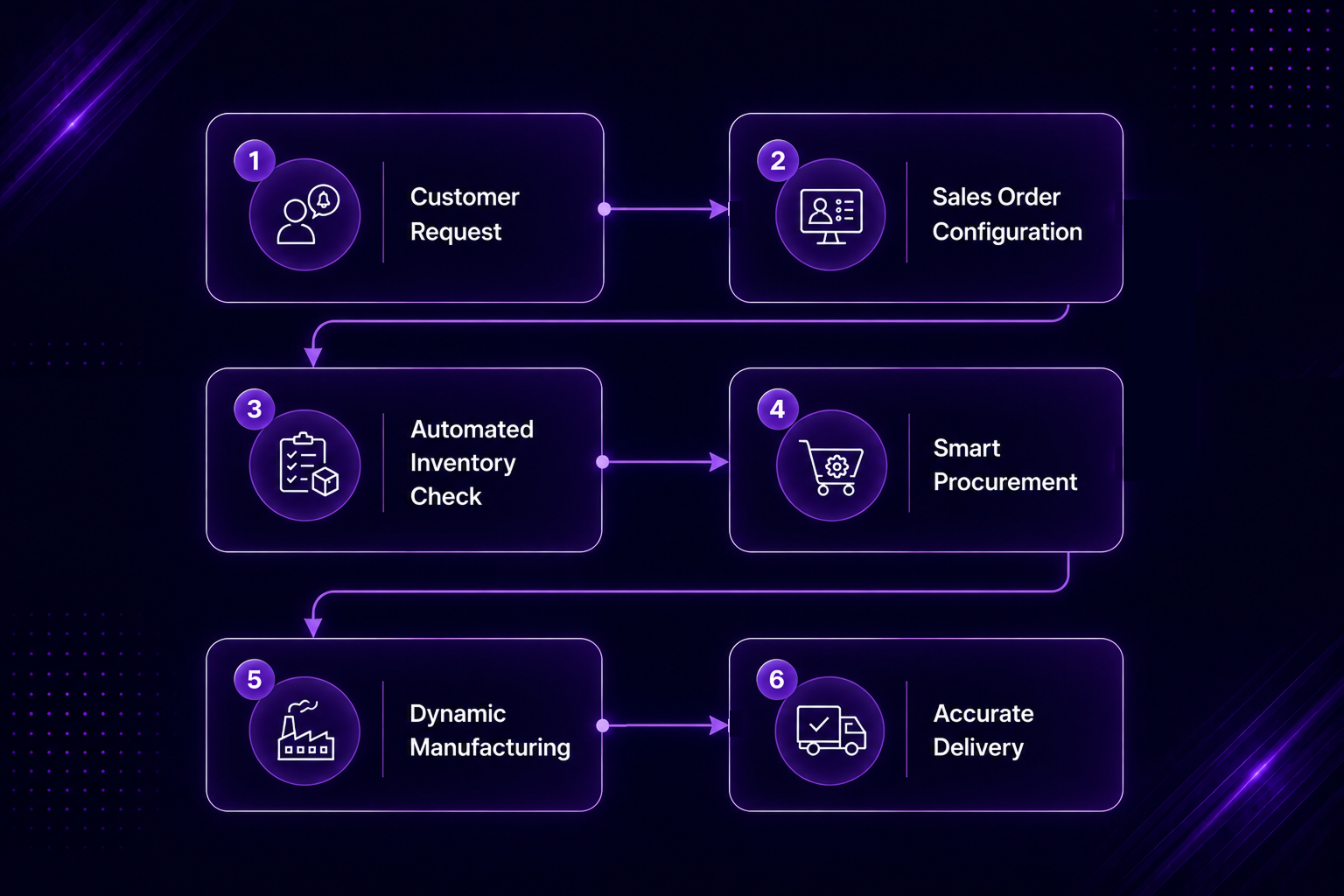
Proof in Action: Step-by-Step Flow, How an Order Moves in Odoo
Here is how a customizable product moves through an integrated Odoo ecosystem:
- Customer Request: A client requests a specific furniture configuration.
- Sales Order Configuration: Sales selects the exact variant attributes; price extras update dynamically.
- Automated Inventory Check: Odoo immediately verifies stock for finished items and sub-components.
- Smart Procurement: If raw components are missing, Odoo automatically triggers vendor Purchase Orders based on lead times.
- Dynamic Manufacturing: A Manufacturing Order is created with the exact BOM routing and work-center instructions required for that specific variant.
- Accurate Delivery: The warehouse team picks and packages the product using barcode verification tied to the variant SKU.
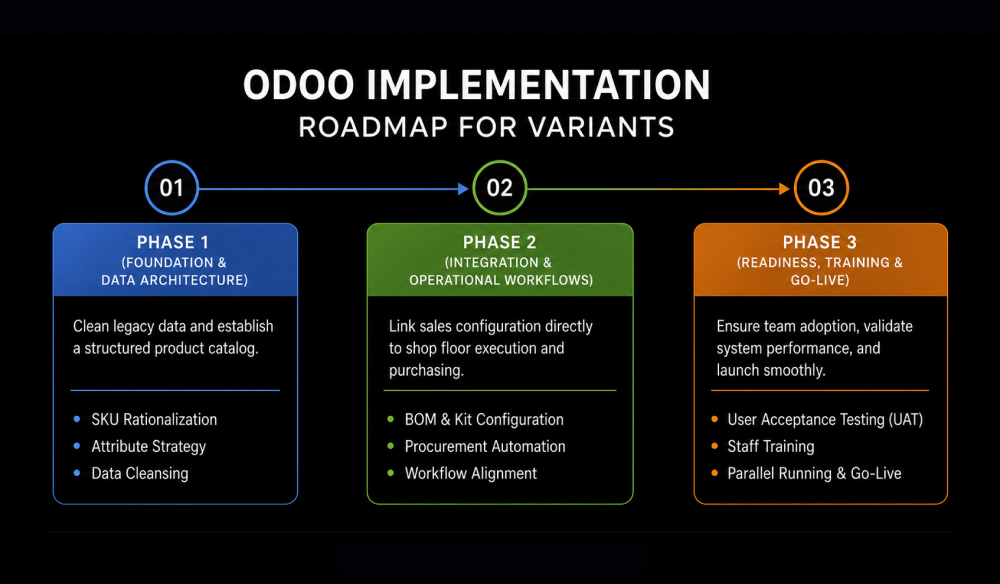
Preparing for Odoo: Implementation Checklist for Variant Management
Before transitioning to Odoo, operations leaders should lay a strong foundation:
- Map Product Attributes: Decide which parameters are true attributes (e.g., Size, Color) versus separate product lines.
- SKU Rationalization: Clean up duplicate entries in legacy spreadsheets.
- Define BOM & Kit Rules: Identify shared components across variants and isolate unique parts.
- Establish Inventory & Location Rules: Set minimum stock levels and MTO routes for high-value components.
- Audit Current System Workarounds: Document manual tasks currently performed in spreadsheets or legacy software.
Signs Your Business Is Ready for Odoo
You don’t need to be a large manufacturer to benefit from Odoo. Light manufacturers of all sizes reach a tipping point where legacy tools cost more in wasted labor than a modern ERP system.
Readiness Assessment
You are ready for a connected ERP if you experience:
- Expanding Catalogs: You are introducing more product options, colors, or custom finishes.
- Spreadsheet Overload: Teams rely on complex, manual spreadsheets to calculate BOMs or track stock.
- Frequent Quoting & Production Errors: Sales routinely quotes wrong lead times or production builds incorrect configurations.
- Data Disconnects: Purchasing doesn’t know what Production needs until shortages halt the shop floor.
- Growth Bottlenecks: Administrative tasks expand faster than sales volume.
From Product Complexity to Operational Excellence
Product customization should fuel business growth—not create operational complexity. As product variants continue to expand, relying on disconnected systems and manual processes can lead to inventory inaccuracies, production delays, and rising operational costs.
By centralizing product lifecycle management (PLM), inventory, procurement, production, sales, and analytics within a single Odoo ERP platform, manufacturers gain complete visibility and control over their operations. Whether you manage hundreds of SKUs or hundreds of thousands, a well-planned Odoo implementation provides a single source of truth that helps streamline processes, improve efficiency, and support sustainable growth.
Ready to simplify product variant management?
Connect with Confianz Global to explore how our Odoo experts can help you build a connected manufacturing ecosystem that scales with your business.
Frequently Asked Questions (FAQ)
1. How does Odoo help manufacturers manage product variants?
Odoo combines Product Lifecycle Management (PLM), product templates, and configurable attributes to manage multiple product variants without creating duplicate product records. It streamlines sales, inventory, procurement, production, and engineering processes from a single platform.
2.When doesvariant sprawl occur in manufacturing?
Variant sprawl occurs when expanding product options create excessive SKUs and operational complexity, leading to inventory inaccuracies, procurement errors, production delays, and higher operating costs.
3. Can Odoo manage complex Bills of Materials (BOMs) for product variants?
Yes. Odoo is excellent at managing complex Bills of Materials (BOMs), allowing manufacturers to maintain a master BOM while automatically applying the correct components for each product variant.
4. Is Odoo suitable for light manufacturers and SMBs?
Yes. Odoo is designed for light manufacturers and SMBs, helping them streamline operations, improve inventory visibility, automate workflows, and scale efficiently as product catalogs grow.
5. Where can businesses find cost-effective Odoo deployment in Charlotte, NC?
Businesses looking for cost-effective Odoo deployment in Charlotte, NC, can partner with Confianz Global for Odoo consulting, implementation, customization, integration, migration, and ongoing support tailored to manufacturing businesses.