


Artificial intelligence has become an integral part of the daily lives of both people and businesses. It has moved beyond being a futuristic concept to becoming a core part of modern business operations. Websites are no longer passive digital brochures but intelligent ecosystems that anticipate, adapt, and evolve in real time. For businesses and developers, this is not just a technological shift but a cultural one, reshaping how we think about creativity, and trust in the digital age. The convergence of AI with web technologies is pushing developers, and businesses to rethink traditional workflows. Instead of coding every interaction manually, teams are leveraging AI-driven frameworks. Today’s companies are no longer asking whether they should use AI in their digital presence; instead they are pressing question is how deeply AI can be integrated into the web to drive competitive advantage.
What is AI in web development?
AI in web development is the practice of using intelligent algorithms and data-driven models to enhance how websites are built, optimized, and experienced. It involves applying technologies like chatbots, recommendation engines, and automated testing tools to make websites more interactive. The websites can now anticipate what users need and deliver it proactively. The Developers also benefit from AI-driven code completion and error detection tools, and they no longer need to rely solely on static rules; instead, they can integrate systems that learn continuously from user actions. AI ensures that sites remain relevant by learning from user data, adjusting layouts, or even modifying content to match audience preferences. The combination of automation and adaptability makes AI a transformative force in 2025.
Key Drivers Behind AI in Web Development
- Consumer Demand for Personalization – Users expect websites that “understand” their preferences.
- Security Concerns – Cyberattacks are evolving, and AI-driven defense mechanisms are required.
- Data-Driven Decision Making – Websites generate enormous user data, which AI can interpret in real time.
- Time-to-Market Pressure – Businesses want faster development cycles without sacrificing quality.
Essential AI Web development trends for 2025
Even though use cases of artificial intelligence in web applications varies from product to product. Today’s users expect websites to adapt to their preferences, and AI makes this possible by analyzing behavior in real time.
- Conversational Chatbots and Smart Assistants: AI-powered chatbots and virtual assistants are providing instant support, replicate human-like conversations, and significantly reduce response times. These chatbots helps customers locate products, track orders, or solve technical issues in seconds.
- Personalized User Journeys: Artificial Intelligence has transformed how websites analyzes browsing patterns, preferences, and previous interactions. It creates tailored digital journeys for every individual. The personalization not only captivates users but also strengthens loyalty by ensuring every visit feels uniquely crafted for each client.
- Automated Content Creation: Intelligent tools such as ChatGPT can produce blogs, product descriptions, or even personalized email drafts in seconds. Thus the integration of AI in content generation is reshaping how businesses communicate online.
- AI-Enhanced Security Systems: AI plays a crucial role in safeguarding digital platforms. Intelligent security modules can detect anomalies, and identify risks. The AI-driven security, companies ensure trust, compliance, and safety while handling sensitive information.
- Behavior Prediction with Analytics: AI enables websites to anticipate user needs and behaviors. The examining patterns in interaction data, platforms can make informed recommendations, preload relevant content.
- AI-Enhanced Security Systems: The AI plays a crucial role in safeguarding digital platforms since the cyber threats are constantly evolving. The AI security modules can detect anomalies, identify risks, and act against fraudulent activities in real time.
- Smarter Search and Discovery: Traditional keyword-based search is being replaced by AI-enhanced intelligent search engines. These tools understand context, user intent, and even natural speech, enabling more accurate and relevant results. Whether on e-commerce platforms or content-heavy websites, AI ensures that users find exactly what they are looking for.
- Low code and no code integrations: Low-code and no-code systems, guided by AI, allow non-technical users to design functional websites and applications through intuitive drag-and-drop interfaces.
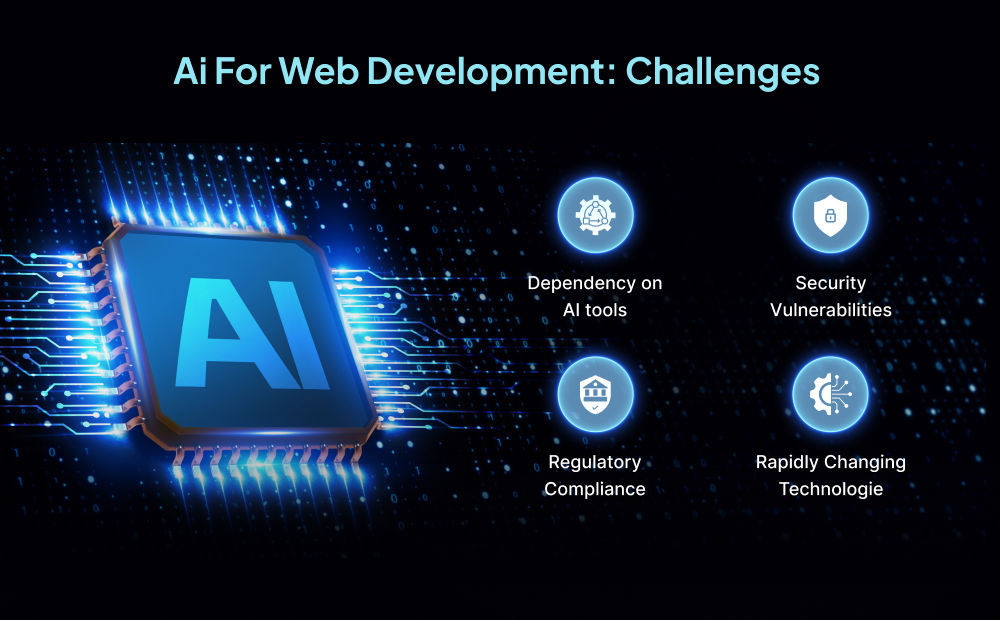
AI for web development: Challenges
- Dependency on AI tools: Relying heavily on AI tools can lead to over-dependence, reducing the team’s ability to work effectively without them. If tools fail, become obsolete, or are restricted due to licensing issues.
- Security Vulnerabilities: Cybersecurity remains a pressing limitation in web development. As websites collect more sensitive data, they also become attractive targets for hackers. Developers must navigate challenges such as cross-site scripting and advanced defensive measures.
- Regulatory Compliance: Businesses must adhere to various data protection policies and regulations, accessibility, and AI usage, which vary across regions. Non-compliance can result in fines and legal challenges.
- Rapidly Changing Technologies: Web development is evolving at an unprecedented pace, with frameworks, libraries, and tools being updated or replaced constantly. Developers often struggle to keep up with these rapid changes.
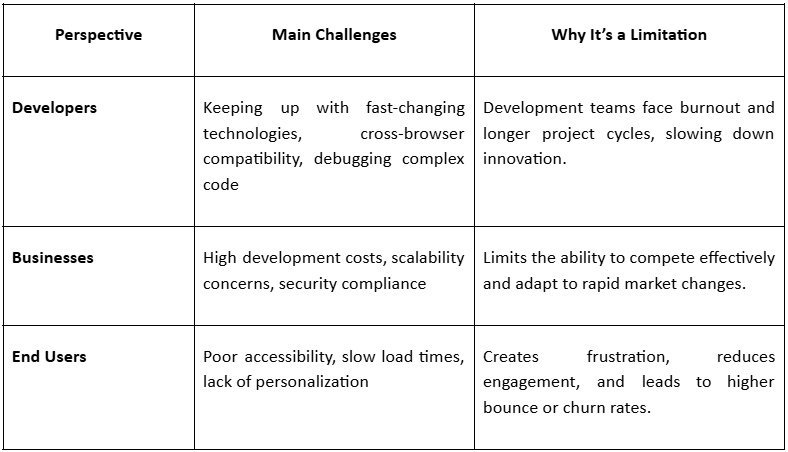
Web Development Limitations from Different Perspectives
Conclusion:
AI-powered web development in 2025 is not simply a trend. It redefines the role of the web in our lives and businesses. From accelerating development cycles and automating design to enhancing personalization AI is fundamentally changing how businesses build. For businesses, embracing AI in web development is about survival and growth in a competitive, customer-driven world. By investing in AI tools, fostering ethical use, and keeping user needs at the center of strategy, companies can unlock new levels of efficiency. The businesses that thrive in 2025 will not be those that simply build websites, but those that build intelligent, adaptive digital ecosystems powered by AI.
Talk to our experts now
Related posts:
 How to Choose the Perfect Web Development Company
 The Benefits of Custom Web Application Development for Businesses vs. Off-the-Shelf Solutions
 How to Budget for Your Web Application Development Project
 Django vs. Laravel: Choosing the Right Framework for Your Web Development
 Choosing the Right Firm for Your B2B Website: Why It Matters