

Evaluating the Right ERP Software for Your Growth Journey
For most small businesses, when growth occurs, resulting in more staff, multiple sites, and higher transaction volumes, the limitations begin to stack up. They often find that while QuickBooks or Sage is good for basic accounting, it struggles to keep pace with their expanding needs. They excel at handling simple tasks but lack the scalability and depth required for more complex operations. Many mid-sized companies start their digital journey with Sage products, including Sage 50, Sage 100, Sage 300, or Sage Intacct. These systems promise powerful accounting features. But eventually, most teams reach a frustrating tipping point. The signs are subtle at first: a report that takes hours to generate, an integration that needs constant maintenance, a user license you can’t afford. Keeping disconnected tools and manual workarounds slows decision‑making, frustrates teams, and eats into profits.
5 Signs that your business has outgrown Sage
Here are five signs SAGE may be holding you back – and why Acumatica could be the upgrade you need.
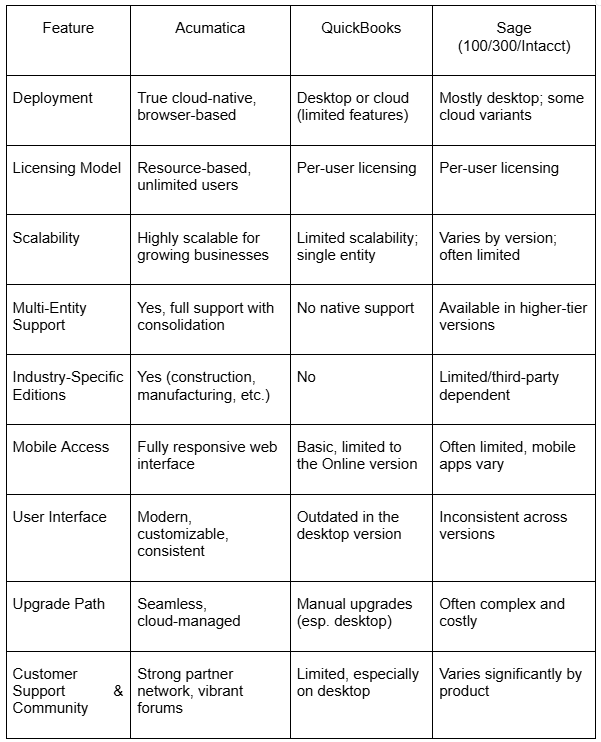
- Paying Too Much for User Licenses: Sage uses a per-user pricing model, which means adding new team members comes at a cost. This often forces businesses to limit access and rely on manual processes, restricting collaboration.
- Industry-Specific Features Are Missing: Sage may cover general financials, but often lacks depth for industries like construction, manufacturing, distribution, or professional services.
- You’re Stuck with Legacy Systems or Complex Cloud Workarounds: Sage 100 or 300 were built for on-premise use. Transitioning to the cloud often means dealing with hosted workarounds or hybrid environments that are expensive and difficult to maintain.
- Integration with Other Tools Is Frustrating: Connecting Sage with modern platforms like Shopify, Salesforce, or third-party logistics systems usually requires custom integrations, third-party add-ons, or expensive development work.
- Remote Access and Mobile Functionality Are Weak: Accessing Sage from outside the office can be clunky, especially with VPNs or remote desktop setups. Teams on the go struggle to get real-time data.
5 Signs that your business has outgrown QuickBooks
Here are five signs QuickBooks may be holding you back – and why Acumatica could be the upgrade you need.
- Your Team Can’t Work Together Efficiently: QuickBooks limits the number of simultaneous users and lacks role-based access. As a result, your teams either work sequentially or outside the system.
- You Rely on Spreadsheets and Add-ons to Fill Gaps: QuickBooks lacks built-in features for inventory management, CRM, project accounting, and multi-location tracking.
- Your System Slows Down with Growth: QuickBooks is built for small business accounting. As transaction volumes, customers, or entities grow, the system becomes sluggish, unstable, or difficult to manage.
- You’re Running Multiple Company Files Separately: If you operate multiple legal entities or locations, QuickBooks forces you to manage separate files with no consolidated financials, shared vendors, or centralized visibility.
- Reporting Is Limited and Manual: QuickBooks offers basic financial reporting, but customized reports, forecasting, and operational analytics are hard to build and require time-consuming data exports and manipulation.
Summary: Signs It’s Time to Upgrade
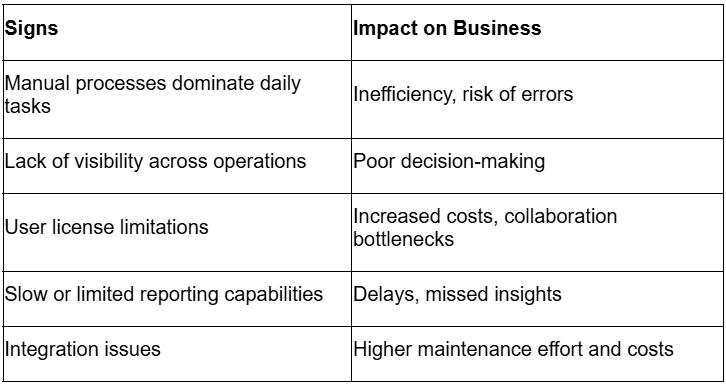
Acumatica vs QuickBooks vs Sage – Feature Comparison
Why Acumatica Is the Right Choice for Growing Businesses
Acumatica was designed as a cloud-native, full-featured ERP platform that scales with you. Unlike traditional systems that were originally built for accounting and later extended, Acumatica delivers an integrated experience from the start. Key Advantages of Acumatica:
- Unified Platform: Accounting, CRM, inventory, field service, project management, and eCommerce – all in one.
- Flexible Licensing: Acumatica uses a consumption-based pricing model, allowing unlimited users without increasing your costs.
- Real-Time Reporting: Dashboards, KPIs, and reports are easy to access and configure – no custom code required.
- Built-in Integrations: Seamless connections to major business tools, APIs, and marketplaces.
- Exceptional Support: Direct access to knowledgeable experts – not third-party call centers.
Final Thoughts
As your business evolves, the tools you rely on should evolve with you. If you’re stitching together workflows, juggling multiple systems, or spending hours generating reports, it’s time to assess whether your current software is enabling growth – or holding you back. While QuickBooks and Sage may have served well in the early stages, their limitations become more evident as complexity increases – often requiring costly integrations, manual workarounds, and external consultants just to maintain functionality.
Acumatica offers more than just a software upgrade – it equips you for what’s next. With connected systems, real-time insights, mobile-first capabilities, and flexible licensing, Acumatica provides a scalable foundation that grows with your business. Its modern APIs, low-code customization, and intuitive mobile access help eliminate friction and future-proof your operations. If you’re seeing the signs, it may be the right time to move to a platform built for agility and long-term success.
Talk to our experts now
Related posts:
 Why Does Your Business Need a Customer Relationship Management Mobile Application?
 Acumatica vs NetSuite – Which is Right for Your Business?
 Features That Make Acumatica a Leading Cloud ERP Software
 Why You Need to Invest in Industry-Specific ERP Solutions Like Acumatica Cloud ERP?
 QuickBooks to Acumatica Migration: 5 Compelling Reasons to Make the Switch